
The one number that tells you what driving really costs
Ask most people what their car costs to run and they'll shrug. But there's a single, honest number that cuts through the guesswork: your fuel cost per mile (or per kilometre). Once you know it, every trip has a price tag. That 40-mile commute? Multiply and you know. Weighing a weekend road trip against the train? Now it's a real comparison, not a hunch.
The good news is the maths is genuinely simple — one core idea, a couple of unit conversions, and you're done. In this guide I'll show you the formula, how to convert between MPG, L/100km, km/l and EV efficiency, the sneaky UK imperial-gallon quirk that trips people up, how to measure your car's real economy (not the optimistic sticker figure), and how to scale a single per-mile number into daily, weekly, monthly and yearly totals.
If you'd rather skip the arithmetic entirely, our free fuel cost calculator does all of this for you and compares Petrol, Diesel, CNG and EV side by side. But it's worth understanding what's happening under the hood — so let's build the number from scratch.
One caveat up front: this is running cost only. It's the fuel (or electricity) you burn to move. It does not include the purchase price, insurance, servicing, tyres, road tax or depreciation. Those matter for the full cost of ownership, but they're a separate conversation.
The core formula (it's just a division)
Every fuel-cost calculation, in every country, comes down to one thing:
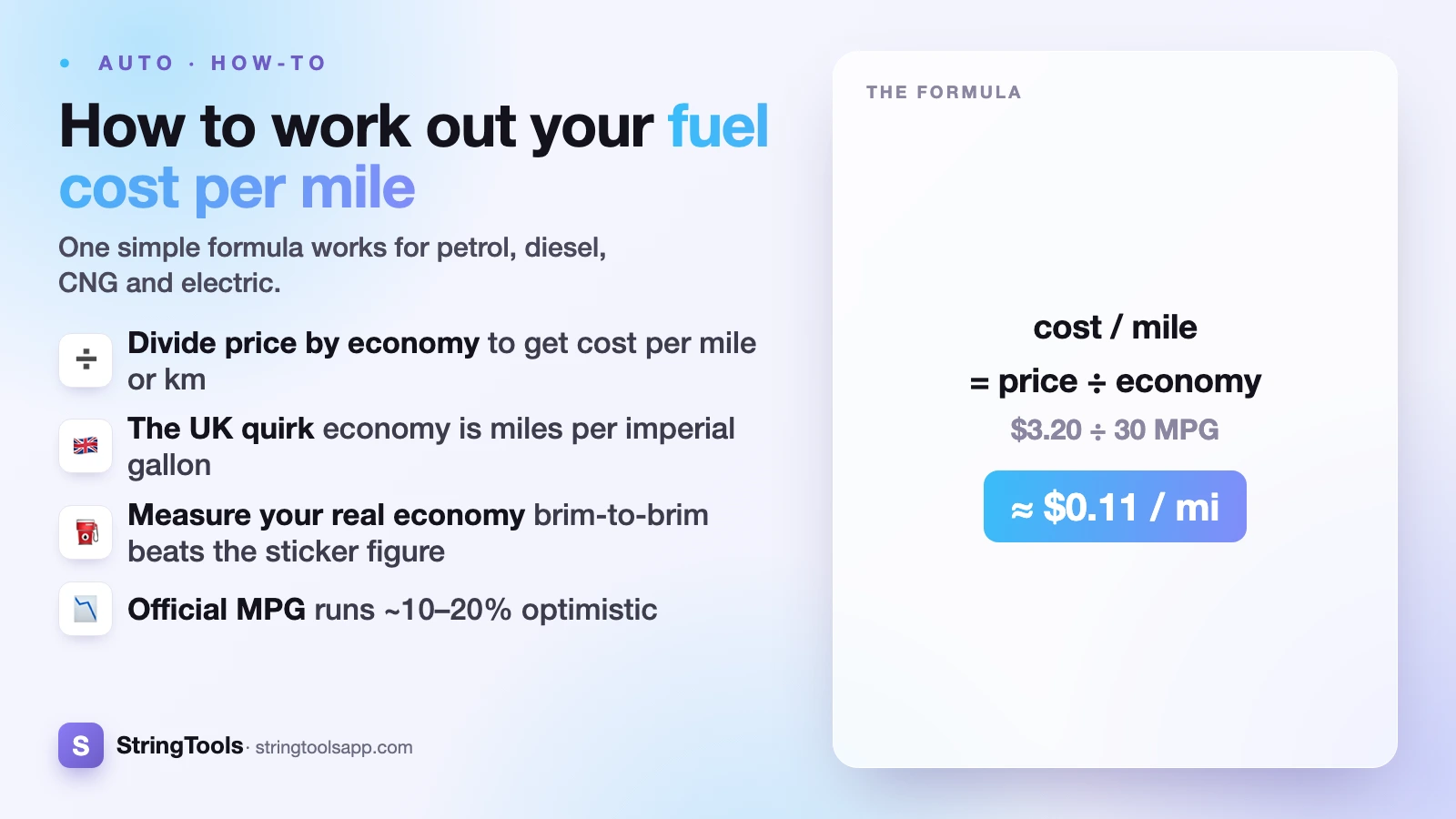
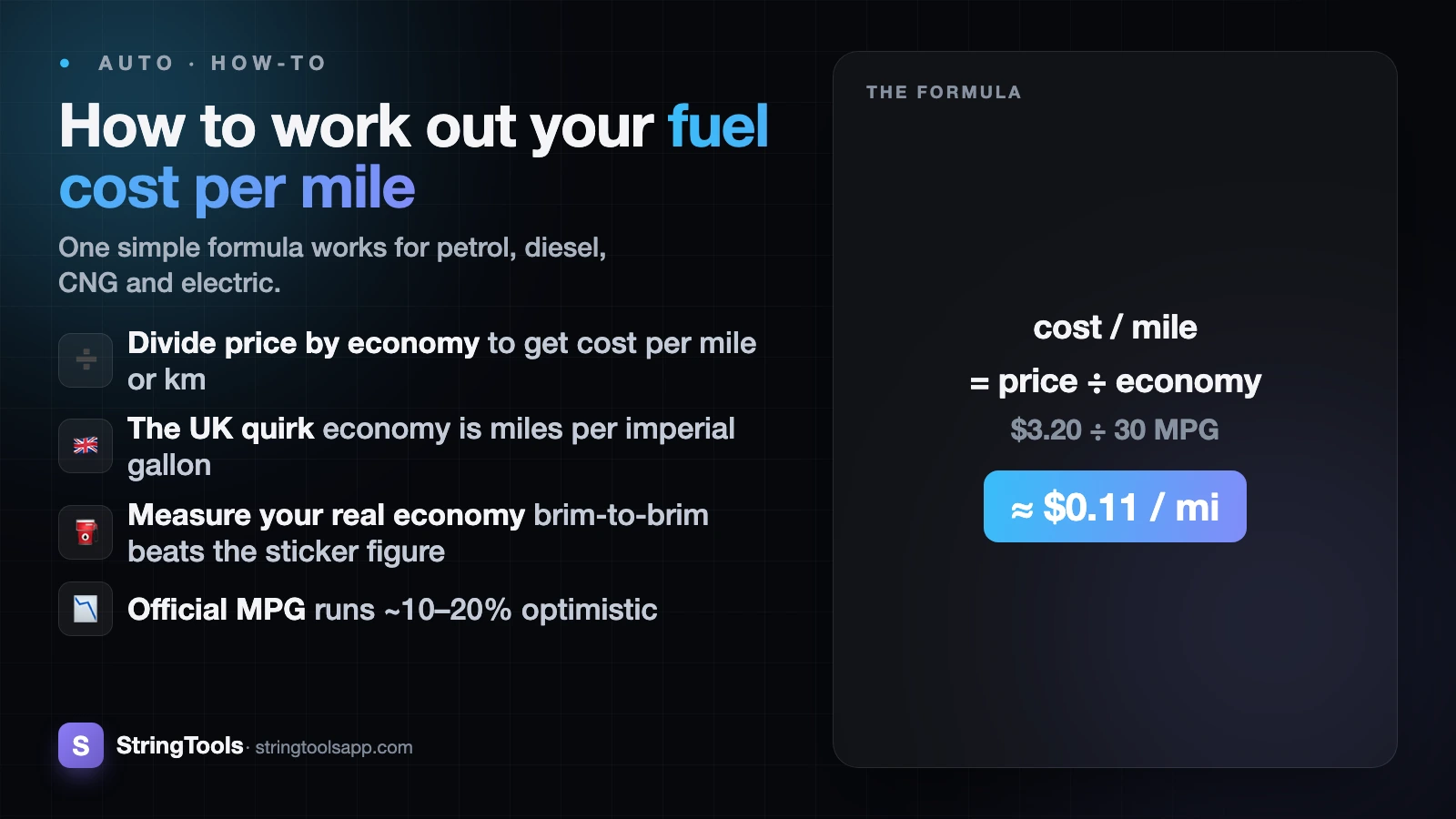
Cost per distance = price of one fuel unit ÷ distance that one unit takes you.
That's it. A "fuel unit" is whatever you buy fuel in — a litre, a US gallon, an imperial gallon, or a kilowatt-hour for an EV. The "distance it takes you" is your economy expressed in those same units.
Let's do the cleanest possible example. In India, petrol is sold by the litre. Say it's ₹100 per litre and your car does 16 km on a litre (16 km/l). One litre costs ₹100 and carries you 16 km, so:
₹100 ÷ 16 km = ₹6.25 per km.
A diesel car at ₹90/litre doing 20 km/l works out to ₹90 ÷ 20 = ₹4.50 per km. Same formula, different numbers — and you can already see why diesel's better economy often wins on running cost even when the fuel itself is cheaper per litre.
The US works identically, just with gallons. Petrol at $3.20 a gallon in a car doing 30 miles per gallon (MPG) is $3.20 ÷ 30 = $0.1067, which rounds to about $0.11 per mile. Buy the unit, divide by how far it goes. That single division is the whole engine of fuel-cost maths.
Converting between MPG, L/100km and km/l
The formula is easy — the headaches come from the three different ways the world measures economy. Here's how they relate, with the exact conversions you need.
The fixed constants: 1 US gallon = 3.785 litres, 1 imperial gallon = 4.546 litres, and 1 mile = 1.609 km. Memorise those three and you can convert anything.
km/l and L/100km are two views of the same thing, flipped. To go between them: km/l = 100 ÷ (L/100km), and L/100km = 100 ÷ (km/l). So a car burning 6 L/100km does 100 ÷ 6 = 16.7 km/l. A car doing 20 km/l uses 100 ÷ 20 = 5 L/100km. Lower L/100km is better; higher km/l is better — they move in opposite directions, which is exactly why comparing across systems confuses people.
Going from US MPG to km/l: multiply MPG by 1.609 (miles to km) and divide by 3.785 (gallon to litres). A 30 MPG (US) car does 30 × 1.609 ÷ 3.785 = 12.75 km/l. In L/100km that's 100 ÷ 12.75 = 7.8 L/100km.
My honest advice: don't convert your economy if you don't have to. Do the whole cost calculation in your own local units — litres and km, or gallons and miles — and you'll avoid conversion slips entirely. Convert only when you're comparing a car spec quoted in a foreign unit.
The UK imperial-gallon trap
The UK is where people quietly get their sums wrong, and it's worth slowing down here. British car economy is quoted in miles per gallon — but it's the imperial gallon (4.546 litres), which is about 20% bigger than the US gallon (3.785 litres). Yet fuel at UK pumps is sold by the litre. So you have economy in one unit and price in another, and you must reconcile them.
Here's the clean way to handle it. Your MPG figure tells you how many miles one imperial gallon takes you. One imperial gallon is 4.546 litres, so its cost is (price per litre × 4.546). Divide that by your MPG and you get cost per mile:
Cost per mile = price per litre × 4.546 ÷ MPG.
Worked example: petrol at £1.40/litre, a car doing a realistic 45 MPG. That's 1.40 × 4.546 = £6.3644 to buy a gallon's worth of litres, then ÷ 45 = £0.1414, or about £0.14 per mile. Over a 12,000-mile year that's roughly £1,700 in fuel.
The classic mistake is grabbing a US cost-per-mile figure and assuming it applies in Britain, or dividing price-per-litre straight into MPG without the 4.546 factor. Keep that constant in the equation and UK maths behaves.
EVs: swap gallons for kilowatt-hours
Electric cars use the exact same formula — you just change the unit. Instead of price per litre or gallon, you use price per kWh (kilowatt-hour) from your electricity tariff. Instead of MPG or km/l, EV efficiency is quoted as miles per kWh (mi/kWh) or km per kWh (km/kWh).
US example: home electricity at $0.17/kWh, an EV managing 3.5 mi/kWh. Cost per mile = $0.17 ÷ 3.5 = $0.0486, about $0.05 per mile. Put that next to our earlier petrol figure of $0.11/mile and the EV runs at roughly half the fuel cost — the headline reason EVs are cheaper to drive per mile even where electricity isn't dirt cheap.
Some EVs quote efficiency the other way round, as kWh per 100 miles or kWh/100km (like L/100km — lower is better). To convert, flip it: mi/kWh = 100 ÷ (kWh per 100 miles). A car rated 28 kWh/100 miles does 100 ÷ 28 = 3.57 mi/kWh.
Two honest cautions. Public rapid chargers can cost several times your home rate, so a car charged mostly on the road won't hit these numbers. And cold weather, motorway speeds and climate control cut real EV efficiency noticeably. If you want the petrol-vs-EV comparison laid out fully, see is an electric car cheaper than petrol.
Measure your real economy with the brim-to-brim method
Every number so far assumes you know your true economy — and here's the uncomfortable truth: the figure on the brochure or the dashboard is usually optimistic. Official lab-tested economy (WLTP, EPA and the like) tends to overstate real-world results by roughly 10–20%, and sometimes more for hybrids and EVs driven hard. Your commute, your right foot and your local hills all matter.
So measure your own. The brim-to-brim method is dead simple and needs no gadgets:
1. Fill the tank right to the brim and note the odometer reading (or zero a trip meter). 2. Drive normally for a week or two — mixed roads, real conditions. 3. Fill to the brim again at the same pump if you can. Note the litres (or gallons) it took and the miles or km travelled. 4. Divide: km ÷ litres gives km/l; miles ÷ gallons gives MPG. For L/100km, do litres ÷ km × 100.
Example: you drove 480 km and it took 32 litres to refill. That's 480 ÷ 32 = 15 km/l, or 32 ÷ 480 × 100 = 6.67 L/100km. Do this over two or three tanks and average them — a single fill can be skewed by how far the pump auto-clicks off. This real figure, dropped into the core formula, gives you a cost per mile you can actually trust.
Turning cost-per-mile into daily, weekly and yearly totals
A per-mile number is powerful because it scales to any distance with plain multiplication. Cost for a trip = cost per mile × miles driven. That's the whole trick.
Let's build a full picture from the US petrol example: $0.11 per mile.
Daily commute of 30 miles: 30 × $0.11 = $3.30/day. Weekly (5 commuting days): $3.30 × 5 = $16.50. Add typical weekend driving and you might round to 250 miles a week: 250 × $0.11 = $27.50/week. Monthly, at about 1,000 miles: 1,000 × $0.11 = $110. Yearly, at 12,000 miles: 12,000 × $0.11 = $1,320 in fuel.
Now do the same 12,000 miles in the EV at $0.05/mile: 12,000 × $0.05 = $600. That $720 annual gap is the running-cost story in one line — and it's exactly the kind of comparison our fuel cost calculator runs instantly across Petrol, Diesel, CNG and EV so you don't have to build the table by hand.
A quick sanity check on your annual mileage: most drivers underestimate it. Take your odometer reading, subtract last year's (many service records show it), and use the real figure. Guessing low here is the most common way people convince themselves a thirsty car is cheaper than it is.
Putting it all together
You now have everything: cost per distance = price of a fuel unit ÷ how far that unit takes you. You can convert between MPG, L/100km, km/l and EV kWh figures with three constants (3.785, 4.546, 1.609). You know the UK imperial-gallon fix (× 4.546 ÷ MPG). You can measure your own real economy brim-to-brim instead of trusting the optimistic sticker. And you can scale a single per-mile number into a yearly bill.
Remember the boundaries. This is fuel cost only — not insurance, servicing, tyres, tax or depreciation. Fuel and electricity prices move constantly and vary by region, so treat any figure here as indicative, not a live quote or a guarantee; plug in today's local prices for your own answer. And always use your real economy, because the official number is usually 10–20% rosy.
When you're ready to compare fuels or cars quickly, let the fuel cost calculator do the division for you — it's the fastest way to skip the manual math and see day, week, month and year totals at a glance. From there, these deeper dives help you choose: petrol vs diesel vs CNG vs EV running cost, diesel vs petrol: which to buy, and is a CNG car worth it. Know your number, and no car salesman can talk you out of it.
Frequently Asked Questions
What is the formula for fuel cost per mile or per km?
Cost per distance = the price of one fuel unit ÷ the distance that unit takes you. If petrol is $3.20 a gallon and your car does 30 MPG, that's $3.20 ÷ 30 = about $0.11 per mile. In litre-based countries, use price per litre ÷ km per litre. Same idea everywhere — just keep the units consistent.
How do I convert L/100km to km/l?
Use km/l = 100 ÷ (L/100km), and reverse it with L/100km = 100 ÷ (km/l). So 6 L/100km equals 100 ÷ 6 = 16.7 km/l, and 20 km/l equals 100 ÷ 20 = 5 L/100km. Remember they run opposite ways: lower L/100km is better, but higher km/l is better.
Why is UK fuel-cost maths different?
UK economy is quoted in miles per imperial gallon (4.546 litres), but fuel is sold per litre. So cost per mile = price per litre × 4.546 ÷ MPG. For example, £1.40/litre at 45 MPG gives 1.40 × 4.546 ÷ 45 = about £0.14 per mile. Forgetting the 4.546 factor, or borrowing US figures, is the usual mistake.
How do I work out the running cost of an EV?
Same formula, different unit: cost per mile = price per kWh ÷ miles per kWh. At $0.17/kWh and 3.5 mi/kWh, that's 0.17 ÷ 3.5 = about $0.05 per mile — roughly half a typical petrol car. But home charging gives these numbers; public rapid chargers cost far more, and cold weather or motorway speeds reduce real efficiency.
Is official MPG or fuel economy accurate?
Usually not — lab-tested official figures (WLTP, EPA and similar) tend to be 10–20% optimistic versus real-world driving, and sometimes worse. To get a figure you can trust, measure your own using the brim-to-brim method: fill up, drive normally, refill, then divide distance by fuel used. Average a few tanks for reliability, then feed that real number into the cost formula.