
The short answer, and the honest catch
If you drive a lot in the city, CNG probably saves you a serious amount of money. On the numbers below, running a car on CNG works out roughly 48% cheaper per kilometre than petrol in India. Over a year of average driving that can be ₹40,000–₹45,000 back in your pocket. For a taxi or a daily long-commute car, it's often a no-brainer.
But CNG isn't free money. You either pay a premium for a factory-fitted CNG variant or a few thousand rupees more (plus fitting) for an aftermarket kit, and that upfront cost has to be earned back kilometre by kilometre. You also give up some boot space, a bit of performance, and the convenience of a dense refuelling network. Whether it's "worth it" depends almost entirely on how much you drive and where.
This post walks through the real math, the break-even, and the trade-offs nobody puts on the showroom poster. To plug in your own city's prices and your own mileage, use our free fuel cost calculator as you read. A note on scope: we're talking running cost and kit payback only here. Purchase price, insurance, servicing, and depreciation are separate line items we deliberately keep out of the headline number so the fuel comparison stays clean.
How much CNG actually saves per kilometre
Running cost per kilometre is simple: fuel price divided by how far that fuel takes you. Here are indicative India figures for August 2026. Treat them as a starting point, not gospel: CNG and petrol prices vary a lot by city and change often, and real-world mileage depends on your car, traffic, and driving style.
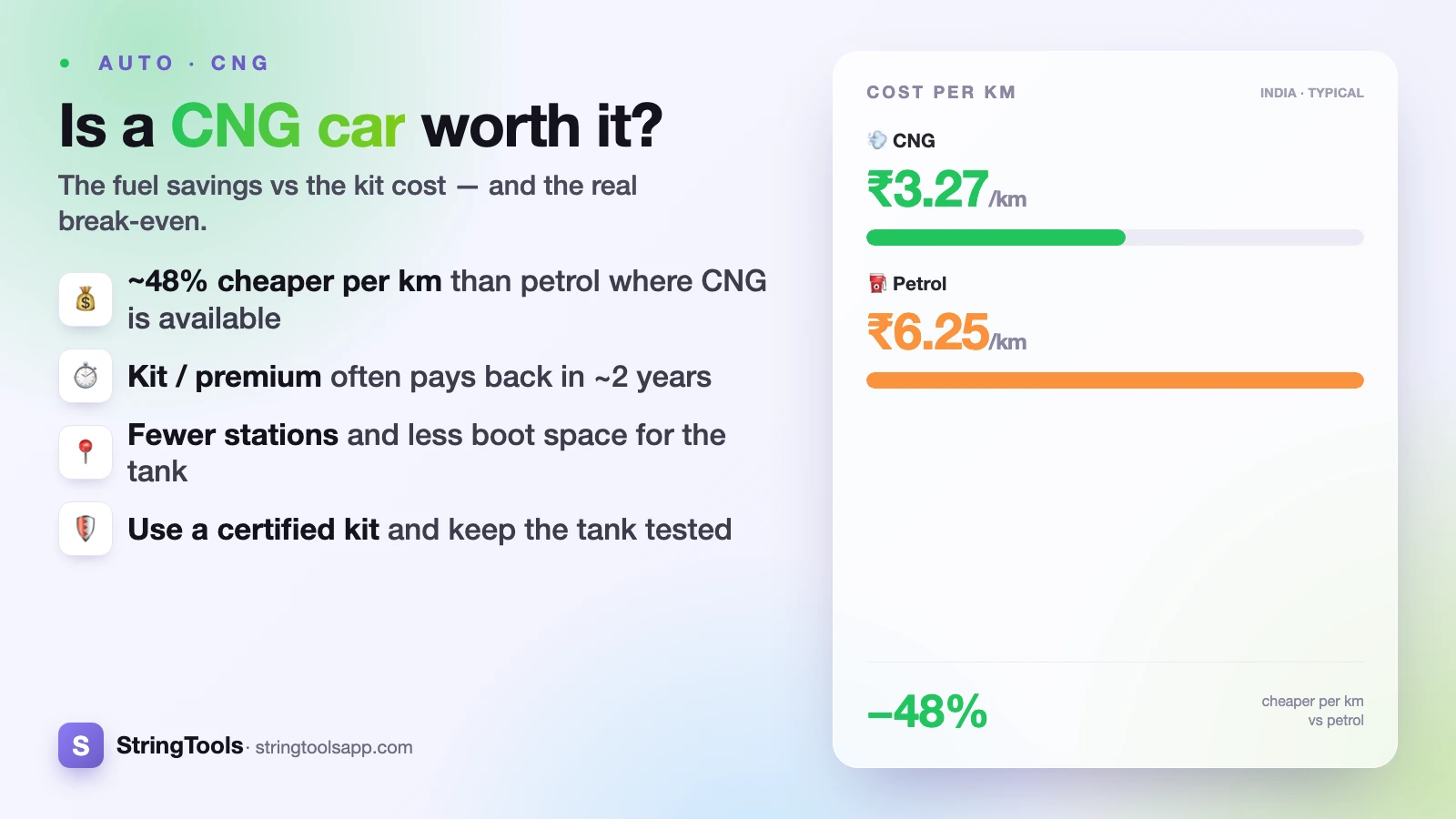
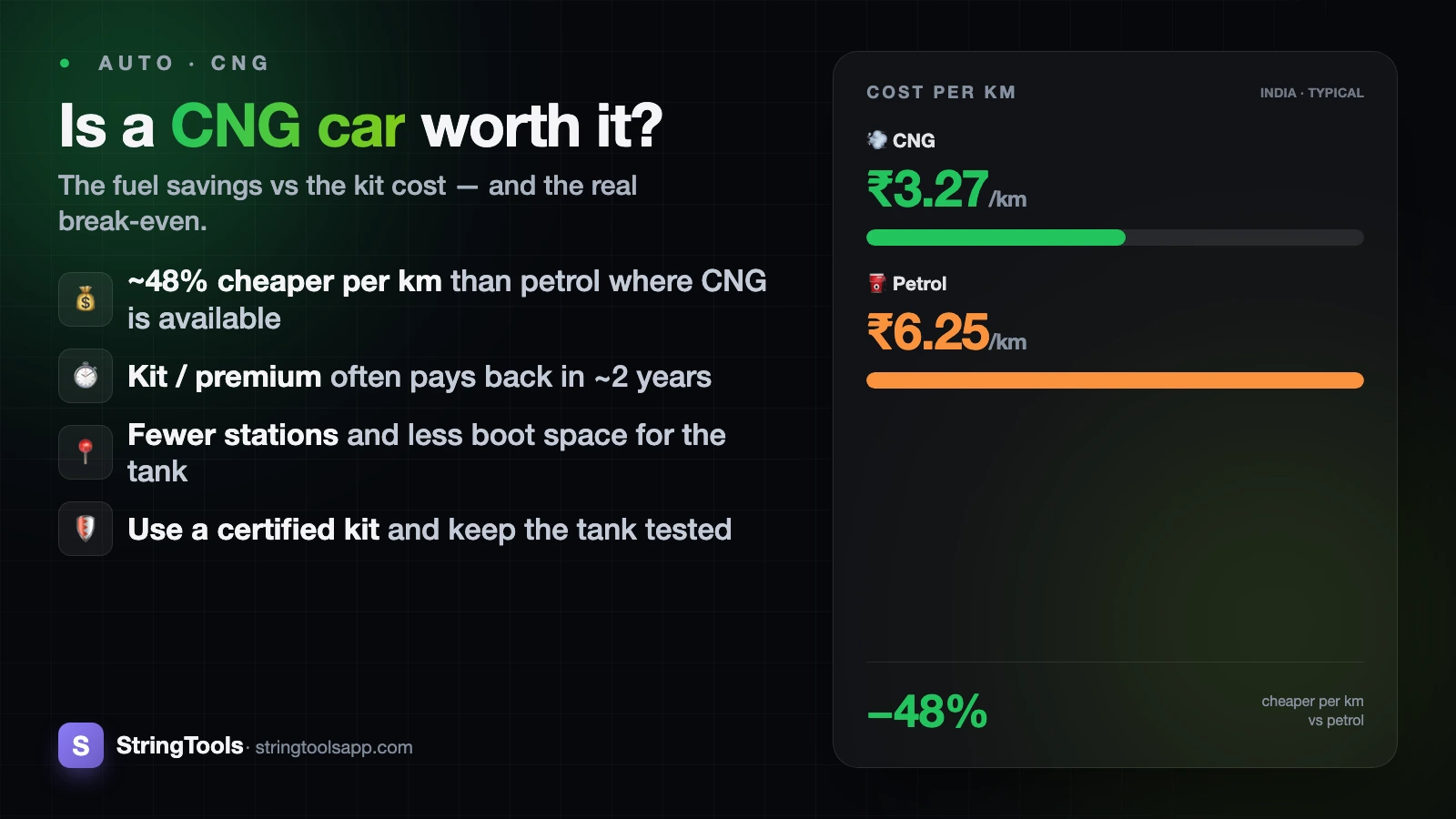
Petrol: ₹100 per litre at 16 km/l works out to about ₹6.25 per km.
CNG: ₹85 per kg at 26 km/kg works out to about ₹3.27 per km.
EV (for context): ₹8 per kWh at 8 km/kWh works out to about ₹1.00 per km.
So CNG costs roughly ₹3.27 per km against petrol's ₹6.25 — a saving of about ₹2.98 per km, or close to 48% cheaper per kilometre. That gap is why high-mileage drivers gravitate to CNG. Notice the EV number is lower still; if you can charge at home and your usage fits an EV's range, electricity is cheaper again. We compare all four side by side in petrol vs diesel vs CNG vs EV running cost. Because prices and mileage differ everywhere, don't take these as "live" or guaranteed — punch your own numbers into the fuel cost calculator to get a figure that reflects your reality.
A worked example: 15,000 km a year
Let's make it concrete with an average private car doing 15,000 km in a year.
On petrol at ₹6.25 per km, that's 15,000 × ₹6.25 = ₹93,750 in fuel for the year.
On CNG at ₹3.27 per km, that's 15,000 × ₹3.27 = ₹49,050 for the year.
The difference is ₹44,700 saved in a single year. Against a ₹90,000 factory CNG premium, you've recovered almost exactly half the premium in year one and the rest early in year two — after which that ₹44,700 a year is pure saving.
Now scale it up. A taxi or ride-hail car doing 40,000 km a year saves roughly ₹1,19,000 in fuel annually at the same per-km gap. It claws back a ₹90,000 premium in well under a year. This is exactly why you see so many CNG cars in commercial fleets: the more you drive, the faster CNG wins, and the bigger the ongoing prize. The flip side is equally true — drive only 6,000–7,000 km a year and the break-even stretches past four or five years, by which point other factors may matter more than fuel.
The trade-offs nobody puts on the showroom poster
CNG's running-cost advantage is real, but it comes with genuine compromises. Be honest with yourself about these before you commit.
Refuelling network and queues: CNG stations are far less common than petrol pumps, and in many cities they attract long queues, especially at peak hours. If you don't have a convenient station on your regular routes, the time cost eats into the money you save.
Boot space: The CNG cylinder usually sits in the boot, and it takes a big bite out of your luggage room. For a family that travels with luggage or does airport runs, this is a daily annoyance, not a one-time one. Some factory-fitted models integrate the tank more neatly than aftermarket kits.
Performance: Running on gas typically gives slightly lower power and pickup than petrol, most noticeable on inclines or when fully loaded. Most drivers adapt quickly, but enthusiasts will feel it.
Safety and tank testing: A CNG tank is a high-pressure vessel and must be periodically tested and re-certified (hydro-testing on a fixed schedule). Only a professionally fitted, government-certified kit installed by an authorised centre is acceptable — a cheap, uncertified kit is a false economy and a genuine safety risk. Factory-fitted CNG comes certified from the manufacturer, which is one reason many buyers prefer it.
Resale: This cuts both ways. In cities where CNG demand is strong, a well-maintained CNG car with a certified kit can resell well. Elsewhere, a buyer pool that's smaller or wary of aftermarket kits can soften resale value.
Where CNG makes sense, and where it doesn't
CNG is worth it when high mileage and a good refuelling network line up. If you're a city commuter clocking 1,200-plus km a month, a taxi or ride-hail driver, or anyone whose daily routes pass a convenient CNG station without brutal queues, the math is firmly on your side. The per-km saving compounds fast, and the break-even lands well within the time you'll own the car.
CNG makes less sense if you drive lightly — say under 8,000 km a year — because the break-even stretches out and the boot-space and queue compromises start to outweigh a modest annual saving. It's also a weaker fit if you frequently do long highway trips into areas where CNG stations thin out, or if luggage space is non-negotiable for your family. In those cases, an efficient petrol car, or an EV if you can charge at home, may serve you better. If EVs are on your shortlist, weigh them honestly in is an electric car cheaper than petrol before deciding.
The single best thing you can do is stop guessing and run your own numbers. Your city's prices, your actual mileage, and your real annual distance change the answer completely — the fuel cost calculator does the per-km and per-year math for petrol, diesel, CNG, and EV in seconds so you're comparing your situation, not a generic average.
A quick note for readers outside India
If you're reading this from the US, UK, Canada, or Australia, the calculus is different. CNG (sometimes sold as compressed natural gas or measured in gasoline-gallon equivalents) is niche for passenger cars in these markets. Factory CNG cars are scarce, aftermarket conversions are uncommon and often expensive, and the public fuelling network is thin outside certain commercial and fleet corridors.
The running-cost saving can still exist. In the US, for rough contrast, CNG at around $2.30 per gasoline-gallon equivalent at 28 miles per GGE is about $0.08 per mile, against roughly $0.11 per mile for petrol. That's a real per-mile gap, but with so few stations and so few cars built for it, most private buyers in these countries end up choosing between an efficient petrol or hybrid and an EV rather than CNG. CNG's real stronghold in Tier-1 markets is heavy-duty and municipal fleets — buses, refuse trucks, and the like — not the family driveway. So if you're outside India, treat CNG as an interesting comparison point rather than a mainstream option, and focus your decision on petrol, hybrid, and EV.
Wrap-up: run your numbers before you decide
So, is a CNG car worth it? If you drive a lot in a city with decent CNG coverage, yes — the near-half saving per kilometre is hard to argue with, and a factory premium or certified kit typically pays for itself inside two years, faster still for high-mileage and commercial use. If you drive lightly, need your full boot, or live where stations are scarce, the case gets weaker and an efficient petrol car or an EV may suit you better.
Whatever you're leaning toward, don't decide on a showroom brochure or a WhatsApp forward. Use certified kits only, factor in the boot space and the queues you'll actually face, and above all, do the arithmetic on your own driving. Head to the free fuel cost calculator, enter your city's fuel prices and your real annual mileage, and let it show you the per-km and per-year cost of petrol, CNG, and EV side by side. Five minutes of honest math beats years of guessing — and it's the difference between a CNG car that pays you back and one that just clutters your boot.
Frequently Asked Questions
How much cheaper is CNG than petrol per kilometre in India?
On indicative August 2026 figures — petrol at ₹100/litre and 16 km/l versus CNG at ₹85/kg and 26 km/kg — CNG costs about ₹3.27 per km against petrol's ₹6.25, roughly 48% cheaper. The exact gap depends on your city's prices and your car's real mileage, so run your own numbers in the fuel cost calculator rather than relying on a generic average.
How long does it take for a CNG car to pay for itself?
Divide the extra upfront cost by your saving per km, then by your annual distance. A ₹90,000 factory premium at a ₹2.98/km saving needs about 30,200 km to break even — roughly two years at 15,000 km a year. A high-mileage taxi doing 40,000 km a year recovers it in well under a year. Drive little and the payback stretches out.
Is a factory-fitted CNG car better than an aftermarket kit?
Factory CNG comes certified from the manufacturer, usually integrates the tank more neatly, and protects your warranty, but costs more upfront (often around a ₹90,000 premium). A certified aftermarket kit is cheaper and breaks even sooner. Whichever you choose, insist on a professionally fitted, government-certified kit — an uncertified one is a safety risk and a false economy.
What are the main downsides of a CNG car?
The big ones are a sparse refuelling network with long queues in many cities, reduced boot space because the cylinder sits in the trunk, slightly lower performance and pickup, and the need for periodic tank testing and re-certification. Resale can go either way depending on local CNG demand. None are dealbreakers for high-mileage city drivers, but they matter more if you drive lightly.
Does CNG make sense for cars in the US, UK, Canada, or Australia?
For private passenger cars, generally no. CNG is niche in these markets — few factory CNG cars, uncommon conversions, and a thin public fuelling network. A per-mile saving can exist (roughly $0.08 vs $0.11 in the US on indicative figures), but the lack of cars and stations pushes most buyers toward efficient petrol, hybrid, or EV. CNG's real strength there is commercial fleets, not family cars.