
The quiet tax on not shopping around
Key Takeaways
- A single percentage point looks trivial on paper but compounds across every month of the loan — on a 30-year mortgage it can mean tens of thousands in extra interest.
- The longer the term and the larger the balance, the more a small rate gap costs you. Mortgages punish complacency far more than short personal loans do.
- Getting two or three quotes is one of the highest hourly-rate tasks in personal finance: an afternoon of comparison can routinely save hundreds on a car loan and thousands on a home loan.
- The reasons people skip comparison are behavioural, not rational — bank loyalty, showroom pressure, and judging a loan only by whether the monthly payment “fits.”
- Fees matter too: an origination fee, arrangement fee, or discount points can wipe out a headline rate that looked cheaper.
- The figures below are illustrative examples, not current market rates — but the pattern holds at any rate level.
Most people spend more time comparing phones than comparing loans. That is backwards. A phone costs a few hundred dollars once; a loan can cost tens of thousands over its life, and the difference between a good offer and a lazy one is often decided in a single afternoon of shopping around.
The trap is that loan pricing hides its true cost behind a comfortable monthly number. Lenders know that most borrowers ask one question — “can I afford the payment?” — and never ask the more important one: “how much will this loan cost me in total, and could I get it cheaper somewhere else?” This article makes the money case for asking that second question, with worked examples in dollars (with pound equivalents) across a personal loan, a car loan, and a mortgage.
Why one percentage point never feels like real money
A percentage point sounds like a rounding error. If one lender quotes 6.5% and another quotes 7.5%, the gap is “just one percent,” and the monthly payments might differ by only the price of a couple of coffees. Our brains treat that as noise.
The problem is that interest is charged on the whole outstanding balance, every single period, for the entire term. That small percentage is applied to a large number, repeatedly, for years. On a short loan the effect is modest. On a long one it is enormous, because the extra interest accrues month after month for decades and the principal falls slowly in the early years — exactly when the higher rate is doing the most damage.
There is also a framing problem. When a lender advertises a rate, the difference between 6.5% and 7.5% is “one point.” But measured the way it actually hits your wallet — as extra dollars paid — 7.5% is not one part in a hundred more expensive. On a 30-year mortgage it can be roughly a fifth more total interest. The honest way to compare loans is never rate-to-rate in isolation; it is total cost against total cost, using an amortization-aware calculator rather than a gut feeling about the monthly figure.
What one point actually costs, across loan sizes and terms
Here is the same one-percentage-point increase applied to four common loans. Every figure is the extra total interest you pay over the life of the loan compared with the lower rate — nothing else changes except the rate. All amounts are illustrative and rounded; they show the shape of the cost, not today’s market pricing.
| Loan type | Amount | Term | Rate gap | Extra total interest |
|---|---|---|---|---|
| Personal loan | $10,000 (~£7,900) | 3 years | +1 point | ~$170 |
| Car loan | $20,000 (~£15,800) | 5 years | +1 point | ~$560 |
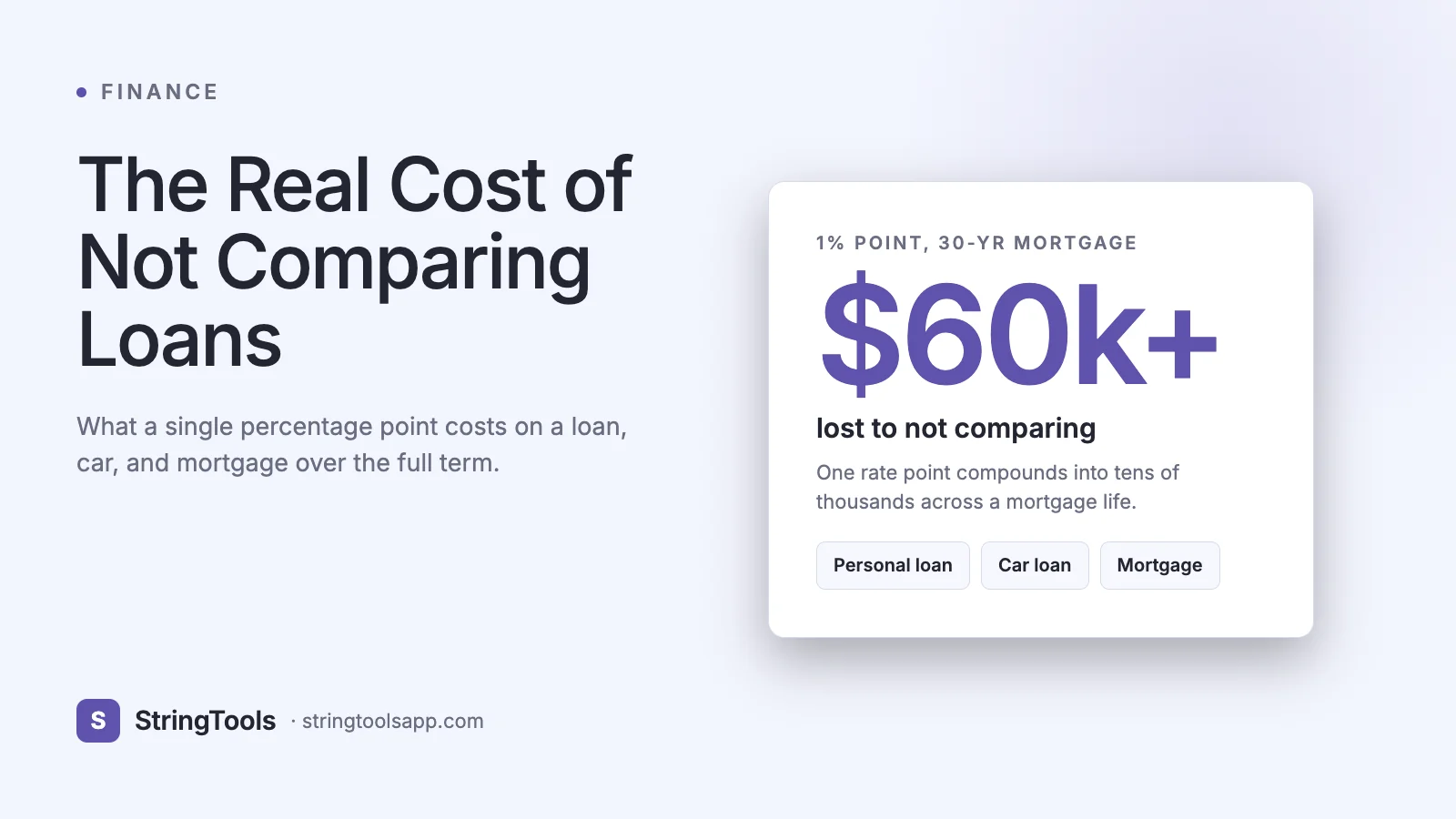
| Mortgage | $250,000 (~£197,000) | 30 years | +1 point | ~$60,400 |
| Mortgage | $300,000 (~£237,000) | 30 years | +1 point | ~$72,500 |
The pattern is the story. On a small, short personal loan, one point costs about the price of a nice dinner — real, but not life-changing. On a mortgage, the same one point costs more than most people’s annual salary, spread silently across 360 payments.
Two forces drive this. First, size: interest scales with the balance, so a point on $300,000 is thirty times a point on $10,000. Second, and less obvious, time: a long term multiplies the effect because the money stays borrowed for so long. This is why remortgaging and mortgage shopping deserve far more of your attention than the interest-free store card at the till — and why the mortgage calculator is the single most valuable tool to run before you sign anything.
Three worked examples: personal, car, and home
Numbers make the case better than adjectives. Here are three realistic scenarios, each comparing a first offer against a slightly better one you might have found by asking around.
Personal loan — $15,000 (~£11,800) over 3 years. At 13% the monthly payment is about $505 and you pay roughly $3,195 in total interest. At 11% — a plausible improvement from a credit union or online lender — the payment drops to about $491 and total interest falls to around $2,679. The two-point difference saves you roughly $516 for the price of filling in two more applications. That is a genuine return for an hour’s work.
Car loan — $20,000 (~£15,800) over 5 years. Dealer or showroom finance quotes you 9%, giving a payment of about $415 and total interest near $4,910. A credit union or bank pre-approval at 7% brings the payment to about $396 and total interest to roughly $3,761 — a saving of about $1,150. Point-of-sale car finance is one of the most marked-up products most people ever buy, precisely because it is sold at the moment you are least likely to compare. In the UK the same logic applies to dealership PCP and HP deals versus an independent car-finance quote.
Mortgage — $300,000 (~£237,000) over 30 years. At 7.5% the payment is about $2,098 a month; at 6.5% it is about $1,896. The monthly gap is only around $202 — small enough to shrug off — but over the full term it adds up to roughly $72,500 in extra interest. That is the single most expensive shrug in personal finance. UK borrowers face the same maths at remortgage time: a fixed-rate deal one point higher than the best available, held over the full mortgage, quietly costs a five-figure sum. Run both offers side by side in our loan comparison calculator before you commit to either.
Why smart people still take the first offer
If comparison is so obviously worth it, why do so many people skip it? The reasons are human, not financial.
Loyalty and inertia. Many borrowers go straight to the bank where they keep their current account, assuming a long relationship earns them a better deal. It rarely does — your existing bank has no competitive pressure to give you its sharpest rate, because it assumes you will not leave. Loyalty is priced as complacency.
Point-of-sale pressure. Car showrooms, furniture stores, and home-improvement firms offer finance at the exact moment you have emotionally committed to the purchase. The salesperson frames the finance as a convenience — “we can sort that here” — and comparison feels like an awkward interruption to a decision you have already made in your head. That convenience is exactly what you pay for.
The monthly-payment illusion. This is the big one. Lenders and dealers compete on the monthly figure, not the total cost, because a payment that “fits the budget” feels affordable regardless of the rate behind it. Stretch the term and almost any payment can be made to fit — while the total interest quietly balloons. A loan that fits your monthly budget is not the same as a loan that is cheap.
Effort and intimidation. Comparison feels like homework, and finance paperwork is intimidating, so people default to whatever is in front of them. But the effort is small and the reward is concentrated: a couple of quotes, an hour of your time, and hundreds or thousands of dollars on the table. Our guide on how to get a loan at the lowest interest rate walks through where that effort pays off most.
How to compare without hurting your credit
Comparison is not just a good idea in theory — it is procedurally easy, and the fear that shopping around will wreck your credit score is mostly misplaced.
Get two or three quotes, not just one. The evidence from lending studies is consistent: borrowers who gather even a couple of offers get meaningfully better rates than those who take the first. You do not need ten quotes; the jump from one to three captures most of the benefit.
Use soft-search pre-qualification first. In the US and UK, most lenders now offer a “check your rate” or eligibility check that uses a soft inquiry, which does not affect your credit score. This lets you see personalised rates before any hard application. Only convert to a full application once you know the offer is competitive.
Rate-shop inside a short window. When you do submit formal applications for the same type of loan — a mortgage or an auto loan — credit-scoring models typically bundle multiple hard inquiries made within a short period (commonly 14 to 45 days, depending on the model) into a single event. So concentrated shopping is treated as one search, not many.
Compare total cost and fees, not just the headline rate. The advertised rate (the APR or representative APR) is meant to fold in fees, but always confirm the arrangement fee, origination fee, or discount points, and read whether the representative rate is one most applicants actually receive. A lower rate with a large upfront fee can cost more than a slightly higher rate with none. When a fixed-rate mortgage deal ends, revisit the market rather than rolling onto the lender’s standard variable rate — our guide on when should you refinance your mortgage covers the timing. And if you would rather have offers brought to you than chase them yourself, our loan comparison service is built to surface competing quotes from vetted lenders.
The bottom line
The cost of not comparing loans is invisible, which is exactly why it is so easy to pay. Nobody sends you a bill that says “you overpaid by $72,500 because you took the first mortgage offered.” The money simply leaves your account, a couple of hundred dollars at a time, for thirty years.
The defence is almost insultingly simple: never accept the first offer without checking at least two others, judge loans by total cost rather than the monthly payment, and factor in every fee. On a small personal loan the payoff is a decent dinner; on a car it is a holiday; on a mortgage it can be a year’s salary. Few financial habits pay a higher hourly rate than the hour you spend comparing.
Before you sign anything, put the offers side by side and let the totals — not the salesperson — make the decision. Run each one through our loan comparison calculator and see the lifetime cost in black and white.
This article is general education, not financial advice; the savings from comparing depend on your circumstances and the offers available, so run your own numbers and confirm terms with each lender.
Frequently Asked Questions
Does one percentage point really make a big difference on a loan?
On a short, small loan the difference is modest — often just a couple of hundred dollars. On a large, long loan it is dramatic, because interest is charged on the whole balance for the entire term. On an illustrative $300,000 mortgage over 30 years, a one-point difference (6.5% versus 7.5%) works out to roughly $72,500 in extra interest. The longer the term and larger the balance, the more a single point costs you.
Will comparing loans and getting multiple quotes hurt my credit score?
Usually not, if you do it correctly. Most lenders offer soft-search pre-qualification that shows your likely rate without any impact on your score. When you do make formal applications, credit-scoring models typically treat multiple inquiries for the same loan type within a short window (often 14 to 45 days) as a single search. The small, temporary effect of concentrated rate-shopping is almost always outweighed by the money you save on a better rate.
How many loan quotes should I actually get?
Two or three is the sweet spot. Lending research consistently shows that borrowers who gather even a couple of offers secure noticeably better rates than those who take the first one. The biggest improvement comes from moving from one quote to three; beyond that, the extra effort brings diminishing returns. Aim for a mix — for example your own bank, an online lender, and a credit union or broker.
Why is dealer or point-of-sale finance often more expensive?
Point-of-sale finance is sold at the moment you have emotionally committed to a purchase, when you are least likely to shop around. That convenience is exactly what you pay for, and the finance is frequently marked up compared with an independent bank, credit union, or car-finance quote. Getting pre-approved before you walk in gives you a benchmark and real negotiating power. Always compare the total cost of the dealer offer against at least one outside quote.
Is the lowest interest rate always the cheapest loan?
Not necessarily. A headline rate can be undercut by fees such as origination fees, arrangement fees, or mortgage discount points, so a slightly higher rate with no fees can end up cheaper overall. The APR or representative APR is designed to fold fees into a single comparable number, but always confirm the fees separately and check whether the advertised rate is one most applicants actually receive. Compare the total amount repayable, not just the rate.
Why shouldn't I just choose the loan with the lowest monthly payment?
Because a low monthly payment often hides a high total cost. Lenders can shrink the monthly figure simply by stretching the term, which keeps you in debt longer and increases the total interest you pay. A payment that fits your budget is not the same as a loan that is cheap. Always look at the total interest and total amount repayable over the full term, not just whether the monthly number feels comfortable.