
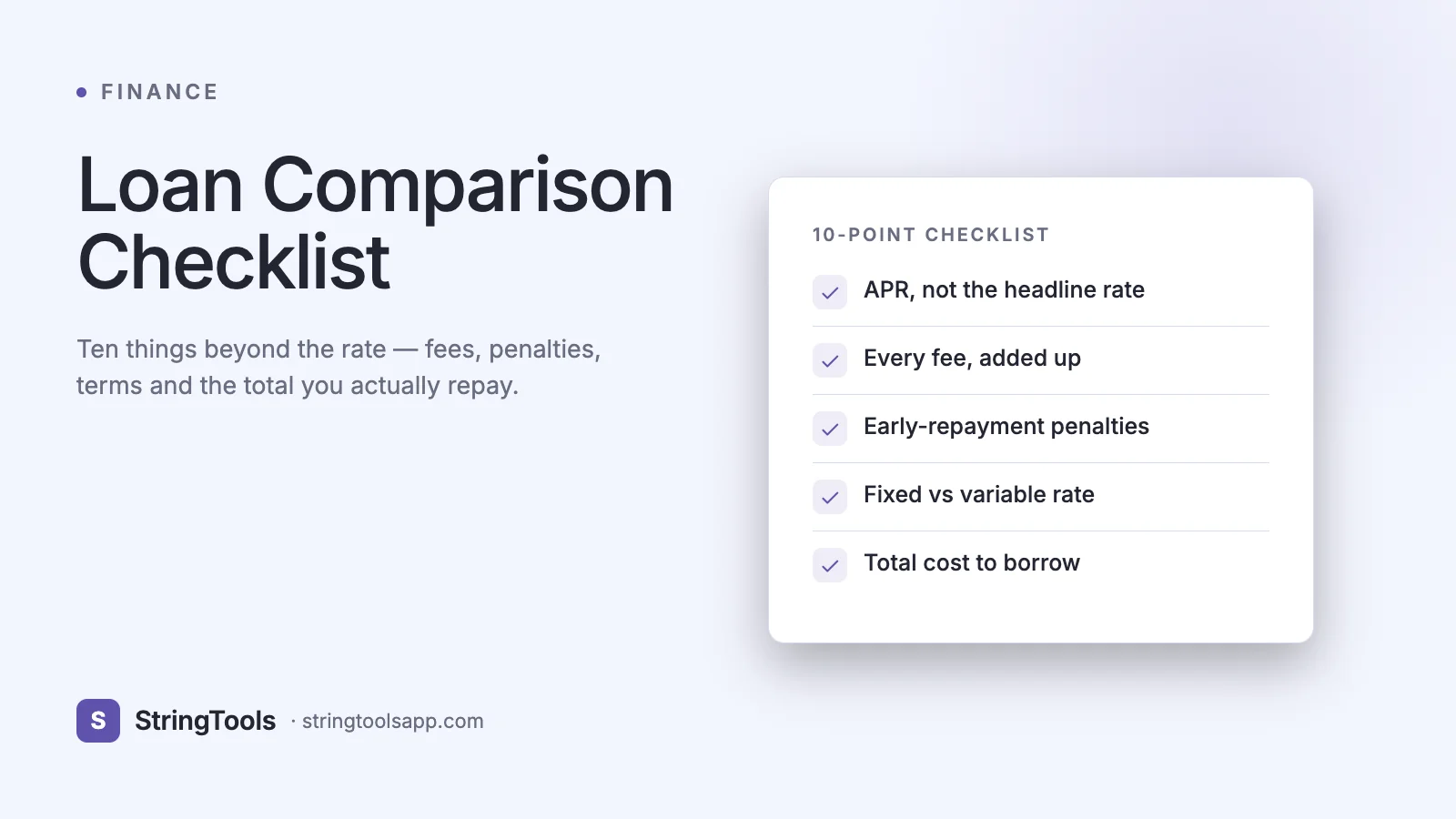
Why the Headline Rate Lies to You
Key Takeaways
- The advertised interest rate is a marketing number; the APR (US) or representative APR (UK) is closer to the true cost because it folds in compulsory fees.
- Only about half of applicants get the advertised “representative” rate — lenders are legally required to offer it to just 51% of accepted borrowers, so your personal quote may be higher.
- Fees decide winners between similar rates: a $495 origination fee or a 2% UK arrangement fee can outweigh a 0.3% rate difference on a small, short loan.
- Early repayment charges (UK ERCs, commonly 1–5% of the balance) and US prepayment penalties can trap you in a loan you would otherwise clear early.
- Always compare the total amount repayable over the same term — a lower monthly payment often just means a longer term and thousands more in interest.
- Checking your own eligibility is usually a soft search that does not dent your credit score; a full application triggers a hard search that does.
Two loan offers can advertise the same 7.9% rate and still cost hundreds of dollars apart once fees, term length and penalties are counted. The interest rate answers only one question — what the lender charges for the money each year. It says nothing about what you pay to set the loan up, what happens if you clear it early, or how much interest the term quietly stacks on top.
This is a checklist, not a lecture. Work through all ten items for every offer before you sign anything. Where the rules differ across markets we flag it: the United States uses APR, origination fees and (occasionally) prepayment penalties; the United Kingdom uses representative APR, arrangement fees and early repayment charges (ERCs); the EU uses APRC under euro-denominated (€) rules that broadly mirror the UK approach. You can run the raw numbers alongside this guide with our loan comparison calculator.
Items 1–3: The True Price of the Money
The first three checks turn a headline rate into an honest number.
1. APR versus the headline rate
The headline (or nominal) rate is the pure cost of borrowing. The APR — Annual Percentage Rate in the US, representative APR in the UK, APRC in the EU — is designed to be comparable across lenders because it bundles the interest and most compulsory fees into a single yearly figure. When two loans quote the same rate but different APRs, the one with the higher APR carries more baked-in cost.
One trap: in the UK and EU, the advertised APR is a “representative” figure the lender must give to at least 51% of accepted applicants. The other 49% can be quoted more. So treat any advertised APR as a starting point, then get a personal quote. What to ask: “What APR will I personally be charged, and does it include every compulsory fee?”
2. Arrangement, origination and processing fees
This is where near-identical rates split apart. In the US it is usually called an origination fee, often 1–8% of the amount borrowed and frequently deducted from the funds you receive — borrow $10,000 with a 5% fee and $9,500 lands in your account while you repay the full $10,000. In the UK it is an arrangement or product fee, sometimes a flat amount, sometimes a percentage. Ask whether the fee is added to the loan (so you pay interest on it too) or taken upfront, and whether it is refundable if you cancel within the cooling-off period.
3. The total repayable, not the monthly payment
The single most useful number in any comparison is the total amount repayable — every payment you will make over the life of the loan, principal plus interest plus fees. A tempting monthly payment can hide a longer term or a big arrangement fee. Line the offers up on the same loan amount and the same term, then compare the totals. Our loan calculator shows the total interest for any rate and term so you can rank offers on true lifetime cost rather than the number the salesperson leads with.
The 10-Point Checklist at a Glance
Keep this table beside each offer. If a lender will not answer a row in writing, treat that as an answer.
| What to check | Why it matters | What to ask |
|---|---|---|
| APR / representative APR | Truer yearly cost than the headline rate | “What APR will I personally get?” |
| Origination / arrangement fee | Can outweigh a small rate gap | “Is it a % or flat, and taken from the funds?” |
| Early repayment charge / prepayment penalty | Can cost 1–5% to clear the loan early | “What do I pay to settle early?” |
| Fixed or variable rate | Variable can rise with the base rate | “Is my rate locked for the full term?” |
| Total repayable | The real lifetime cost | “What is the total I will repay?” |
| Loan term | Longer term means more total interest | “What is the total at each term option?” |
| Insurance / add-ons | Can be bundled and quietly priced in | “Is any insurance mandatory or optional?” |
| Late & default charges | Turn a missed payment into a spiral | “What are the fees for a late payment?” |
| Flexibility & payment holidays | Overpay, top-up or pause when needed | “Can I overpay free of charge?” |
| Soft or hard credit search | Hard searches mark your file | “Is this quote a soft or hard search?” |
The rest of this guide works through items 4 to 10 with the detail behind each row.
Items 4–6: Rate Type, Term and How Interest Compounds
4. Fixed or variable (floating) rate
A fixed rate stays the same for the whole term, so every payment is predictable. A variable or floating rate moves with an index — the Federal Reserve federal funds rate in the US, the Bank of England base rate in the UK, ECB rates across the euro area — so your payment can rise or fall after the loan starts. A variable loan can advertise a lower opening rate precisely because the risk of future increases sits with you, not the lender. Ask what the rate is tied to, how often it can change, and whether there is a cap. For a deeper look at the trade-off, read our guide on fixed vs floating interest rate.
5. The term, and how it quietly multiplies interest
Lenders love to compete on the monthly payment because a longer term makes any loan look cheaper per month while making it far more expensive overall. Stretching a $15,000 loan at 9% from three years to six roughly halves the monthly payment but can add thousands in total interest, because you are borrowing the money for twice as long. Always compare offers at the same term. If you must lengthen the term to afford the payment, check whether you can overpay later (item 9) to shorten it again without penalty.
6. Reconciling the totals
Once you know the rate type and term, put the total-repayable figures side by side. A fixed 8.5% over four years may beat a variable 7.9% that could climb — or it may not, depending on your appetite for risk. The point of the checklist is to make the comparison on complete numbers rather than on the one figure each lender chose to advertise.
Items 7–8: The Charges That Bite Later
7. Mandatory insurance and add-on bundling
Some loan quotes quietly include payment protection insurance, credit insurance or a “membership” product that raises the effective cost. In principle these should be optional, but they are sometimes pre-ticked or presented as a condition of approval. Ask directly: “Is any insurance or add-on compulsory to get this rate, and what is the loan cost with it stripped out?” A genuinely optional product can be declined; a mandatory one belongs in your total-cost comparison. Be especially wary of single-premium insurance added to the loan balance, because you then pay interest on the premium for the whole term.
8. Late-payment and default charges
Every lender charges something when a payment is missed, but the amounts and triggers vary widely — a flat late fee, a penalty interest rate, or both, plus the credit-file damage a reported default causes. Read the specific numbers: how many days before a payment counts as late, the fee, whether the interest rate increases after a default, and how quickly it is reported to the credit bureaus. A loan with a marginally higher rate but humane arrears handling can be the safer choice if your income is variable. Missed payments are also one of the fastest routes to future rejection — see why loan applications get rejected.
Items 9–10: Flexibility and the Credit-Search Trap
9. Overpayments, top-ups and payment holidays
Flexibility is worth real money over a loan's life. Check whether you can make overpayments or clear the loan early without a penalty (this links back to item 3), whether you can take a top-up if you need to borrow more later, and whether the lender offers payment holidays if you hit a rough patch. Payment holidays are not free — interest usually keeps accruing while you pause, so the total cost rises — but the option can prevent a missed payment and a default. A loan that lets you overpay freely can be cheaper in practice than a lower-rate loan that locks you in, because you can attack the principal whenever you have spare cash.
10. Early repayment charges and prepayment penalties
This is the item borrowers most often miss. In the UK, an early repayment charge (ERC) is common on fixed-rate products and typically runs 1–5% of the balance repaid early, sometimes tapering down over the term. In the EU, similar early-settlement fees apply under consumer-credit rules, usually capped by law. In the US, prepayment penalties are far less common on personal loans and are prohibited on many, but they still appear on some loans and are more common on mortgages and certain auto or business loans — so confirm rather than assume. Ask for the exact charge to settle the loan one, two and three years in. If you expect a bonus, an inheritance or a remortgage that might let you clear the balance early, an ERC can wipe out the savings from a lower rate.
The soft-versus-hard search
Checking your eligibility should not cost you anything, including credit-score points. Most lenders and comparison sites now offer a quote via a soft search (sometimes called a soft credit check or eligibility check) that only you can see and that leaves no mark on your file. A full application triggers a hard search (a hard inquiry / hard footprint) that is visible to other lenders and can nudge your score down for a while; several hard searches in a short window look like distress and can hurt approval odds. Ask “Is this a soft or hard search?” before you click, and use soft-search eligibility checkers to shortlist before you formally apply. Whether you borrow from a high-street bank or a specialist lender can also change fees, flexibility and search practices — compare the two in our guide to bank vs NBFC loans.
This article is general education, not financial advice; loan terms and charges vary by lender and country, so read the full agreement and confirm every item on this checklist before you sign.
Frequently Asked Questions
What is the difference between the interest rate and the APR?
The interest rate is the pure cost the lender charges for borrowing the money each year. The APR (Annual Percentage Rate in the US, representative APR in the UK, APRC in the EU) folds in most compulsory fees on top of the interest, so it is a fairer basis for comparing two loans. Two offers can share the same headline rate but have very different APRs once origination or arrangement fees are counted. Always compare APRs, and ask for your personal APR rather than the advertised representative figure.
Do personal loans have prepayment penalties in the US?
Many US personal loans have no prepayment penalty, and a number of lenders advertise this as a feature. However, some loans do carry one, and prepayment penalties are more common on mortgages and certain auto or business loans. Never assume — ask the lender directly what it would cost to settle the loan early one, two and three years in. If you might clear the balance ahead of schedule, a penalty can erase the benefit of a lower rate.
How much is a UK early repayment charge?
On UK fixed-rate loans an early repayment charge (ERC) is commonly around 1–5% of the amount you repay early, and it often reduces as you move through the term. The exact figure and structure are set out in your loan agreement, so read the early-settlement section before signing. Under UK rules some early-settlement rebates and caps apply on regulated consumer credit, but the charge can still be significant on a large balance. If you expect a windfall that could clear the loan, factor the ERC into your comparison.
Will comparing loans hurt my credit score?
Comparing loans usually does not hurt your score, provided you use eligibility checkers that run a soft search. A soft search is visible only to you and leaves no mark on your credit file. A full application triggers a hard search, which other lenders can see and which can lower your score slightly for a while. Do your shortlisting with soft-search tools, then submit a formal application only to the lender you have chosen.
Why is the total repayable more important than the monthly payment?
The monthly payment is easy to make look small by stretching the term, but a longer term means you borrow the money for longer and pay far more interest overall. The total repayable captures every payment plus fees across the whole loan, so it reflects the true lifetime cost. Comparing offers on total repayable, at the same loan amount and term, stops a low monthly figure from hiding an expensive loan. Our loan calculator shows the total interest for any rate and term.
Should I take a fixed or a variable rate loan?
A fixed rate keeps every payment the same for the whole term, which makes budgeting predictable and protects you if rates rise. A variable or floating rate can start lower but moves with a benchmark such as the base rate, so your payments could increase. If certainty matters more to you than a slightly lower opening rate, fixed is usually the safer choice. Consider how long the loan runs and whether your budget could absorb a rate increase before you decide.