
The one number that actually matters
Most people pick a loan by scanning for the lowest advertised rate or the smallest monthly payment. Both instincts are wrong often enough to cost you real money. A loan that looks cheaper on the shelf can quietly be the most expensive one you sign, once fees and term length are counted properly.
This guide gives you a repeatable method to compare any two or more offers on equal footing. The goal is a single figure we will call your cost to borrow: the total interest you pay plus every fee the lender charges, added together. When you rank offers by cost to borrow, the marketing noise falls away and the genuinely cheapest loan reveals itself.
Everything below applies whether you are borrowing in dollars in the US, pounds in the UK, or euros in the EU. The vocabulary differs slightly by market, and we flag those differences as we go, but the math is identical everywhere. You can run every calculation here yourself with our loan comparison calculator, which is built to line offers up side by side.
Key Takeaways
- Compare like for like: only compare offers for the same loan amount and the same term, or the comparison is meaningless.
- Use APR, not the headline rate: APR folds most fees into a single annualised cost, so it is a fairer basis for comparison than a bare interest rate.
- Cost to borrow = total interest + all fees. This one figure, in currency, is what you should actually rank offers by.
- The lowest monthly payment usually means a longer term, which almost always means more total interest paid.
- A higher rate with no fee can beat a lower rate with a fee. We show a worked example where it does.
- Advertised rates are not guaranteed: in the UK only 51% of accepted applicants need to get the representative APR, and your real offer may be higher.
Rule one: compare like for like
Before you compare anything, freeze two variables: the loan amount and the term. If Offer A is for $20,000 over 4 years and Offer B is for $20,000 over 6 years, you are not comparing loans, you are comparing two different financial commitments that happen to share a name.
This matters because a longer term shrinks the monthly payment, which makes a loan feel more affordable while making it more expensive overall. Stretching the same debt over more months means more months of interest. We will quantify that trap in a later section, but the defence against it is simple: hold the term constant across every quote you gather.
Lenders do not always make this easy. One may quote you 4 years by default and another 5. When you request quotes, specify the exact amount and the exact term you want, so every offer answers the same question. If a lender can only offer a longer term, that is useful information, but note it as a difference rather than pretending the two are equivalent.
The same discipline applies to loan type. A secured loan, an unsecured personal loan, and a credit-card balance transfer are different products with different risks. Compare within a category first. Once amount, term, and type are pinned down, the remaining differences, rate and fees, are the ones worth analysing.
What APR really means, and why it beats the headline rate
The interest rate is the price of borrowing the money itself. The APR, or Annual Percentage Rate, is broader: it expresses the total yearly cost of the loan as a percentage, folding in the interest plus most compulsory fees, standardised so you can compare products fairly. Because it captures more than the bare rate, APR is almost always the better comparison figure.
A quick but important distinction: APR is not the same as APY. APR describes what a loan costs you and generally does not compound within the year the way APY does for savings. If that difference is fuzzy, our guide on APR vs APY vs interest rate untangles all three in plain language.
The terminology shifts by market. In the US you will see APR alongside an origination fee, typically 1% to 8% of the amount borrowed, often deducted from the funds before you receive them. In the UK, lenders advertise a representative APR, and by law at least 51% of accepted applicants must actually receive that advertised rate; the other 49% can be offered something higher based on their credit profile. The UK equivalent of an origination fee is usually called an arrangement fee or product fee. In the EU, lenders quote an APRC or a comparable standardised annual rate under consumer-credit rules, serving the same comparison purpose.
Here is the catch that keeps APR from being a perfect single answer: what counts inside APR is not identical across lenders or across borders. Some fees are included, some are not, and a very short-term loan can show a distorted APR. So treat APR as your first-pass filter, then confirm the win by calculating cost to borrow in actual currency.
Building your cost to borrow
Cost to borrow is the figure that ends arguments. Define it precisely: cost to borrow equals the total interest paid over the life of the loan plus every fee the lender charges, expressed as a single amount of money rather than a percentage.
To build it for any offer, you need three inputs and one calculation. The inputs are the amount, the rate, and the term. The calculation is amortisation, the standard method by which a fixed-rate instalment loan is repaid: each month you pay the same amount, part covering interest on the outstanding balance and part reducing the principal, with the interest share shrinking over time. If you want to see exactly how each payment splits, our explainer on how loan amortization works walks through the mechanics.
Once you know the monthly payment, the total interest is simply the sum of all payments minus the amount borrowed. Then add the fees. A processing, origination, or arrangement fee gets added on top; so does any compulsory insurance or administration charge the lender bakes in. The result is your cost to borrow.
A note on where fees land. In the US an origination fee is often withheld from the disbursed amount, so a $20,000 loan with a 3% fee may put only $19,400 in your pocket while you still repay based on $20,000. For a clean comparison, treat the fee as a cost you incur regardless of the plumbing, and add it to total interest. You can let our loan calculator produce the monthly payment and interest total for each offer, then add the fee yourself, or use the loan comparison calculator, which does the full side-by-side including fees.
Worked example: when a lower rate loses
This is the case that surprises people. All figures below are illustrative, for a $20,000 loan repaid over 5 years (60 monthly payments), and you can reproduce them in the calculator.
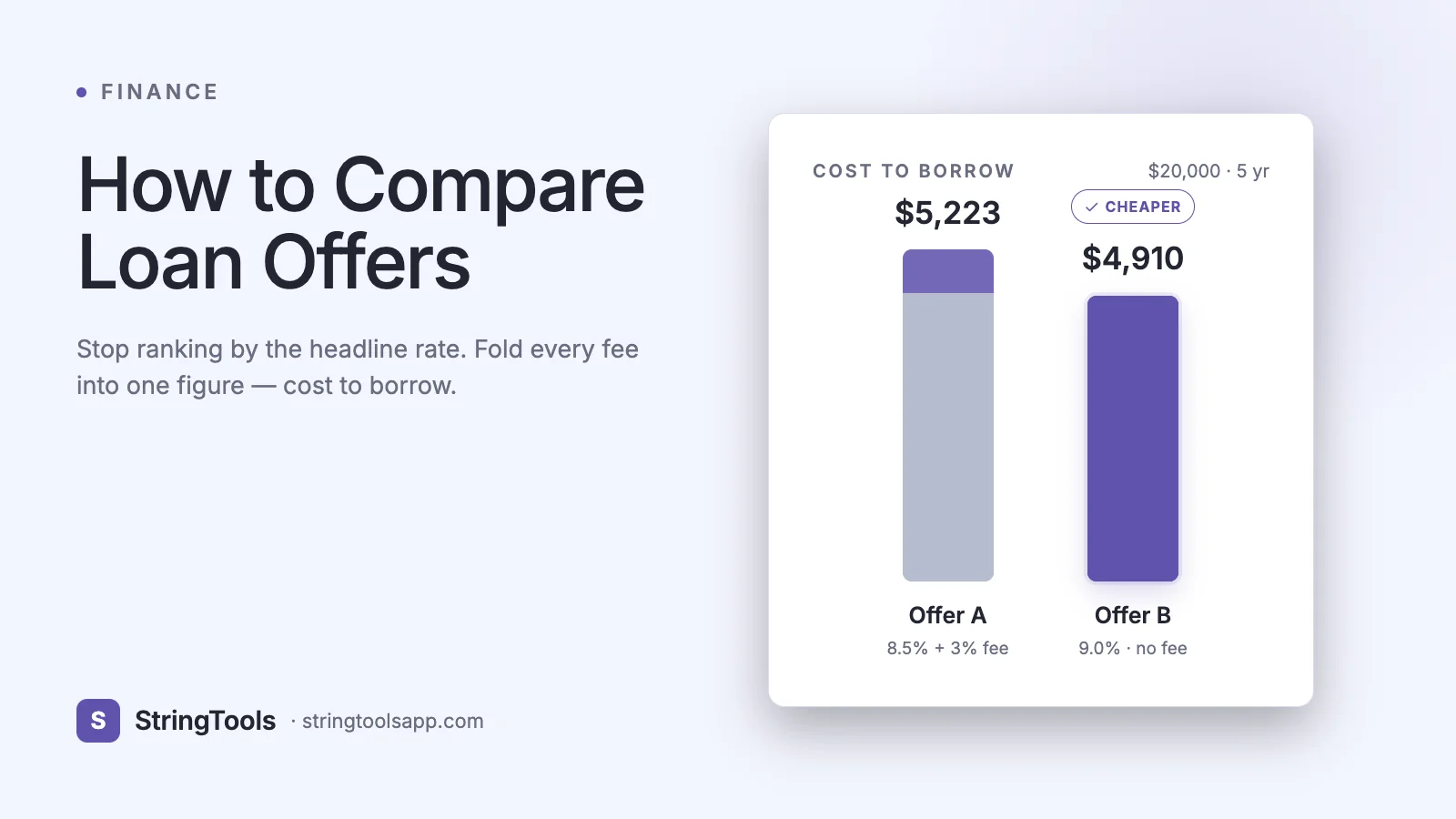
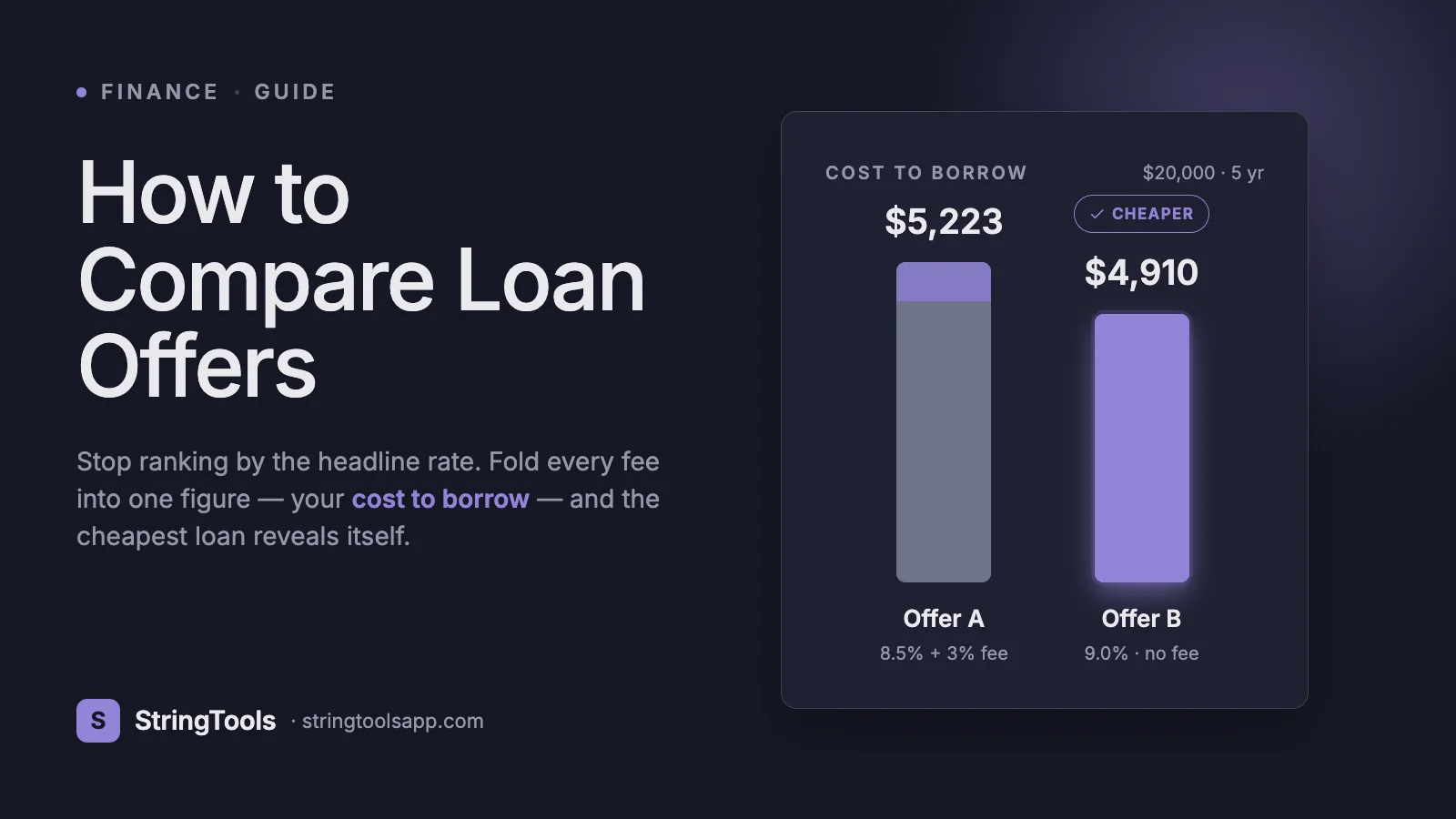
Offer A advertises the lower rate: 8.5% APR, but it carries a 3% origination fee, which is $600 on $20,000. Offer B advertises a higher rate: 9.0% APR, with no fee at all. Instinct says take the 8.5% loan. The math says otherwise.
| Item | Offer A: 8.5% + 3% fee | Offer B: 9.0%, no fee |
|---|---|---|
| Loan amount | $20,000 | $20,000 |
| Term | 5 years | 5 years |
| Monthly payment | ~$410 | ~$415 |
| Total interest | ~$4,623 | ~$4,910 |
| Fees | $600 | $0 |
| Cost to borrow | ~$5,223 | ~$4,910 |
Read the bottom row, not the top. Offer A wins on rate and wins on monthly payment, the two numbers borrowers fixate on, yet its cost to borrow is about $5,223 against Offer B’s $4,910. The no-fee loan is roughly $313 cheaper overall, because the $600 fee more than erases the interest saved by the lower rate.
The lesson is not that fees always lose or that higher rates are secretly good. It is that neither the rate nor the monthly payment tells you which loan is cheaper. Only the fully loaded cost to borrow does. Swap in your own amount, term, rate, and fee, and the ranking can flip either way, which is exactly why you have to run the numbers rather than trust the shelf price. For strategies to push your quoted rate down before you even compare, see how to get a loan at the lowest interest rate.
The lowest-monthly-payment trap
Ask a lender to lower your monthly payment and they have an easy lever: extend the term. A smaller payment feels like a better deal, but stretching the same principal over more months means you pay interest for longer, and the total climbs.
Consider the same $20,000 at a single rate, say 9%. Over 3 years the monthly payment is high but you clear the debt fast and pay relatively little total interest. Stretch it to 7 years and the monthly payment drops noticeably, which is comforting on payday, yet the total interest can roughly double because the balance sits there accruing for four extra years. The headline you feel is the low payment; the price you pay is the larger cost to borrow.
This is why holding the term constant, rule one, is not a technicality. A lender offering a lower monthly payment on a longer term is not necessarily offering a cheaper loan; often it is a more expensive loan wearing comfortable clothing. If affordability genuinely requires a longer term, that can be a reasonable trade, but make it with eyes open, knowing the total you are agreeing to.
The practical rule: choose the shortest term whose monthly payment you can comfortably sustain. That minimises total interest while keeping the payment realistic. Then compare offers only against others at that same term.
Your five-minute comparison checklist
Pull it together into a routine you can run on any set of quotes.
- Fix the amount and the term first, and gather every quote on those exact terms so the comparison is like for like.
- Note the APR of each offer as your first-pass ranking, remembering that a UK representative APR is not guaranteed to be your rate and a US or EU APR may include different fees.
- List every fee separately: origination or arrangement fees, admin charges, and any compulsory insurance. A headline rate with hidden fees is not a bargain.
- Calculate cost to borrow for each: total interest plus all fees, in currency. This is your real ranking.
- Watch the term. If one offer’s low monthly payment comes from a longer term, re-quote it at your chosen term before comparing, or acknowledge you are comparing different commitments.
- Check the flexible extras: early-repayment penalties, late fees, and whether the rate is fixed or variable can change the true cost after you sign.
Run each offer through the loan comparison calculator and let the cost-to-borrow column decide. Two offers that look a hair apart on rate can differ by hundreds once fees and term are in the same frame, and that gap is money you keep.
One last habit worth building: read the pre-contract information document every regulated lender must give you, the Truth in Lending disclosure in the US or the pre-contractual credit information sheet in the UK and EU, because that is where the binding numbers live, not the advert. For the official US rules on how APR must be disclosed, see https://www.consumerfinance.gov/consumer-tools/loans/.
This article is general education, not financial advice; rates, fees, and terms vary by lender and change over time, so confirm the exact figures with each lender before you apply.
Frequently Asked Questions
Is APR or interest rate more important when comparing loans?
APR is generally the more useful figure because it bundles the interest rate together with most compulsory fees into one annualised percentage, giving you a fairer basis for comparison. The bare interest rate only prices the money itself and ignores charges like origination or arrangement fees. That said, APR is not perfect, because lenders and countries do not always include the same fees inside it. Use APR as your first-pass filter, then confirm the winner by calculating the total cost to borrow in actual currency.
What does cost to borrow actually include?
Cost to borrow is the total interest you pay over the entire life of the loan plus every fee the lender charges, added into one figure of money. That means interest across all your monthly payments, plus origination or arrangement fees, admin charges, and any compulsory insurance. It deliberately excludes the principal, because repaying what you borrowed is not a cost of borrowing. Ranking offers by cost to borrow, rather than by rate or monthly payment, tells you which loan is genuinely cheapest.
Can a loan with a higher interest rate be cheaper overall?
Yes, and it happens more often than people expect. If a lower-rate loan carries a large fee and a higher-rate loan has no fee, the fee can wipe out the interest savings and then some. In our illustrative example, an 8.5% loan with a 3% fee cost about $5,223 to borrow, while a 9.0% loan with no fee cost about $4,910, making the higher-rate loan roughly $313 cheaper. The only way to know is to add fees into total cost to borrow rather than trusting the advertised rate.
Why is the loan with the lowest monthly payment not always the best?
A low monthly payment usually comes from stretching the loan over a longer term, and a longer term means you pay interest for more months, which increases the total you pay. The comfortable payment hides a larger overall cost. To compare fairly, hold the term constant across every quote, or re-quote the low-payment offer at your chosen term. As a rule, pick the shortest term whose payment you can comfortably afford to minimise total interest.
What is the difference between a US origination fee and a UK arrangement fee?
They serve the same purpose: an upfront charge for setting up the loan, expressed as a percentage of the amount borrowed. In the US it is typically called an origination fee, often 1% to 8%, and it is frequently deducted from the funds before you receive them. In the UK the equivalent is usually an arrangement fee or product fee. In the EU, similar charges are captured within the standardised APRC. Whatever it is called, add it to total interest when you calculate cost to borrow.
Does the advertised APR mean I will get that rate?
Not necessarily. In the UK, lenders advertise a representative APR that by law only 51% of accepted applicants need to receive, so up to 49% can be offered a higher rate based on their credit profile. US and EU advertised rates are similarly a starting point, with your actual offer depending on creditworthiness, income, and the lender’s assessment. Always compare the personalised offers you actually receive, not the marketing headline, and calculate cost to borrow on your real quoted figures.