
The Cheapest-Looking Loan Is Rarely the Cheapest
Key Takeaways
- Lenders quote interest in three incompatible ways — flat rate, reducing balance, and APR — and a number that looks small in one method can be nearly double in another.
- Flat rate charges interest on your original loan amount for the whole term, even though you owe less every month, so it overstates how cheap the loan is.
- Reducing balance (also called amortizing) charges interest only on what you still owe — this is how most mortgages, credit cards, and reputable personal loans actually work.
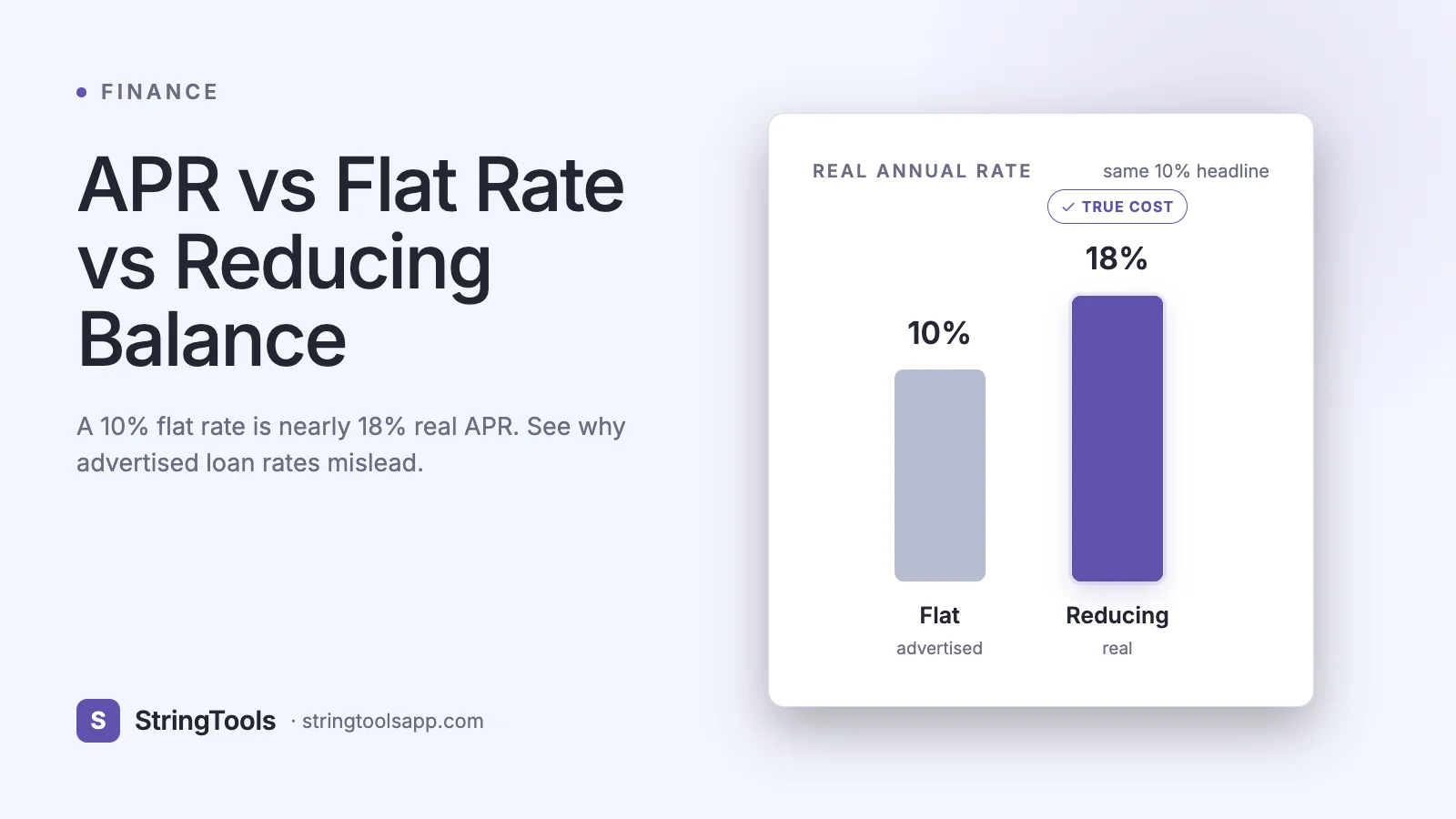
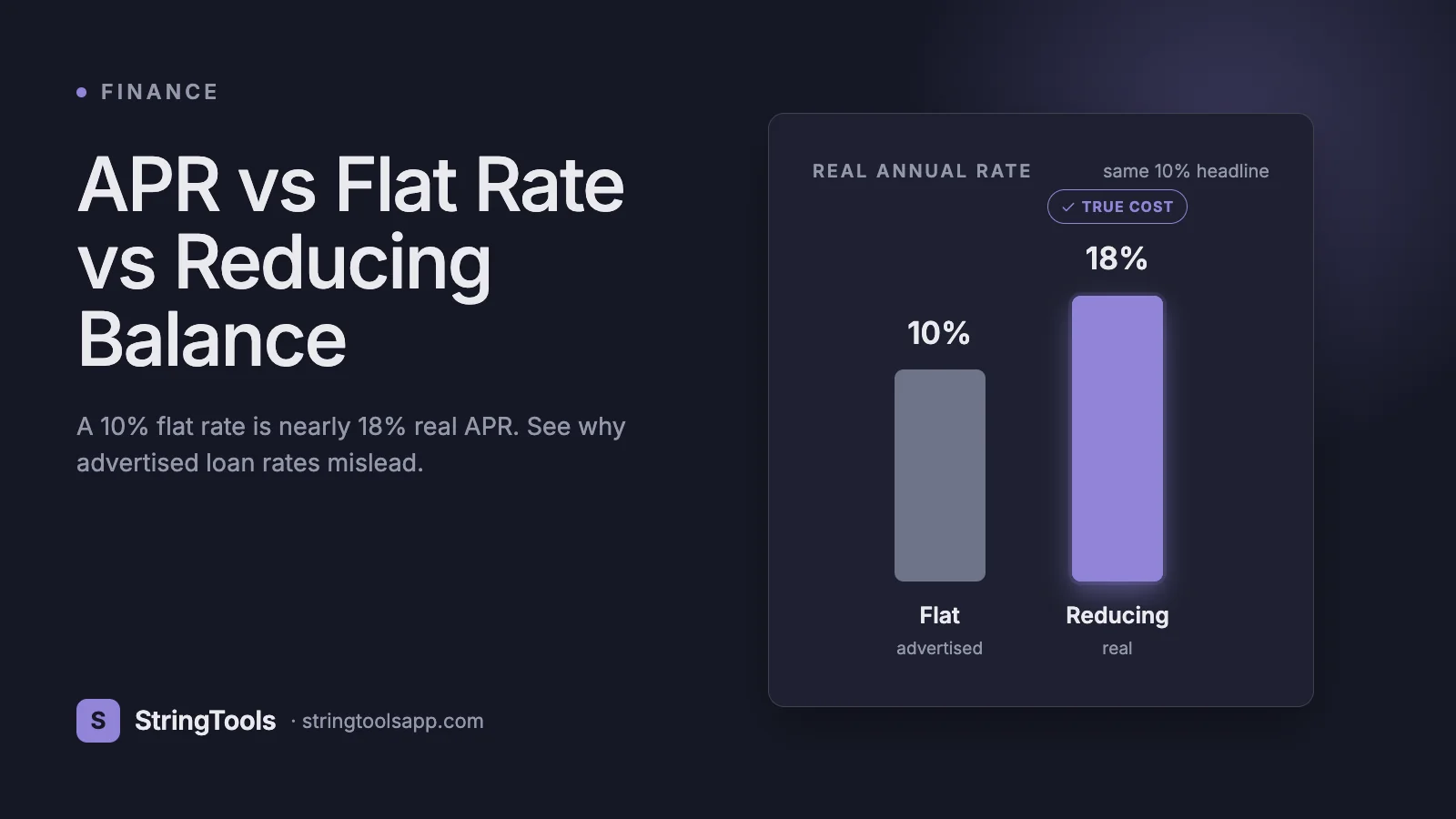
- A flat rate roughly doubles when converted to an honest effective rate: a 10% flat rate over three years works out to approximately 18% APR.
- APR is the standardised, all-in figure — it folds in most compulsory fees and is expressed on a reducing-balance basis, which is why regulators in the US, UK, and EU require it.
- Before signing anything, ask for two numbers only: the APR and the total amount repayable. Everything else is marketing.
Picture two loan adverts side by side. One shouts “9.9% flat rate.” The other quietly lists “15.5% representative APR.” Almost everyone assumes the first loan is cheaper. Almost everyone is wrong. The flat-rate loan can easily cost you more, because the two numbers are not measuring the same thing — they are not even measuring in the same units.
This confusion is not an accident. The way a lender chooses to quote interest is a marketing decision as much as a mathematical one, and the method that produces the smallest-looking headline number tends to win the click. Understanding the three quoting methods is the single most valuable piece of borrowing literacy you can own, and it takes about ten minutes to learn. Once you see it, you cannot unsee it — and you will never be fooled by a headline rate again.
Reducing Balance: How Honest Loans Actually Work
Start with the method that reflects reality, because everything else is measured against it. Reducing balance — often called amortizing — means interest is charged only on the amount you still owe, recalculated every period.
Here is the intuition. When you borrow $10,000, you owe interest on $10,000 in month one. But your first monthly payment pays off some of that principal, so in month two you owe interest on a smaller balance — maybe $9,800. Month by month the balance shrinks, and because interest is charged on that shrinking balance, the interest portion of each payment falls while the principal portion grows. By the final payment, almost the entire instalment is principal.
This is exactly how mortgages, credit cards, and well-regulated personal loans behave. It is the basis of every standard amortization schedule, and it is the calculation behind our loan calculator and EMI calculator. If you want to see the mechanics of how each payment splits between interest and principal over time, our guide on how loan amortization works walks through the full schedule.
The key fairness point: with reducing balance, you only ever pay interest on money you are actually still borrowing. That sounds obvious — you would assume every loan works this way. It does not. Which brings us to the flat rate.
Flat Rate: The Optical Illusion
A flat-rate loan charges interest on the original principal for the entire term — regardless of how much you have already paid back. Your balance falls every month, but the interest does not. You keep paying interest on the full $10,000 even in the final month when you owe almost nothing.
The formula is simple, which is part of its appeal to lenders quoting it:
total interest = principal × flat rate × number of years
Because the interest never reflects the shrinking balance, a flat rate always understates the true cost of borrowing. A 10% flat rate feels like it should be comparable to a 10% credit card, but it is not remotely the same animal. The flat rate is calculated on a number (the original principal) that stops being true the moment you make your first payment.
Flat-rate quoting is widespread on some auto loans, dealer and retail “buy now, pay later” style finance, and consumer loans across India and parts of Asia. In the US, UK, and EU it appears most often in point-of-sale and dealer finance rather than mainstream bank lending — but it turns up often enough that every borrower should recognise it. The giveaway phrases are “flat rate,” “flat interest,” or an interest figure quoted per year with no mention of APR.
The crucial fact every borrower should memorise: a flat rate is roughly half of the equivalent honest rate. Or, flipped around, the real cost is roughly double the flat number. The next section proves it with real figures.
The Worked Example That Exposes the Gap
Let us put a single, identical loan through both methods. All figures are illustrative and rounded for clarity.
The loan: borrow $10,000 over 3 years (36 months). One lender quotes a 10% flat rate. Another quotes a reducing-balance loan. We will calculate what the flat rate truly costs, then find the reducing-balance rate that produces the same monthly payment.
Flat-rate calculation:
- Total interest = $10,000 × 10% × 3 years = $3,000
- Total repayable = $10,000 + $3,000 = $13,000
- Monthly payment = $13,000 ÷ 36 = $361.11
That $361.11 per month looks reasonable. But here is the sting: paying $361.11 a month for 36 months to clear a $10,000 loan is not a 10% loan in any honest sense. Work out the reducing-balance rate that produces that exact payment, and it lands at approximately 17.5–18% — nearly double the advertised flat number.
| Same $10,000 loan, 3 years | 10% flat rate | Reducing balance |
|---|---|---|
| Interest basis | Original $10,000 always | Outstanding balance |
| Monthly payment | $361.11 | $361.11 (to match) |
| Total interest | $3,000 | ~$3,000 |
| Headline rate quoted | 10% | — |
| True effective rate | ~18% | ~18% |
The two loans in that table are the same loan. The only difference is the label on the tin. The flat-rate lender got to advertise “10%” while charging you what is really about 18%. (In pounds, the arithmetic is identical: borrow £10,000 at 10% flat over three years and you repay £13,000 — around 18% on a reducing-balance basis.)
Why does the multiple land near 2x? Roughly speaking, over the life of an amortizing loan your average outstanding balance is a little over half the original principal. So charging the flat rate on the full principal for the whole term is like charging almost double the rate on the balance you actually owe on average. The exact multiple varies with the term — longer terms push it higher — but for typical consumer terms the rule of thumb “flat is roughly half the real rate” holds well. Treat the ~1.8–2x figure as an approximation, not a precise constant.
APR: The Number Regulators Trust
APR — Annual Percentage Rate — exists precisely to kill this confusion. It is a standardised, all-in figure designed so that borrowers can compare two loans on equal footing. Two things make it trustworthy.
First, APR is always expressed on a reducing-balance basis. It answers the honest question: what rate, charged on your outstanding balance, would produce these payments? That is why the flat-rate loan above has an APR near 18%, not 10% — APR refuses to play the original-principal game.
Second, APR folds in most compulsory costs, not just interest. Arrangement fees, mandatory administration charges, and certain other unavoidable costs get baked into the figure. This is why a loan’s APR is usually a touch higher than its raw interest rate: the fees are included. (APR is distinct from APY, the compounding-based figure used for savings — our guide on APR vs APY vs interest rate untangles those.)
The regulatory backing is strong. In the US, the Truth in Lending Act requires lenders to disclose APR so borrowers can compare offers. In the UK, adverts must show a “representative APR” that at least 51% of accepted borrowers receive, which is why you see that phrase everywhere. Across the EU, the Consumer Credit Directive mandates the APRC (Annual Percentage Rate of Charge) on the same principle. Different names, one idea: a single comparable number.
One caveat worth knowing: “representative” APR is the rate offered to the majority, not a guarantee. Your personal APR after a credit check can be higher. So APR is the right number to compare loans — just confirm the APR you are actually offered, not only the one in the advert.
How to Compare Loans Without Getting Fooled
You do not need to be a mathematician to protect yourself. You need a short checklist and one habit.
- Ask which method the rate uses. If a rate is quoted with no “APR” label — especially the words “flat rate” or “flat interest” — assume it understates the true cost and mentally roughly double it before comparing.
- Insist on the APR. Every regulated lender in the US, UK, and EU can give you an APR. If a seller will not or cannot, that itself is a warning sign about the finance on offer.
- Compare the total amount repayable. This single number cuts through every trick. A loan that costs you $13,000 to repay is more expensive than one costing $12,400, no matter how the rates are dressed up.
- Watch the term. A longer term lowers the monthly payment but usually raises total interest, and it widens the gap between a flat rate and its true effective rate.
- Separate the fees. Ask what is bundled into the APR and what is charged on top (early-repayment penalties, insurance add-ons). APR captures most compulsory fees but not every optional one.
The fastest way to see the difference for your own numbers is to run them. Our loan comparison calculator lets you put two offers side by side and see the real cost of each, and our loan calculator shows the full reducing-balance payment for any amount and term. Plug the flat-rate loan’s monthly payment into a reducing-balance tool and you will watch the honest rate reveal itself — usually far above the headline.
The borrower who understands these three methods holds a quiet advantage in every finance conversation. You will spot the optical illusion in a dealer’s brochure, read a credit advert the way a regulator does, and choose the genuinely cheaper loan even when it wears the scarier-looking number. This article is general education, not financial advice; how a lender quotes and calculates interest varies, so always ask for the APR and the total repayable before you sign.
Frequently Asked Questions
Is a 10% flat rate the same as a 10% APR?
No, and the gap is large. A flat rate charges interest on your original loan amount for the whole term, while APR is measured on your reducing balance. A 10% flat rate over three years works out to roughly 18% APR — nearly double. Whenever you see a flat rate, mentally roughly double it before comparing it with any APR figure.
Why does a flat rate roughly double when converted to APR?
Because you repay the loan gradually, your average outstanding balance over the term is a little more than half of the original principal. A flat rate ignores this and charges interest on the full original amount the whole time. Charging the flat rate on money you no longer owe is mathematically similar to charging almost double the rate on the balance you actually owe. The exact multiple depends on the term, so treat “roughly double” as an approximation.
Which loans use reducing-balance interest?
Most mainstream, well-regulated credit uses reducing balance, also called amortizing interest. Mortgages, credit cards, and reputable personal loans all charge interest only on what you still owe. This is the fair method because you never pay interest on money you have already repaid. Standard amortization schedules, like the ones our loan and EMI calculators produce, are all reducing-balance calculations.
Where will I run into flat-rate quoting?
Flat-rate interest is common on some auto loans, dealer and retail point-of-sale finance, and consumer loans across India and parts of Asia. In the US, UK, and EU it shows up most often in dealer and in-store finance rather than mainstream bank lending. The warning signs are the phrases “flat rate” or “flat interest,” or an interest figure quoted with no APR anywhere in the paperwork.
What does representative APR mean in the UK?
Representative APR is the advertised rate that at least 51% of accepted borrowers actually receive. It is required so that adverts cannot showcase an unrealistically low rate that almost nobody gets. Your personal APR after a credit check can be higher than the representative figure. Always confirm the APR you are personally offered rather than relying on the advertised one.
What is the single best number for comparing two loans?
The total amount repayable, backed up by the APR. Total repayable cuts through every quoting trick — a loan costing $13,000 to clear is dearer than one costing $12,400, whatever the headline rates say. APR lets you compare the annual cost on an equal, all-in, reducing-balance basis. Ask any lender for both figures, and run the numbers through a loan comparison calculator before you commit.