

The short answer, and why the number matters
“How much life insurance do I need?” is one of those questions where a bad guess is expensive in both directions. Buy too little and the people who depend on you inherit a shortfall at the worst possible moment. Buy too much — or the wrong type — and you hand an insurer money that could have paid down your mortgage or gone into your pension.
The honest truth is that there is no single right number, but there are two well-established methods that get you very close: the income-multiple rule and the DIME method. This guide walks through both with real arithmetic, then tackles the question most articles dodge — term versus whole life — without pretending one answer fits everyone.
Key Takeaways
- A common rough guide is 10–12× your annual income, but it ignores your specific debts and family, so treat it as a starting point, not a final figure.
- The DIME method (Debt, Income, Mortgage, Education) builds your number from what you actually owe and who actually depends on you — it is more accurate than any multiplier.
- Term insurance is far cheaper than whole/permanent life for the same cover and suits most families with a defined need window (raising children, paying off a mortgage).
- Whole/permanent life is legitimate for lifelong dependents, estate planning and certain tax situations — but it is expensive and its cash value grows slowly in the early years.
- The mainstream “buy term and invest the difference” approach often beats whole life for pure wealth-building, though it relies on you actually investing the gap.
- People with no dependants and no shared debt may need little or no cover at all.
- In the UK, payouts are generally free of income and capital gains tax, and writing a policy in trust can keep it outside your estate for inheritance tax — always check current rules.
Who actually needs life insurance — and who barely does
Life insurance exists to replace the money your death would remove from other people's lives. If nobody is financially worse off when you die, you probably do not need much cover, or any at all.
You likely need meaningful cover if:
- You have children or other dependants who rely on your income.
- You share a mortgage or rent that a partner could not cover alone.
- You have jointly held debt, or debt that would fall on your estate or a guarantor.
- You are a stay-at-home parent whose unpaid work (childcare, running the home) would cost real money to replace.
- You run a business with partners or loans personally guaranteed against you.
You may need little or none if:
- You are single with no dependants and no debt that outlives you.
- Your partner earns enough to be financially fine without your income.
- Your children are grown and financially independent, and your mortgage is paid.
- You have enough assets (savings, pension, property) to self-insure the remaining need.
A quick reality check for the “no cover needed” camp: make sure you are not confusing no income with no cost. A non-earning parent still provides tens of thousands a year in services that would otherwise be bought in. And before you decide savings can cover the gap, confirm those savings are actually there — an unfunded plan is not a plan. If your safety net is thin, sorting out cash reserves first is sensible; our guide on how to build an emergency fund covers that groundwork.
Method 1: The income-multiple rule (fast but blunt)
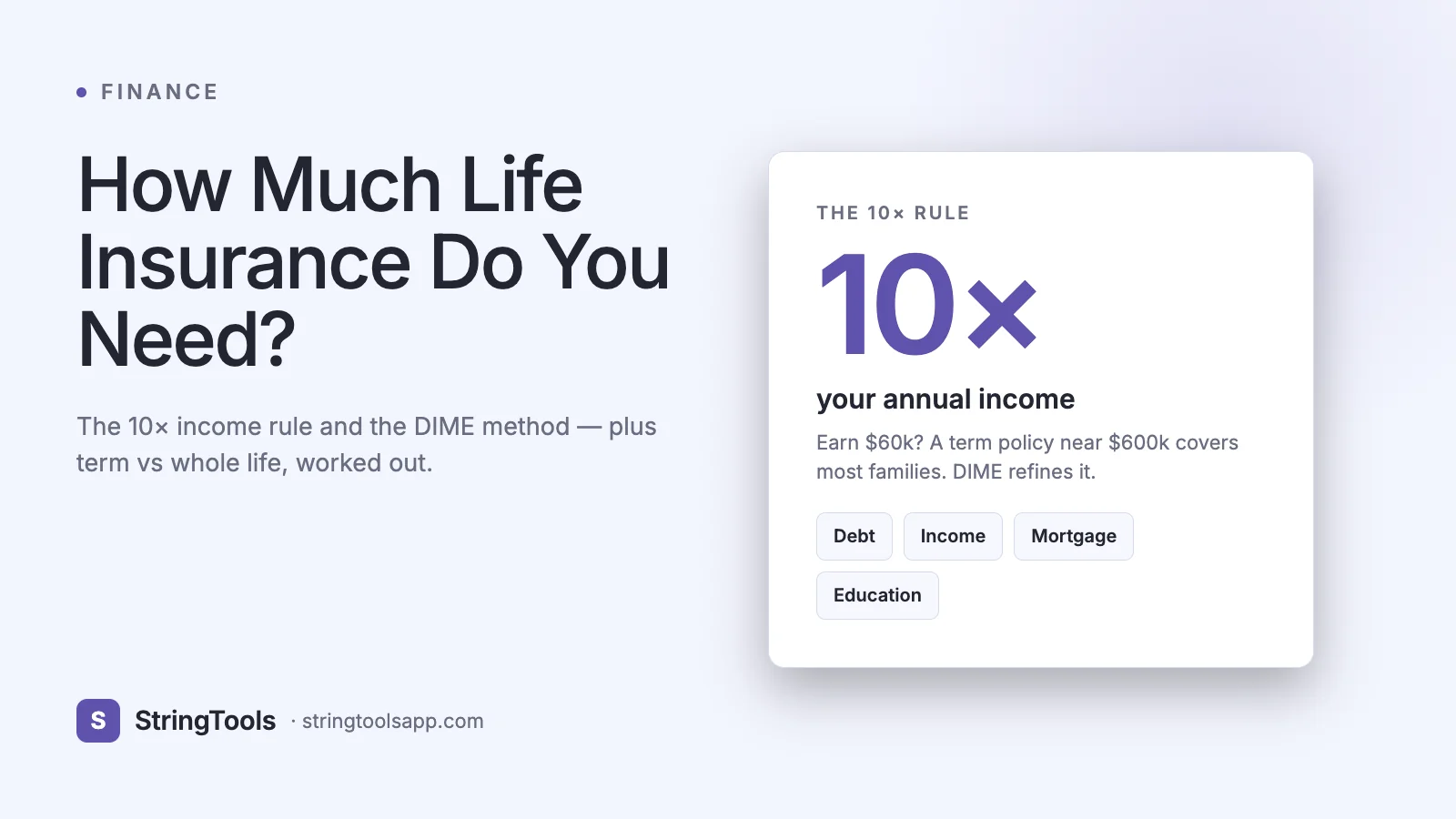
The quickest way to a ballpark figure is to multiply your gross annual income by a factor — commonly 10×, sometimes 12× or more for younger earners with long careers and young children ahead of them.
The logic is simple: a lump sum of 10× your salary, invested sensibly, can throw off an income for years while the capital is gradually drawn down, giving your family time to adjust. If you earn £45,000 a year, the rule points to roughly £450,000 of cover. If you earn $80,000, it suggests about $800,000.
Where the multiple works well: it is fast, it scales with your earning power, and it is a reasonable sanity check against a number you calculated another way.
Where it falls down: it ignores everything specific to you. Two people earning $80,000 can have wildly different needs — one is a renter with no children, the other has three kids and a $400,000 mortgage. The multiple treats them identically, which is exactly why you should not stop here. Use it to get in the right postcode, then switch to the DIME method to find the actual address.
Method 2: The DIME method (build the number from real figures)
DIME stands for Debt, Income, Mortgage, Education — the four buckets that make up most families' financial obligations. You add them up to get a cover figure grounded in your actual life rather than a generic multiplier.
- D — Debt: all non-mortgage debt you would want cleared, plus a realistic allowance for final expenses (a funeral can cost several thousand).
- I — Income: the annual income your family would need to replace, multiplied by the number of years they would need it. A common choice is the years until your youngest child is financially independent.
- M — Mortgage: the outstanding balance, so your family can stay in the home mortgage-free.
- E — Education: the estimated cost of putting your children through education to the level you want to fund.
Here is a worked example. All figures are ILLUSTRATIVE — plug in your own.
| DIME component | Detail (illustrative) | Amount |
|---|---|---|
| D — Debt | Car loan £15,000 + cards £5,000 + funeral £5,000 | £25,000 |
| I — Income | £40,000/yr replaced for 15 years | £600,000 |
| M — Mortgage | Outstanding balance | £250,000 |
| E — Education | Two children, £100,000 each | £200,000 |
| Total cover needed | D + I + M + E | £1,075,000 |
Checking the maths: £25,000 + £600,000 + £250,000 + £200,000 = £1,075,000. That is the gross figure.
Before you buy exactly that, subtract what you already have that would do the same job: existing savings and investments, any life cover through your employer (often 2–4× salary), and any partner's income that continues. If this family already held £200,000 in savings and employer cover, the additional policy they need is closer to £875,000. Notice how far this is from the crude 10× income figure of £400,000 — that is the whole point of DIME.
Term vs whole life: an honest comparison
Once you know how much, the next fork is what type. The two broad families are term insurance (temporary, cheap) and whole or permanent life (lifelong, expensive, with an investment element). Getting this choice right often matters more to your finances than shaving a few thousand off the cover amount.
Term insurance pays out only if you die within a set period — 10, 20 or 30 years, or up to a chosen age. When the term ends, cover stops and there is no payout if you are still alive. Because most policyholders outlive the term, term is dramatically cheaper. In the UK you will see level term (fixed payout), decreasing term (payout falls, often tracking a repayment mortgage) and increasing term (payout rises with inflation). In the US the equivalent is simply level or decreasing term.
Whole/permanent life covers you for your entire life, guaranteeing a payout whenever you die, and builds a cash value you can borrow against or surrender. That guarantee and the investment component make it far more expensive — often five to fifteen times the premium of comparable term cover for a healthy applicant. Exact prices depend on age, health and cover amount, so treat any figure you are quoted as illustrative, not fixed.
| Feature | Term | Whole / permanent |
|---|---|---|
| Covers you for | A fixed period | Your whole life |
| Relative cost | Low | High (much higher) |
| Cash value | None | Yes, grows slowly early on |
| Payout guaranteed? | Only if you die in term | Yes, eventually |
| Best for | Defined need windows | Lifelong needs, estate planning |
When permanent cover genuinely earns its place: you have a dependant who will need support for life (for example a disabled child), you face a likely inheritance-tax bill and want a guaranteed lump sum to cover it, or you have specific estate-planning or business-succession needs. In those cases the “it never expires” feature is the point, and paying for it is rational — not a mistake.
“Buy term and invest the difference” — the maths
The most common mainstream critique of whole life is that you can usually do better by buying cheap term cover and investing the money you didn't spend on expensive permanent premiums. This is the “buy term and invest the difference” strategy, and for pure wealth-building it frequently wins.
The intuition is straightforward. Suppose permanent cover costs £200 a month and equivalent term costs £30. That £170 monthly difference, invested over decades, compounds. The cash value inside a whole-life policy also grows — but early on a large share of your premium goes to fees and the cost of insurance, so the cash value builds slowly in the first years and can be worth little if you surrender early.
You can see why the gap matters by running the difference through our compound interest calculator: £170 a month at a 6% average annual return grows to a substantial sum over 25–30 years — often more than a whole-life policy's cash value over the same period. If the mechanics of that growth are new to you, compound interest explained breaks down why time in the market does the heavy lifting.
The honest caveat: this strategy only works if you actually invest the difference and leave it alone. Whole life is, for some people, a forced-savings mechanism they will stick to when a voluntary investment plan would quietly lapse. Behaviour beats theory. If you know you will invest the gap consistently, term-plus-investing is usually the stronger financial choice; if you know you won't, the comparison is less clear-cut.
How your needs change across life stages
Life insurance is not a set-and-forget purchase. The right amount at 30 is rarely the right amount at 55, so it is worth revisiting your cover after every major life event.
- Young and single, no dependants: often little or no need. A small policy can lock in a low rate while you are healthy, but there is no urgent gap to fill.
- New mortgage or moving in together: a shared mortgage creates a real obligation. Cover sized to the debt (and any joint borrowing) protects your partner from having to sell up.
- First child: typically the peak-need moment. Income replacement, mortgage and future education stack up — this is where DIME numbers are at their largest and term cover is at its most cost-effective.
- Established family, mid-career: review the amount as your mortgage shrinks and savings grow. Your gap may be falling even as your income rises, because your assets are doing more of the work.
- Empty nest, near retirement: children independent, mortgage nearly gone. Many people need far less cover, or none — though some keep a policy for estate planning or a surviving partner.
- Retired with assets: the question shifts from income replacement to whether your estate faces a tax bill your heirs would struggle to pay in cash.
A practical rule: recalculate whenever your debt, dependants, income or mortgage change materially. Your cover should track your obligations down as well as up — there is no prize for being over-insured. Planning the retirement end of this journey deserves its own numbers, which is why we cover it separately in how much do I need to retire.
Tax, trusts, and getting the cover right
A few structural points can materially change the value of a policy to your family, especially in the UK.
Payouts and tax (UK): a life insurance payout is generally free of income tax and capital gains tax for the beneficiary. However, if the policy pays into your estate, the proceeds can form part of your estate for inheritance tax, potentially taxed at 40% above the available threshold. A widely used fix is to write the policy in trust: the payout then goes directly to your chosen beneficiaries, usually sits outside your estate for inheritance-tax purposes, and often reaches them faster because it avoids probate. Trusts are typically free to set up with the insurer, but the right trust and its consequences depend on your situation and on current rules, which change — so confirm the details before relying on them.
A checklist before you buy:
- Calculate your need with DIME, then subtract existing cover, savings and a partner's income.
- Choose the type deliberately — term for a defined window, permanent only if you have a genuine lifelong or estate need.
- Compare quotes; premiums vary widely by insurer, and disclose your health honestly so the policy actually pays out.
- In the UK, ask whether writing the policy in trust makes sense for you.
- Diarise a review for your next major life event.
Get the amount roughly right and the type genuinely right, and life insurance does exactly what it should: it makes sure the people who depend on you are not also worrying about money.
This article is general education, not financial or insurance advice; the right cover type and amount depend on your circumstances and local tax rules, so consult a regulated insurance or financial adviser before buying a policy.
Frequently Asked Questions
Is 10 times my salary enough life insurance?
Ten times your annual income is a reasonable rough guide and a good sanity check, but it is not tailored to you. It ignores your specific mortgage, other debts, the number of years your family would need support, and future education costs. Two people on the same salary can have very different real needs. Use the multiple to get in the right range, then confirm with the DIME method (Debt, Income, Mortgage, Education) for a figure grounded in your actual obligations.
What is the DIME method for calculating life insurance?
DIME is a simple framework that adds up your family's four main financial obligations: Debt (non-mortgage debts plus final expenses), Income (annual income to replace multiplied by the years needed), Mortgage (the outstanding balance), and Education (future costs for your children). You total the four buckets to get a gross cover figure, then subtract what you already have — existing savings, employer life cover, and a partner's ongoing income. The result is far more accurate than any income multiplier because it reflects your real numbers rather than an average.
Is term or whole life insurance better?
For most families with a defined need — raising children and paying off a mortgage — term insurance is better because it is far cheaper for the same cover during the years you need it. Whole or permanent life is genuinely appropriate for lifelong needs, such as a dependant who will need support for life, or estate-planning and inheritance-tax situations where a guaranteed payout matters. The trade-off is cost: whole life can be many times more expensive and its cash value grows slowly in the early years. Choose term for a temporary need and permanent only for a lifelong one.
Do I really need life insurance if I have no children?
Not necessarily. If nobody would be financially worse off when you die — no dependants, no shared mortgage or rent, no jointly held or guaranteed debt — you may need little or no cover. The picture changes if you share a mortgage a partner could not manage alone, have co-signed debt, or support family members financially. A small policy bought while you are young and healthy can lock in a low rate for the future, but there is no urgency to insure a gap that does not exist.
Is a life insurance payout taxed?
In the UK, a life insurance payout is generally free of income tax and capital gains tax for the person who receives it. However, if the money is paid into your estate it can count toward inheritance tax, which may apply above the available threshold. Writing the policy in trust usually keeps the payout outside your estate for inheritance-tax purposes and gets it to beneficiaries faster by avoiding probate. Tax rules differ by country and change over time, so confirm the current position for your situation before relying on it.
What does 'buy term and invest the difference' mean?
It is the strategy of buying inexpensive term insurance instead of costly whole life, and investing the money you save on premiums. Because term cover can cost a fraction of permanent cover, the monthly difference invested over decades can compound into a substantial sum — often more than a whole-life policy's cash value over the same period. The catch is discipline: it only works if you genuinely invest the difference every month and leave it untouched. If you would not stick to that, the forced-savings element of whole life may suit you better in practice.