
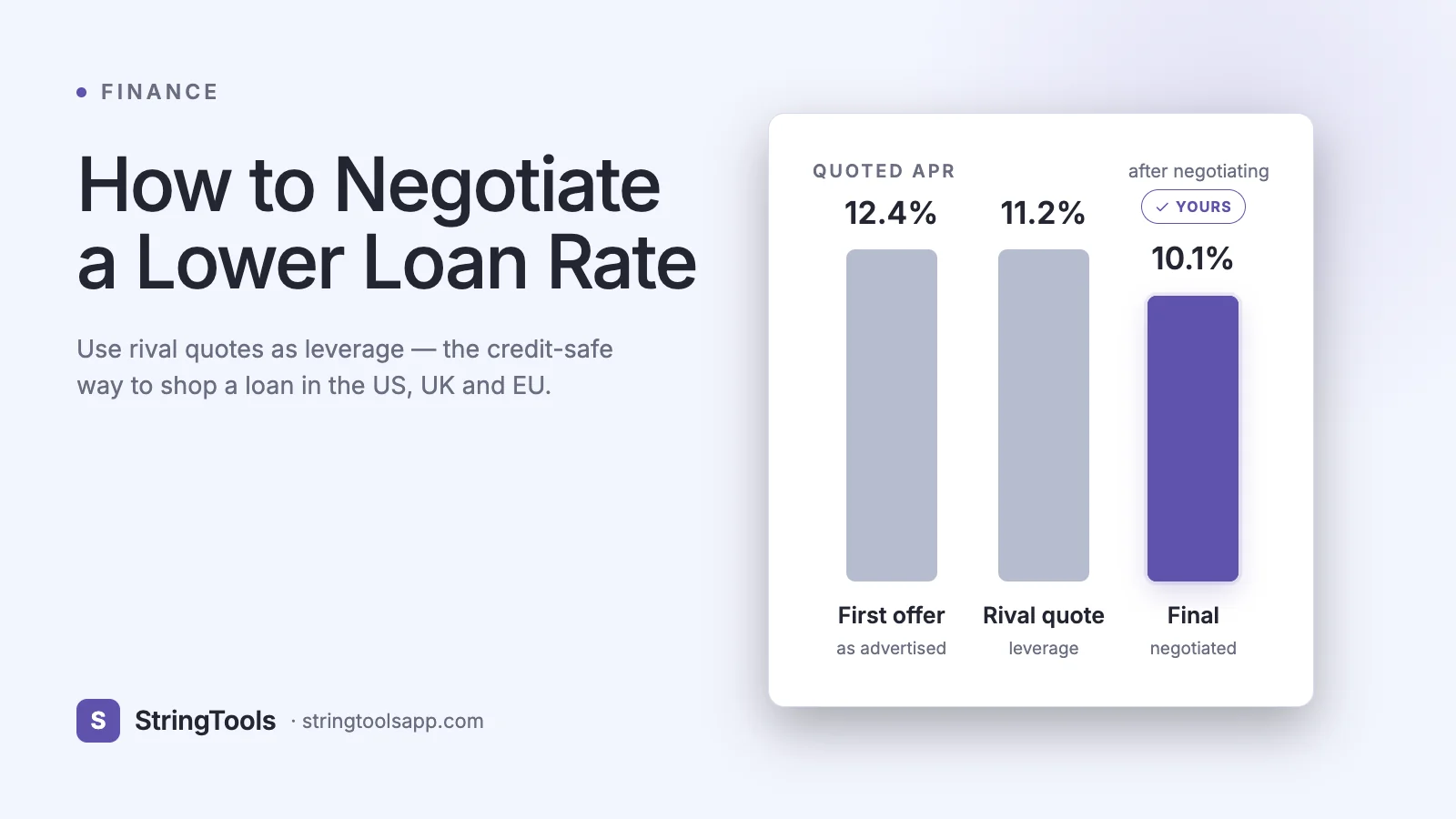
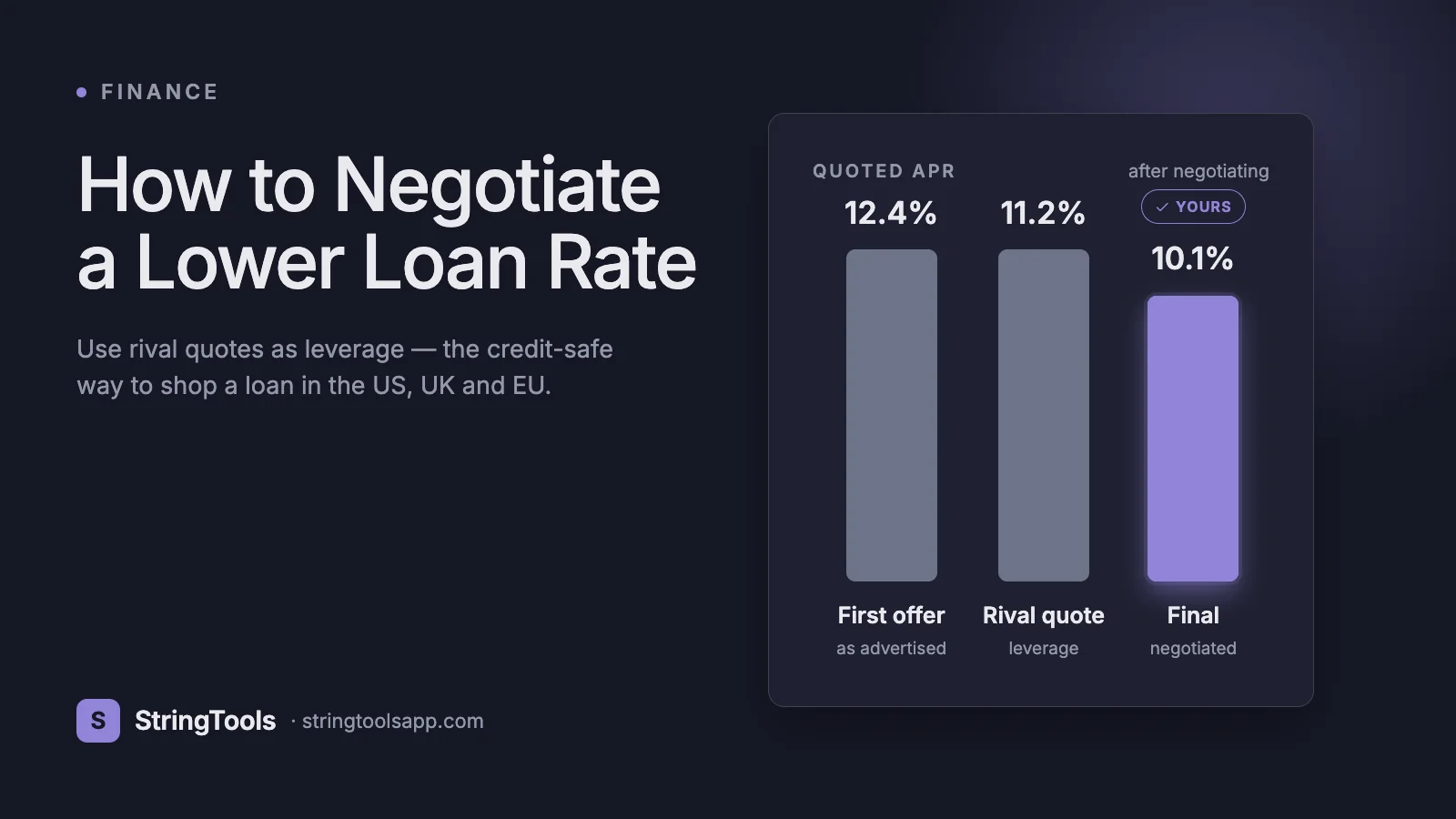
The rate you are quoted is a starting position, not a verdict
Key Takeaways
- Loan rates are set by risk-based pricing, so a lender that wants your business has room to move — a competing offer gives them a reason to use it.
- Gather two to four comparable quotes first: soft-search quotes and eligibility checks in the UK and EU, and pre-approvals in the US, so you have real numbers to leverage.
- Ask the lender you prefer to match or beat the best rival offer in writing, and be ready to send them the competing quote as proof.
- Rate is not the only lever — origination fees, arrangement fees, the term, and cashback are all negotiable and change the true cost.
- Shop inside the credit-safe window: US scoring models treat multiple hard inquiries for the same loan type in a short period as one, and UK soft searches do not affect your score at all.
- Timing helps: lock a rate once you like it, and lenders chasing end-of-quarter targets are often more willing to sharpen a quote.
Most borrowers treat the first number a lender shows them as fixed. It rarely is. Lenders price loans on risk, competition, and their own appetite to lend that month, which means the same borrower can be quoted meaningfully different rates by different institutions on the same day. When you understand why that spread exists, you can use it. This guide shows you how to collect comparable offers, how to ask a lender to beat a rival, what to negotiate beyond the headline rate, and how to do all of it without harming your credit score. Before you talk to anyone, it pays to model the numbers so you can spot a genuinely good offer — our loan comparison calculator lets you line up rate, term, and fees side by side and see the total cost of each.
Why lenders actually have room to negotiate
Lending is a competitive business with thin, volume-driven margins, and three forces give a lender flexibility on the rate they quote you.
The first is risk-based pricing. Lenders do not charge everyone the same rate; they price each applicant according to the risk they represent, using your credit history, income, existing debts, and the loan-to-value or loan-to-income ratio. A strong profile sits in a pricing band where the lender can afford to go lower and still make money. If your file is clean, the quoted rate often has slack built in, because the first offer is calibrated to protect margin, not to win a bidding war.
The second is retention and acquisition targets. Acquiring a new borrower costs money — marketing, credit checks, underwriting time. Once a lender has assessed you and wants to lend, letting you walk to a rival wastes that sunk cost. Many banks and brokers have discretion, sometimes a formal price-match policy, to hold a deal they have already worked on. You are more valuable to them as a closed loan than as a declined quote.
The third is simple market competition. When rates are volatile or lending is slow, institutions compete harder for good applicants. A rival's lower quote is direct evidence of what the market will bear, and it hands the lender a justification to approve a discount they might not otherwise offer. Your job is to turn that evidence into leverage. For the groundwork on where the lowest rates come from in the first place, see our guide on how to get a loan at the lowest interest rate.
Gather comparable quotes the credit-safe way
Leverage only works if your quotes are real and comparable, and the way you collect them matters for your credit score.
In the United Kingdom and much of the EU, start with soft-search eligibility checks. Many lenders and comparison services let you get a quote or a personalised rate through a soft search that does not leave a visible footprint on your credit file and does not affect your score. For a mortgage, a decision in principle gives you an indicative amount and rate on a soft-search basis. Only when you submit a full application does a lender usually run a hard search. So in the UK and EU you can often collect several personalised quotes with zero credit-score cost before you ever formally apply.
In the United States, the equivalent is pre-qualification and pre-approval. Pre-qualification is typically a soft pull; a full pre-approval or application is usually a hard pull. The protection here comes from rate-shopping windows: FICO and VantageScore models are designed to recognise that someone shopping for a single loan will apply to several lenders, so they count multiple hard inquiries for the same loan type within a short window as a single inquiry. The exact length depends on the scoring model in use — commonly cited windows run from about 14 days to 45 days. The practical rule is to cluster your applications for one loan type into a two-week span to be safe across all models.
Make your quotes genuinely comparable. Match the loan amount, the term, and the product type, and compare the APR or representative APR rather than the nominal rate alone, because APR folds in fees. Note whether each rate is fixed or variable. A lower variable rate is not automatically cheaper than a slightly higher fixed one once you weigh the risk. To understand where you sit in the pricing bands before you shop, our guide on what credit score do you need for a loan explains the thresholds lenders use, and if you want to sanity-check how much you can responsibly borrow, read how much loan can I get on my salary.
Dealer, bank, and broker: where competition is fiercest
Where you source quotes shapes how much room there is to negotiate, especially for car and home loans.
For auto loans, dealer financing and direct bank or credit-union financing are two separate markets, and pitting them against each other is one of the most reliable ways to save. A common tactic is to walk into the dealership already holding a pre-approval from your own bank or credit union. That pre-approval is your floor. The dealer's finance office earns money on the loan they arrange, so they often have the ability to beat your bank's rate to keep the financing in-house. If they do, you win; if they cannot, you use the pre-approval you already have. Either way, arriving with an outside offer changes the conversation entirely.
For mortgages and larger personal loans, brokers add a third source of competition. A whole-of-market broker can survey many lenders at once and may access rates not offered directly to the public, while going direct to your existing bank can unlock relationship or retention pricing. Getting both a broker quote and a direct quote gives you two independent numbers to play against each other.
This is exactly the dynamic you want to create. Rather than chasing each lender one by one, gather quotes from a broker and directly from lenders — or a reputable, regulated comparison marketplace — and make multiple lenders compete for the same borrower, which is the position of strength you want before you negotiate anything.
The script: asking a lender to match or beat a rival
Once you hold two or more real quotes, the negotiation itself is straightforward and unemotional. You are not pleading; you are presenting the lender with a business decision.
Go to the lender you would most like to borrow from — often the one with the best service, the most convenient account, or the strongest secondary terms — even if their rate is not the lowest. Tell them plainly that you have a written offer from a competitor at a lower rate, state the exact rate and term, and ask directly: can you match or beat this? Keep it factual. A workable phrasing is: “I would prefer to borrow from you, but I have a firm offer from another lender at 6.9 percent APR over five years. If you can match or improve on that, I will proceed with you today.”
Three things make this land. First, be ready to prove it — offer to email or show the competing quote, because a lender will not discount against a number they cannot verify. Second, signal that you are ready to act now; a lender is far more willing to sharpen a rate for a borrower who will close today than for one who is still browsing. Third, stay willing to walk away. Your leverage is entirely real because you genuinely have somewhere else to go. If they decline, thank them and take the rival offer; if they match, ask them to confirm the new rate and terms in writing before you sign.
Do not bluff with a quote you do not have. If they call it and ask to see the offer, an invented number collapses your credibility and the negotiation with it. Real offers, honestly presented, are what move the price.
What is negotiable beyond the headline rate
The interest rate gets all the attention, but the true cost of a loan is a bundle of terms, and several of them are negotiable. Sometimes a lender who will not touch the rate will happily concede elsewhere, and that can save you as much or more.
Use the table below as a checklist when you compare offers and when you push back on one.
| Lever | What to ask for | Why it moves | Watch out for |
|---|---|---|---|
| Origination or arrangement fee | Reduced or waived fee | It is often discretionary and pure margin for the lender | A low rate paired with a high fee can cost more overall |
| APR versus nominal rate | Quotes compared on APR | APR captures fees, so it reflects true cost | Comparing a nominal rate against a rival APR misleads you |
| Loan term | Shorter term for a lower rate, or a longer one for lower payments | Shorter terms usually carry lower rates and less total interest | Longer terms cut the monthly payment but raise total interest |
| Cashback or incentives | Sign-up cashback or fee credits | Lenders use perks to win borrowers without cutting the headline rate | A perk rarely outweighs a materially higher rate |
| Early repayment terms | No or low early-repayment penalty | Protects you if you refinance or overpay later | Penalties can trap you in a worse deal |
| Rate lock | Locking a quoted rate while you finalise | Shields you from rate rises during processing | Locks can expire or carry a fee |
Always bring the comparison back to the total cost over the life of the loan, not the monthly payment in isolation, because a lower monthly figure achieved by stretching the term can cost far more in interest. Modelling each variation in our loan comparison calculator turns these trade-offs into concrete pound or dollar figures so you can see which concession is actually worth the most.
Timing your move and locking the win
Good timing amplifies every other tactic in this guide.
Cluster your rate shopping into a tight window. As covered above, keeping your applications for a single loan type within roughly two weeks keeps multiple US hard inquiries counting as one, and it also keeps your quotes fresh and comparable since rates and your own circumstances can shift over time. Stale quotes are weak leverage.
Watch the calendar on the lender's side. Many lending teams work to monthly, quarterly, or year-end targets, and a loan officer who is short of a target near the end of a period may have more incentive and more discretion to approve a keen rate. This is not a guarantee, and you should never let a deadline pressure you into a loan you have not fully checked, but it is a genuine tailwind when it lines up.
When you reach a rate you are happy with, lock it. In the US, mortgage rate locks are a standard tool to hold a quoted rate for a defined period while your application is processed, protecting you if the market moves against you before closing. Understand the lock length and whether extending it costs anything.
Finally, close the loop in writing. Verbal agreements evaporate. Get the final rate, fees, term, and any waived charges confirmed in a document before you sign, and read what you sign. The whole point of gathering competing offers is to convert them into a better, verifiable deal — so make sure the deal you agreed is the deal on paper.
This article is general education, not financial advice; what a lender will offer depends on your profile and the market, so compare real quotes and confirm any agreed terms in writing before you commit.
Frequently Asked Questions
Does getting multiple loan quotes hurt my credit score?
Not if you shop the right way. In the UK and much of the EU, many lenders offer soft-search quotes and eligibility checks that leave no footprint and do not affect your score; only a full application triggers a hard search. In the US, pre-qualification is usually a soft pull, and even multiple hard inquiries for the same loan type are grouped as a single inquiry when they fall within a short rate-shopping window. That window is commonly cited as anywhere from about 14 to 45 days depending on the scoring model, so clustering your applications into roughly two weeks is the safe approach.
How many competing offers do I actually need to negotiate well?
Two comparable offers is the practical minimum, because you need at least one rival quote to ask another lender to beat it. Three or four gives you a clearer picture of the true market rate for your profile and stronger leverage. Beyond that you get diminishing returns and risk your quotes going stale. The key is that the offers are genuine, comparable in amount and term, and recent enough to still be valid.
What exactly do I say to ask a lender to beat a rival rate?
Keep it factual and confident. Tell them you would prefer to borrow from them but you have a firm written offer from a competitor, then state the exact rate and term and ask whether they can match or improve on it. Signal that you are ready to proceed immediately if they do, and offer to show the competing quote as proof. Never invent an offer you do not have, because if they ask to see it your credibility collapses.
Besides the interest rate, what else can I negotiate on a loan?
More than most borrowers realise. Origination or arrangement fees are often discretionary and can be reduced or waived, the loan term can be adjusted to trade a lower rate against lower payments, and some lenders offer cashback or fee credits to win your business. Early-repayment penalties are also worth challenging so you keep the freedom to refinance later. Always compare offers on APR and total cost over the life of the loan rather than the monthly payment alone.
Is dealer financing or bank financing better for a car loan?
It depends, which is exactly why you should get both and compare. Arriving at the dealership with a pre-approval from your own bank or credit union sets a floor rate the dealer has to beat to keep the financing in-house, and their finance office often has room to do so. If the dealer beats your pre-approval, take their offer; if not, use the pre-approval you already hold. Having both quotes in hand is what gives you the leverage either way.
What is a rate lock and when should I use one?
A rate lock is a lender's commitment to hold a quoted interest rate for a defined period while your application is processed, which is common for US mortgages. It protects you from rate increases between agreeing a deal and closing it. You should lock once you have a rate you are genuinely happy with and are ready to proceed, since locks have a time limit and extending them can cost money. Always confirm the lock length and any associated fees in writing.