
There is no option that beats inflation for free
You cannot protect savings from inflation without accepting some other risk. The realistic responses are cash that at least matches the inflation rate, inflation-linked government bonds, broad equity exposure over long horizons, and fixed-rate debt that inflation quietly erodes. Each one trades a nominal guarantee for a real one, or the reverse.
Key Takeaways
- Every response that beats inflation introduces a risk of its own. Cash that feels safe is the one option guaranteed to lose in real terms whenever it pays less than inflation.
- The headline savings rate means little by itself. The rate minus inflation decides the outcome.
- Inflation-linked government bonds tie the principal or the interest to a published price index. The instruments, the index and the tax treatment differ by country.
- Broad equity exposure is a long-horizon response, not a short-term shield. Returns are not guaranteed and past performance does not predict future results.
- A mortgage at a fixed rate is eroded by inflation rather than damaged by it: the debt and the payment are fixed in nominal terms.
- The emergency fund is the deliberate exception. Keep it accessible even as it loses real value, because its job is liquidity, not return.
Most articles on this subject go straight to a list of things to buy. This one does not, because which category suits a person depends on their horizon, their tax position and how they behave when a balance falls. What an article can do is set out what each response does and what it costs in exchange.
This is general information, not financial advice, and nothing here recommends any product, provider or allocation. A regulated adviser is the right person for a decision about your own money, and the US Securities and Exchange Commission's Investor.gov publishes plain-language background with nothing to sell.
Two kinds of safety, and you cannot have both
The confusion at the centre of this topic is that "safe" is doing two jobs.
Nominal safety means the number does not fall: deposit an amount in an insured account and it is still there next year, whatever markets do. Real safety means the purchasing power does not fall — the money still buys the same shopping, the same rent, the same replacement boiler.
Cash gives you the first and puts the second at risk. Assets that have historically outpaced prices offer a chance at the second while putting the first at risk. Nothing widely available hands you both with certainty, and any pitch claiming otherwise deserves suspicion.
Time decides which risk matters more. Over a short horizon a fall in value hurts, because you may have to sell into it. Over a long horizon erosion hurts, because it compounds relentlessly in one direction. That is why "what should I do about inflation" cannot be answered until you say when you need the money.
One asymmetry, stated carefully: a fall in a market price can reverse, while purchasing power lost to inflation is not handed back later. That is a difference in the shape of the two risks, not a promise that any particular investment recovers.
The response categories side by side
This is the map, not a recommendation. Read it as "here is what each thing does and what it costs", not as a ranking.
| Response category | What it does about inflation | Main risk it introduces | Horizon it suits |
|---|---|---|---|
| Easy-access cash | Slows erosion if the rate is close to inflation; never reliably beats it | Guaranteed real loss whenever the rate sits below inflation | Days to about 2 years |
| Fixed-term cash deposit | Locks a nominal rate, which is a bet that inflation stays below it | No access during the term; real loss if inflation rises above the locked rate | 1 to 5 years, money you can leave alone |
| Inflation-linked government bonds | Links the principal or the interest to a published price index by design | Price falls if sold before maturity; index lag; tax treatment varies by country | Medium to long, ideally held to maturity |
| Conventional fixed-rate bonds | Nothing. The coupon and principal are fixed in nominal terms | Unexpected inflation hits them hardest of all the categories here | Defined-date needs, accepting the inflation risk |
| Broad equity exposure | Historically has outpaced prices over long periods, with no guarantee | Large falls, long recovery periods, no protection in the short run | 10 years and longer |
| Fixed-rate mortgage debt | Inflation shrinks the real value of the debt and the payment | Only holds while the rate is fixed; borrowing more is a separate decision | The length of the fixed period |
The "main risk" column is not a footnote; it is the price of admission, and the column most people skim. Nothing in the table is mutually exclusive: most households hold several of these at once, for different pots with different dates attached.
Cash: the headline rate is not the point
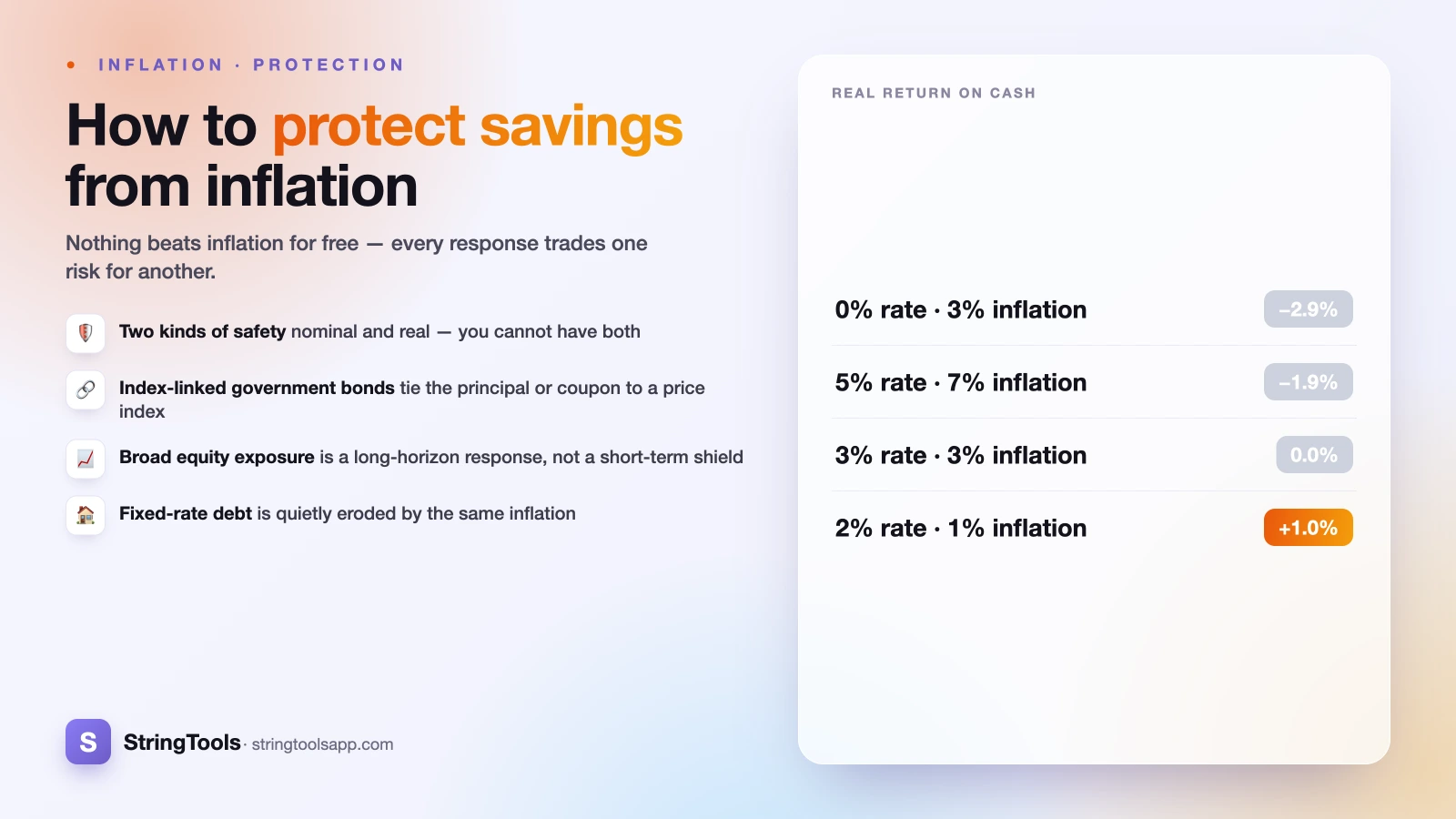
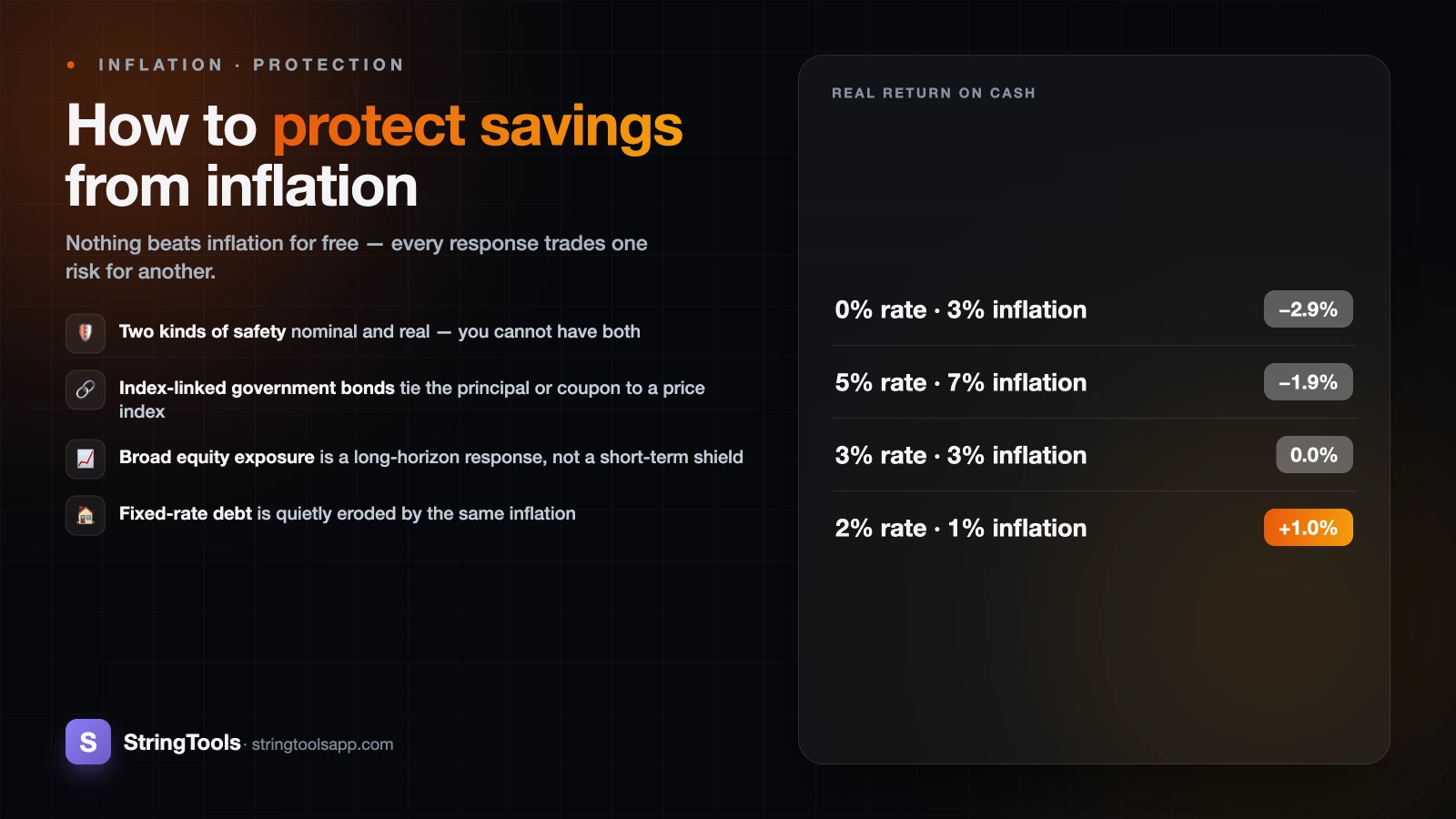
The rate advertised on a savings account is a nominal rate. What it does to your purchasing power depends on what prices are doing at the same time, and the relationship is a ratio of growth factors, not a subtraction:
real return = (1 + interest) / (1 + inflation) - 1
Every row below uses that formula, rounded to one decimal place, with illustrative round numbers rather than current or forecast rates.
| Savings rate | Inflation | Real return | What is actually happening |
|---|---|---|---|
| 0% | 3% | -2.9% | Full erosion, nothing offsetting it |
| 1% | 3% | -1.9% | Erosion slowed by roughly a third |
| 2% | 1% | +1.0% | A modest real gain on a modest headline rate |
| 3% | 3% | 0.0% | Standing still: the balance grows, buys the same |
| 4% | 3% | +1.0% | Same real outcome as the 2% row above |
| 5% | 2% | +2.9% | The best real result in this table |
| 5% | 7% | -1.9% | The highest headline rate, still losing ground |
Read the 2% row against the 5%-with-7%-inflation row. The account paying 2% is doing better for its owner than the one paying five, by a wide margin. That is the argument against judging savings by the number on the poster. Why subtracting inflation slightly overstates the answer is worked through in real vs nominal returns.
Three practical notes, none of which require buying anything:
- Moving to a better rate is close to free. It will not solve inflation, but narrowing a negative real return costs nothing except paperwork.
- Watch introductory and bonus rates. An account that drops after twelve months moves you down the table above while you are not looking.
- A fixed term locks the nominal rate, and therefore locks a bet. If inflation runs above the rate you fixed, you have committed to a negative real return with no exit. That can still be right for money with a date on it; it is not risk-free.
To see what a given combination does to a specific amount over a specific number of years, run your own figures through the inflation calculator.
Inflation-linked government bonds: what the link actually does
Several governments issue bonds whose return is defined relative to a price index rather than as a fixed nominal number. The mechanism comes in two forms. In the more common one, the principal is uprated in line with a published consumer price index and a fixed coupon rate is applied to the uprated principal, so both the interest and the sum repaid at maturity move with the index. In the other, the interest payment itself is set by reference to the index while the principal stays fixed. Either way the intent is the same: a return defined above measured inflation, rather than a fixed number that inflation then eats.
The details are national, and they matter:
- The index differs, and some countries have changed which measure they apply to new issues. Any index is an average of a representative basket, not your personal inflation rate.
- There is a lag, because a month's index is not published until after the month ends.
- Deflation terms differ. Some issues guarantee repayment of at least the original principal; others can repay less if the index falls.
- Selling early is not protected. The link governs the cash flows, not the market price. Sell before maturity and you get the market price, which moves with real yields and can be below what you paid.
- Tax treatment varies, sometimes awkwardly. In some countries the inflation uplift is taxed in the year it accrues, before it has been received in cash. In others this debt attracts relief, and some tax-sheltered account types remove the question entirely.
So the category does something no other cash-like instrument does, while adding timing, pricing and tax complications that are country-specific. The authoritative source is your own government's debt-management or treasury body, which publishes the terms of its issues.
Equity exposure: a long-horizon response, not a shield
The reasoning here is structural rather than magical. Companies sell at prices that rise and pay costs that rise, so over long periods nominal revenues and earnings tend to move with the general price level, and broad equity markets in many countries have grown faster than consumer prices. That is a description of history, not a promise: it has not held in every country or every decade, and it says nothing about the next ten years.
The risks are specific and worth stating without softening:
- Falls are large and can last. Broad markets have repeatedly fallen a long way and taken years to recover. Anyone needing the money in that stretch turns a paper fall into a realised loss.
- Shares are a poor short-term inflation hedge. When inflation surprises upward, equities have often fallen at the same time rather than rising to compensate.
- Sequence matters when you are withdrawing. A bad run early in a drawdown period does more damage than the same run later, because you are selling units into it.
- Returns are not guaranteed and past performance does not predict future results.
Which is why the horizon question comes first. If money is needed inside a few years, volatility risk dominates erosion risk whatever inflation is doing. If it genuinely will not be touched for a decade or more, the arithmetic in what inflation does to your savings shows how expensive doing nothing becomes over the same stretch. How you get that exposure, and in what proportion, is the personal decision this article will not make for you.
The fixed-rate mortgage that inflation is quietly repaying
This one surprises people, and it is a genuine effect rather than a trick of framing.
A mortgage at a fixed rate is a fixed nominal debt with a fixed nominal payment. Inflation changes neither number. It changes everything around them: prices rise, and over time nominal wages tend to follow. The debt shrinks in real terms without you paying a penny extra, and the payment falls as a share of a rising income.
Take a payment fixed at 1,000 a month, with prices rising at an illustrative 3% a year — the rate used in the table above. In today's purchasing power that payment is worth about:
| Years from now | Nominal payment | Worth in today's money |
|---|---|---|
| 0 | 1,000 | 1,000 |
| 5 | 1,000 | 863 |
| 10 | 1,000 | 744 |
| 20 | 1,000 | 554 |
The lender receives the same 1,000 throughout; you hand over progressively less real value to produce it, and the outstanding balance behaves the same way. The caveats are not small:
- It only holds while the rate is fixed. On a variable or tracker rate the opposite can happen, because central banks typically respond to inflation by raising policy rates, which raises your payment.
- It depends on your income actually rising. If your earnings do not move with prices, the payment stays exactly as heavy as it was.
- This is a mechanism, not a reason to borrow more. Taking on debt you cannot service to capture an erosion effect is a bad trade.
The symmetry is worth seeing: the same force that erodes a borrower's debt erodes a saver's deposit. Both sit on opposite sides of one mechanism.
The emergency fund is the exception you keep on purpose
Everything above pushes one way: cash loses in real terms, so hold less of it. The emergency fund is where that logic must stop, and this is the point that matters most for ordinary savers.
An emergency fund is not an investment with a poor return. It is an option, and what it buys is the ability to meet a sudden cost without selling something at a bad moment or borrowing at an unsecured rate. Judging it by return is as wrong as judging an insurance premium by its investment growth.
The cost is small and calculable. An illustrative fund of 6,000 held at a real return of -2% loses roughly 120 of purchasing power over a year. That is the annual premium. One event that forces you to sell a long-term holding during a market fall, or to carry an unsecured balance for months, will usually cost more than that in a single go.
There is also a correlation problem. The circumstances that trigger a need for emergency money, redundancy above all, cluster in exactly the periods when markets are down. A fund held in volatile assets is likely to be smallest at the moment it is needed, which defeats the point of holding it.
So the response to inflation is not to make the fund risky. It is to size it deliberately, keep it in the best-paying instant-access home you can find, and raise the amount when your expenses rise — this is the one place where inflation should actively make the fund bigger. If you have not set the figure yet, the sizing method is in how to build an emergency fund.
Questions to work through, in order
The useful output of all this is not a shopping list. It is a sequence to run on your own numbers, in this order, because each answer narrows the next question.
1. Put a date on every pot of money. Not a vague intention, a date. Money needed within a couple of years is a cash problem whatever inflation is doing.
2. Separate the pots. Spending, emergency fund, known medium-term costs, long-term money. Merging them forces one answer onto four horizons.
3. Check the real return on each cash pot. Run (1 + interest) / (1 + inflation) - 1 on each account. You are looking at how negative it is, not whether it is negative.
4. Restate long-term targets in today's money, then inflate at the end. A target set in future nominal currency is almost impossible to sanity-check.
5. Ask what you would do if the balance fell by a third. If the honest answer is "sell", the horizon is shorter than you told yourself, and that changes the category before you commit any money.
6. Audit anything defined as a flat amount — sums insured, standing contributions, deductibles, the price on a contract you issue. They shrink in real terms until somebody updates them, and nobody sends a reminder.
7. Write down the rate you assumed, then run the plan again two points higher. The spread tells you more than either number alone.
That tells you which category your problem falls into. It will not tell you what to hold, and it is not meant to: that choice depends on your tax position, other assets, income security and temperament under a falling balance, which is a conversation for a regulated adviser. For the figures behind step 3, use the source rather than a headline — the UK publishes consumer price statistics through the Office for National Statistics, the US through the Bureau of Labor Statistics.
Frequently Asked Questions
What is the safest way to protect savings from inflation?
There is no option that is safe in both senses at once. Cash is safe from falling in nominal terms and guaranteed to lose in real terms whenever it pays less than inflation. Inflation-linked government bonds define their return relative to a price index, but carry price risk if sold early and tax treatment that varies by country. Broad equity exposure has historically outpaced prices over long periods, with no guarantee and large interim falls. Which of these fits is a personal decision for a regulated adviser.
Do inflation-linked government bonds guarantee you beat inflation?
No. The link governs the cash flows, not the outcome in every circumstance. Indexation is applied with a lag, the index used is a national average rather than your own inflation rate, selling before maturity gets you the market price rather than the indexed value, and in some countries the inflation uplift is taxed in the year it accrues even though it is not received until maturity. The terms differ by country and are published by each government's own debt-management body.
Should I move my emergency fund into investments to beat inflation?
The job of an emergency fund is liquidity, not return, so losing a little real value each year is the price of the option rather than a mistake. There is also a correlation problem: the events that trigger a need for emergency cash, redundancy above all, cluster in periods when markets are down, so an invested fund is likely to be smallest exactly when it is needed. The better responses are to size it deliberately, keep it in the best-paying instant-access home available, and raise it as your expenses rise.
Does inflation reduce my mortgage debt?
In real terms, yes, while the rate is fixed. The balance and the payment are both fixed nominal amounts, so rising prices shrink what they represent. At an illustrative 3% a year, a payment fixed at 1,000 a month is worth about 744 in today's money after ten years and 554 after twenty. Two conditions apply: it only holds while the rate is fixed, since variable rates can rise as central banks respond to inflation, and the relief is only felt if your own income rises with prices.
Is a high savings interest rate enough to beat inflation?
Not on its own, because the headline rate is only half the calculation. What matters is (1 + interest) / (1 + inflation) - 1. An account paying an illustrative 2% while inflation runs at 1% gives a real return of about +1.0%, while an account paying 5% while inflation runs at 7% gives about -1.9%. The lower headline rate is the better outcome. Compare every rate against inflation rather than against other accounts.
How much cash is too much to hold?
There is no universal figure, but there is a test. Cash held against a known cost with a date inside the next couple of years is doing its job, and so is a deliberately sized emergency fund. Cash beyond that, with no date and no assigned purpose, is the portion paying a guaranteed real cost for no corresponding benefit. The fix is to give every pot a date and a job, then decide about the leftover, rather than to make the money you might need next month riskier.
Sources and references
Investor.gov (investor.gov) · Office for National Statistics (ons.gov.uk) · Bureau of Labor Statistics (bls.gov). Content was reviewed against these sources as of the last-updated date above; external figures and rules may change after publication.