
The three numbers a deposit plan needs
To save for a house deposit, first size the target properly: the deposit itself is the purchase price multiplied by the deposit percentage, plus the buying costs that have to be paid in cash on top. Then subtract what you already hold, divide the gap by the months until you want to buy, and check the monthly figure against your income before you commit to it.
Key Takeaways
- The deposit is not the whole cash requirement. Transaction taxes, legal fees, surveys, searches and moving costs are paid in cash at the same time, and they are the reason buyers arrive at completion short.
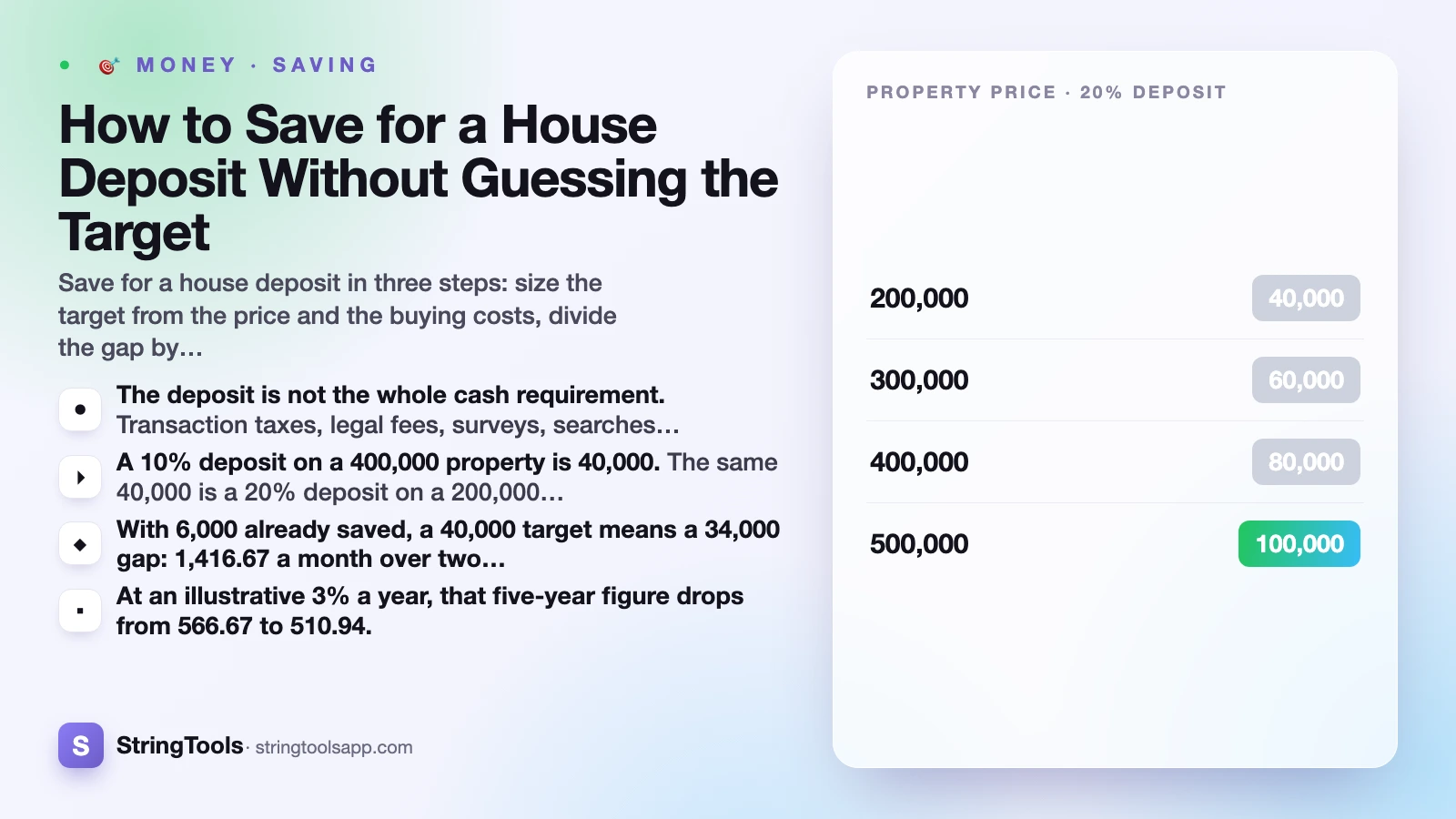
- A 10% deposit on a 400,000 property is 40,000. The same 40,000 is a 20% deposit on a 200,000 property, which is why the target must come from a price range you have actually researched, not from a round number.
- With 6,000 already saved, a 40,000 target means a 34,000 gap: 1,416.67 a month over two years, 566.67 over five, or 404.77 over seven.
- At an illustrative 3% a year, that five-year figure drops from 566.67 to 510.94. Useful, but not the thing that decides whether you get there.
- A deposit you need within about five years is a cash goal. The reasons are set out in saving or investing for a goal.
- This is general information, not personal financial advice, and property taxes and mortgage rules differ by country.
Step one: size the target from a price, not a feeling
A deposit target is a percentage of a specific number. Start with the price range of the kind of property you would actually buy, in the area you would actually buy it, and work from the upper end of that range rather than the lower one.
Here is what each deposit percentage costs across a spread of prices. Every figure is just the price multiplied by the percentage, so you can extend the table to your own numbers in a moment.
| Property price | 5% deposit | 10% deposit | 15% deposit | 20% deposit |
|---|---|---|---|---|
| 200,000 | 10,000 | 20,000 | 30,000 | 40,000 |
| 300,000 | 15,000 | 30,000 | 45,000 | 60,000 |
| 400,000 | 20,000 | 40,000 | 60,000 | 80,000 |
| 500,000 | 25,000 | 50,000 | 75,000 | 100,000 |
Two things fall out of that grid. The first is that the deposit percentage matters more than the price for most savers: dropping from 20% to 10% on a 300,000 property halves the cash you need, while shopping 50,000 cheaper only saves 5,000 at a 10% deposit. The second is that a larger deposit is worth more than the cash it represents, which is the next section.
Then add the costs that are not the deposit. Depending on where you buy, these can include a transaction or stamp tax, conveyancing or attorney fees, a survey or inspection, searches, lender or broker fees, buildings insurance from exchange, and the removal van. They are paid in cash, they do not come out of the mortgage, and they are the single most common reason a deposit plan lands short. Look up the rules that apply to you rather than assuming: in the UK the transaction tax and its thresholds are set out on GOV.UK, and the amounts and bands change, so check them in the year you buy rather than trusting a figure you read earlier.
Why the deposit percentage buys you more than the deposit
Lenders price a mortgage partly on loan-to-value, which is the loan as a percentage of the property's value. A bigger deposit means a smaller loan against the same property, which means a lower loan-to-value, and lenders generally reserve their better pricing for lower bands.
Those bands tend to sit at round numbers, commonly at 95%, 90%, 85%, 80% and 75% loan-to-value, though the exact ladder differs by country and by lender and changes over time. The practical consequence is that the last few thousand before a band can be worth much more than the few thousand before that. Saving an extra 5,000 that takes you from a 91% loan-to-value to 89% may change the rate you are offered; the same 5,000 taking you from 89% to 87% usually does not.
That is worth knowing before you fix your target. If your researched price range puts you just above a band, pushing the deposit to the band is often the highest-value change you can make to the plan, and it costs less than waiting another year.
What a bigger deposit does not do is make the house affordable on its own. The monthly payment, the running costs and the stress-tested income requirement are a separate question, worked through in how much house can I afford.
Step two: turn the gap into a monthly figure
Take the target, subtract what you already hold for it, and divide by months. Say the target is 40,000, including an allowance for the buying costs, and you have 6,000 set aside. The gap is 34,000.
The table below solves that gap two ways. The first column assumes the money earns nothing, which is the safe way to plan. The second assumes an illustrative 3% a year, compounded monthly, purely to show the size of the effect. It is not a rate on offer, not a prediction, and no return is guaranteed.
| Timeline | Monthly at 0% | Monthly at an illustrative 3% |
|---|---|---|
| 2 years | 1,416.67 | 1,361.37 |
| 3 years | 944.45 | 888.77 |
| 4 years | 708.34 | 652.57 |
| 5 years | 566.67 | 510.94 |
| 7 years | 404.77 | 349.26 |
The interest column saves between 55 and 56 a month at every horizon here. Take it, but do not build the plan on it. What actually moves the monthly figure is the timeline and the target.
The savings goal calculator solves the same equation with your own numbers, including a starting balance and an optional rate, and will tell you the month you land on rather than a count of months. It also flags a plan that would take more than roughly 20% of the income you enter, which matters here: a deposit plan is usually the largest single goal a household runs, and it is competing with rent at the same time.
The problem nobody warns you about: the target moves
A deposit is a percentage of a price that is not under your control. If prices in your area rise while you save, a fixed cash target quietly becomes a smaller deposit percentage, and you can save diligently for four years and end up further from the band you were aiming at.
There is no way to remove that risk from a cash savings plan, and you should be suspicious of anything that claims to. What you can do is manage it.
Re-price the target once a year rather than once at the start. Look at what the kind of property you want is actually selling for, not what it is listed at. In the UK, sold prices are published by HM Land Registry and the housing statistics are at the Office for National Statistics; most countries have an equivalent official source, and a national statistics office is a better guide than a property portal's headline.
Express the target as a percentage as well as a number, so that when you re-price it you can see whether you are gaining or losing ground in the terms that matter to a lender.
And prefer the shorter plan where you can sustain it. Not because the money grows faster, but because a shorter plan gives the target less time to move.
Where to keep a deposit you will need in a few years
A house deposit has two features that decide where it belongs: you need the whole amount on a date that is not fully in your control, and a shortfall on that date does not just delay the purchase, it can collapse a chain.
That rules out anything whose value could be lower on the day you need it. It also rules out anything you cannot reach in time, because completion dates move earlier as well as later.
In practice that leaves cash held in accounts you can access quickly, at institutions covered by your country's deposit protection scheme, within the protected limit. In the United States that protection is explained by the FDIC for banks, with an equivalent scheme for credit unions; other countries run their own. Where a government offers a tax-advantaged account specifically for first-time buyers, that is worth researching on the relevant tax authority's own site, because eligibility rules and withdrawal penalties are strict and they change.
A fixed term that matures after your expected completion date is a common mistake. So is holding the deposit in the same account as everything else, where it becomes the balance you dip into. Keep it separate and keep it boring.
The longer argument about what belongs in cash and what does not is in saving or investing for a goal, and the general principles of investment risk are set out by the SEC's investor education service at Investor.gov.
What to check every three months
A deposit plan runs for years, which means it needs a review rhythm or it drifts. Four things are worth checking each quarter, and it takes about fifteen minutes.
Is the transfer still going out on the day after payday, at the full amount. A transfer that was reduced once during a hard month and never restored is the most common quiet failure.
Has the target moved. Re-price annually, but note anything dramatic sooner.
Is the money still where you decided to put it, still accessible, and still within protection limits as the balance grows. This one catches people late in the plan, when the balance crosses a threshold.
And has anything else been quietly funded from the same money. A deposit pot that also absorbed a holiday and a car repair is not behind because of the market; it is behind because it was doing three jobs.
If you want the habit side of this rather than the arithmetic, how to set a savings goal you will actually hit covers automating the transfer and keeping the plan under the share of income that people actually sustain.
Frequently Asked Questions
How much deposit do I need for a house?
It depends on the lender, the country and the property, but the deposit is always the purchase price multiplied by a percentage. A 10% deposit on a 400,000 property is 40,000; the same 40,000 is 20% of a 200,000 property. Size the target from a price range you have researched, then add the buying costs that must be paid in cash on top.
How long does it take to save a house deposit?
Divide the gap by what you can save each month. With 6,000 already saved and a 40,000 target, the 34,000 gap takes 1,416.67 a month over two years, 566.67 over five years, or 404.77 over seven. Most households are choosing the timeline that fits the monthly figure they can sustain, rather than choosing the monthly figure.
Should I invest my house deposit to get there faster?
For a deposit needed within about five years, most guidance points to cash, because the amount has to be intact on a date you do not fully control and a shortfall can collapse a purchase. Growth is not guaranteed and a fall close to the date cannot be waited out. The trade-off is explained in full in our post on saving or investing for a goal, and a regulated adviser is the right person to ask about your own case.
Does a bigger deposit actually save me money?
Usually, because lenders price on loan-to-value and reserve better pricing for lower bands, which commonly sit at round numbers such as 90%, 85% and 80%. That makes the last few thousand before a band worth more than the few thousand after it. The bands and the pricing differ by lender and country and change over time, so check what applies when you apply.
What costs should I add to the deposit target?
Whatever your country requires in cash at purchase: a transaction or stamp tax, legal or conveyancing fees, a survey or inspection, searches, lender or broker fees, insurance from exchange, and moving costs. These do not come out of the mortgage. Look up the current rules on your tax authority's own site, since thresholds change from year to year.
What if house prices rise while I am saving?
A fixed cash target becomes a smaller deposit percentage, so you can save consistently and still lose ground against a lender's bands. You cannot remove that risk from a cash plan. Re-price the target once a year from official sold-price statistics rather than listings, track the target as a percentage as well as a number, and prefer the shortest timeline you can genuinely sustain.
Sources and references
GOV.UK (gov.uk) · Office for National Statistics (ons.gov.uk) · FDIC (fdic.gov) · Investor.gov (investor.gov). Content was reviewed against these sources as of the last-updated date above; external figures and rules may change after publication.