
A wedding is a deadline goal, and the deadline is not the day
To save for a wedding without borrowing, work backwards from the payment dates rather than the wedding date. Suppliers take deposits at booking and final balances several weeks before the event, so the money has to be ready earlier than the day itself. Size the total, map when each portion falls due, then fund the earliest date first.
Key Takeaways
- A wedding is the rare savings goal with a hard date. You cannot extend it by three months when a bill lands, which is what makes the planning different from every other goal.
- The money is not needed as one lump on the day. Deposits are due at booking and final balances are typically due weeks in advance, so the real deadline is earlier than the date on the invitation.
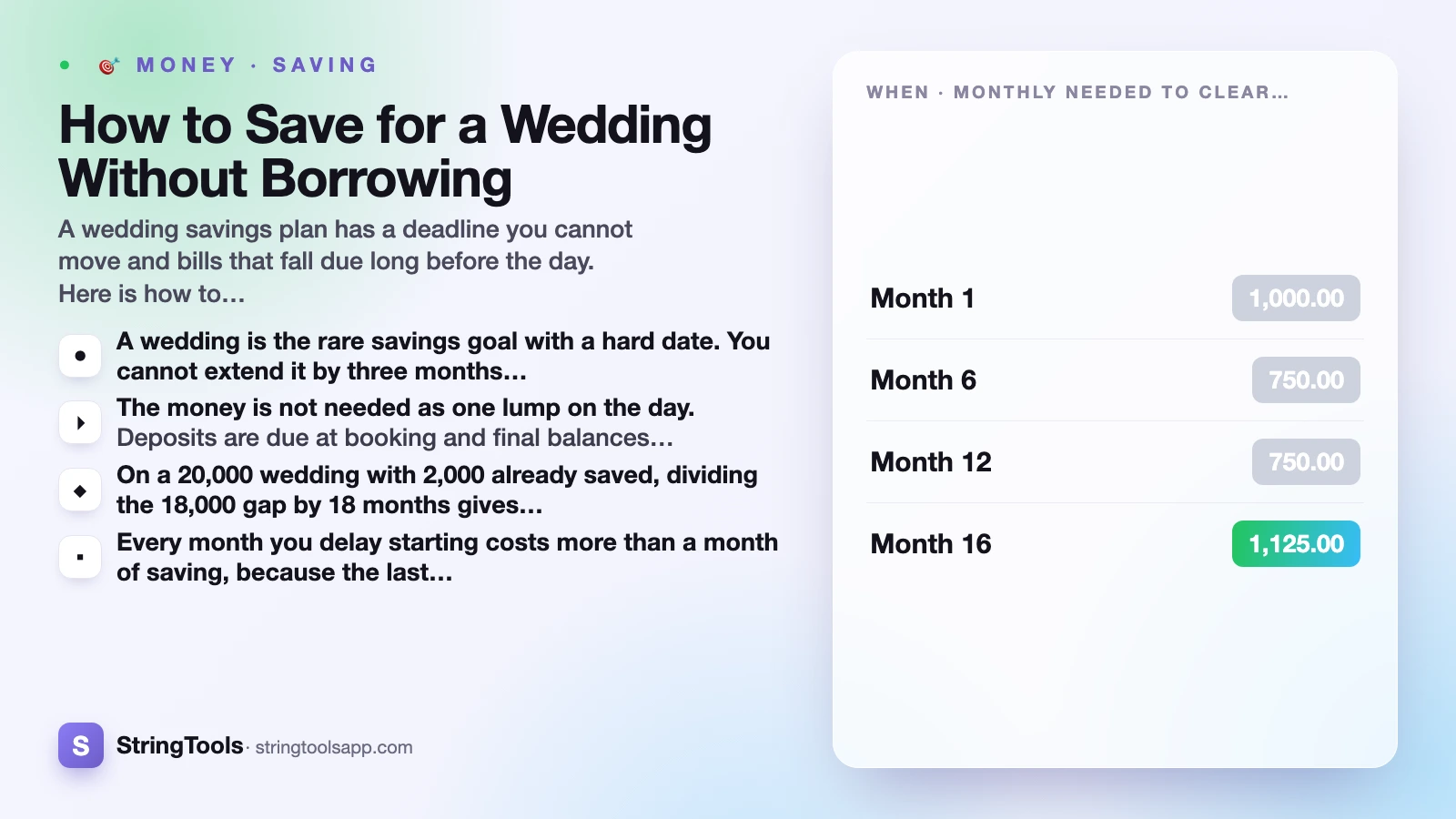
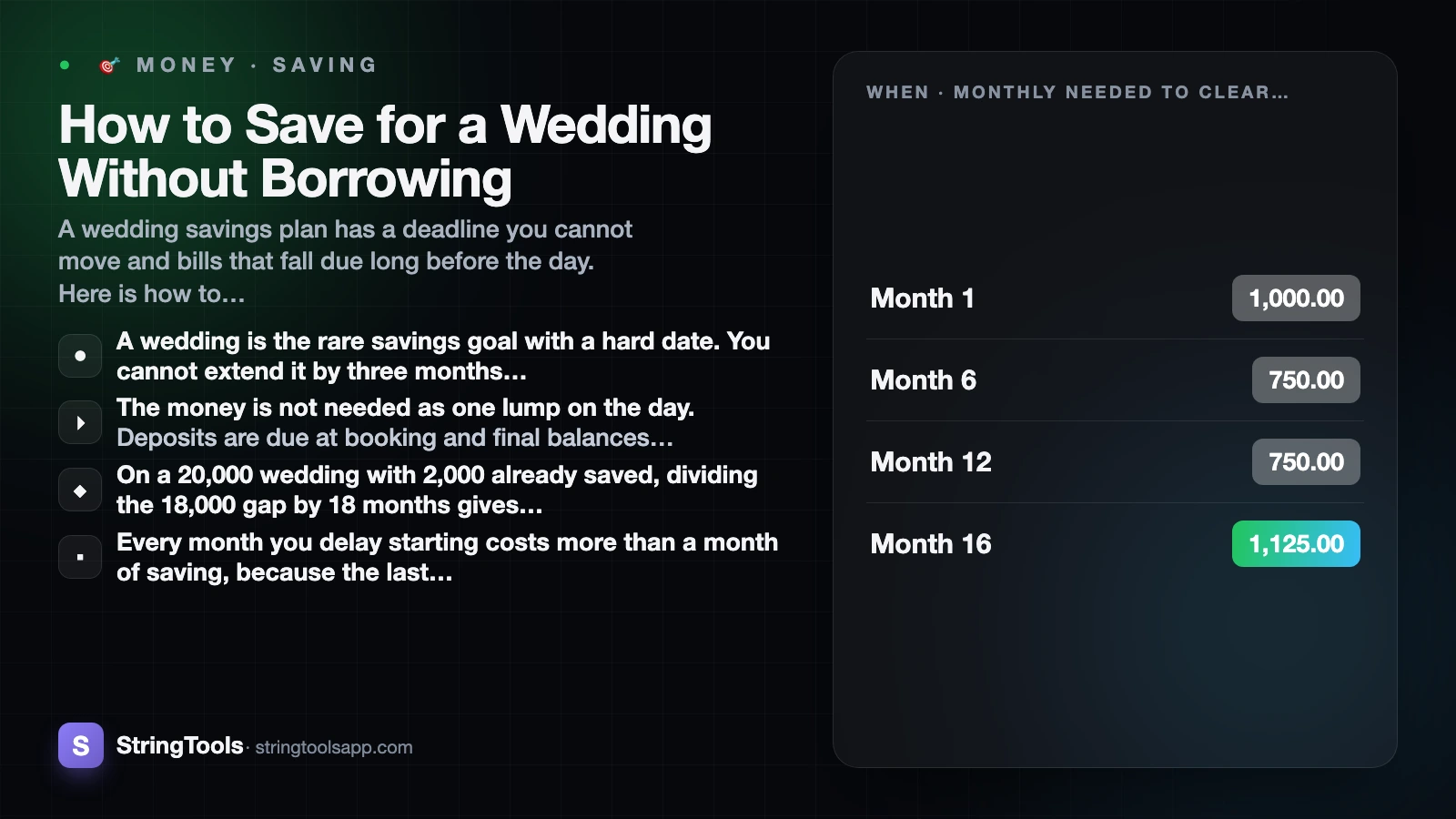
- On a 20,000 wedding with 2,000 already saved, dividing the 18,000 gap by 18 months gives 1,000 a month. Staging the actual payment dates gives 1,125 a month. The naive figure is 11% short.
- Every month you delay starting costs more than a month of saving, because the last payment date does not move: the same 18,000 gap needs 1,125 a month when the wedding is 18 months away and 1,800 when it is 12 months away.
- Interest is close to irrelevant over this horizon. At an illustrative 3% a year the 1,125 becomes 1,099.06, a difference of about 26 a month. That 3% is an illustration, not a rate on offer and not a forecast; rates move and returns are not guaranteed.
- This is general information, not personal financial advice.
Step one: get a total you believe, then add the gaps
Wedding budgets fail on omissions rather than on the headline items. Almost everyone remembers the venue, the food and the photographer. The costs that arrive uninvited are the ones with no obvious owner.
Write the list yourself rather than copying one, but make sure it includes the items people forget: supplier travel and accommodation, corkage or cake-cutting charges, overtime if the evening runs long, transport between locations, stationery and postage, alterations after the first fitting, hair and make-up trials, marriage licence or registrar fees, gifts, insurance, and the cost of setting up and clearing the venue if that is not included.
Then add a contingency of roughly 10% of the total and treat it as a real line, not a comfort blanket. Weddings have a reliable habit of producing one unplanned cost in the final month, when there is no time to economise and no negotiating power left.
Once the total is written down, decide who is funding what. A contribution promised by a relative is not savings until it is in an account, and a plan that depends on money someone else controls is a plan with a second deadline you cannot see.
We will use 20,000 as the total for the rest of this post, with 2,000 already saved, and a date 18 months away. The figures scale: halve the total and the monthly figure falls by rather more than half, because the opening balance covers a larger share of a smaller goal with it.
Step two: map the payment dates, not just the total
This is the step that separates a wedding from an ordinary savings goal. You are not saving up one amount for one date. You are meeting a staircase of dates, and the plan has to clear every step.
A typical shape, with the same 20,000 total and 2,000 opening balance, over 18 months:
| When | What falls due | Amount | Cumulative due | Monthly needed to clear this step |
|---|---|---|---|---|
| Month 1 | Venue and date deposit | 3,000 | 3,000 | 1,000.00 |
| Month 6 | Catering and photography deposits | 3,500 | 6,500 | 750.00 |
| Month 12 | Attire, flowers, cake, music | 4,500 | 11,000 | 750.00 |
| Month 16 | Final balances | 9,000 | 20,000 | 1,125.00 |
The last column is the cumulative amount due minus the 2,000 opening balance, divided by the month it is due. The binding step is the one with the largest figure, which here is month 16 at 1,125.00 a month.
Compare that with the naive calculation. The gap is 18,000 and the wedding is 18 months away, so 18,000 divided by 18 is 1,000 a month. That plan is 11% short, and it does not fail on the wedding day. It fails two months earlier, when the final balances are due and the account holds 20,000 minus two months of contributions.
Build your own version of that table with your suppliers' actual terms before you set a standing order. Ask each one when the balance is due, in writing, and put the earliest of those dates in the plan rather than the wedding date.
Step three: what the calendar costs you
Because the final payment date is fixed, every month of hesitation is removed from the top of the plan, not the bottom. The effect compounds in a way that surprises people.
Here is the same 18,000 gap against different wedding dates, assuming the last balances fall due two months before the day:
| Wedding is | Months of saving available | Monthly needed |
|---|---|---|
| 12 months away | 10 | 1,800.00 |
| 18 months away | 16 | 1,125.00 |
| 24 months away | 22 | 818.19 |
| 30 months away | 28 | 642.86 |
| 36 months away | 34 | 529.42 |
Going from 12 months to 18 cuts the monthly figure by 675. Going from 30 to 36 cuts it by 113. The early extensions buy almost all of the relief, which is a useful thing to know while the date is still negotiable.
It also means the single most valuable decision in a wedding savings plan is made before anything is booked: setting a date far enough out that the arithmetic works, rather than setting a date and then discovering what it demands. Once deposits are paid, the date is no longer a variable.
The savings goal calculator will solve any of these for you, including the reverse question: enter what you can genuinely save each month and it returns the month you reach the target, which tells you the earliest date the wedding can realistically be.
When the monthly figure is more than you can spare
If the binding step comes out above what you can sustain, there are four honest levers and one trap.
Move the date. It is the cheapest lever by far, and off-peak dates and days often come with lower supplier pricing as well as more saving months, so it can work on both sides of the equation at once.
Cut the guest count. Per-head costs drive catering, drinks, stationery, favours, table hire and often the venue itself, so this changes more lines than any other single decision.
Cut the total, line by line, before the deposits are paid. After a deposit is paid you are usually negotiating with your own sunk cost.
Use a contribution from family, but only after it is in the account and the amount is agreed in a number rather than a gesture.
The trap is deciding to borrow the difference and to repay it afterwards. That converts a fixed, finished cost into an open-ended one, and it starts the marriage with a payment schedule. If you are weighing how that debt would actually behave, personal loan vs credit card sets out the mechanics of both without recommending either.
One thing not to do: never fund a wedding from the emergency fund. The wedding has a date; a boiler does not. Draining the emergency fund to make a deposit means the next unexpected cost goes on a card, which is the same borrowing by a longer route. Keep the two pots apart, which is the general principle in sinking fund vs emergency fund.
Where to keep wedding money
Wedding savings need to be reachable on specific dates and intact when they arrive. That points to plain cash in an instant-access or short-notice account, held with an institution covered by your country's deposit protection scheme and within the protected limit. In the United States that cover is explained by the FDIC for banks and by the National Credit Union Administration for credit unions; most countries run an equivalent.
What does not suit this money is a fixed term maturing after a payment date, or anything whose value could be lower on the day a supplier expects payment. A goal with a date you cannot move has no room to wait for a recovery.
A few practical points. Keep it in an account separate from day-to-day spending, so the balance is not the number you check before a night out. If two people are saving, agree in advance whether it is one joint pot or two matched contributions, and write down who has paid what, because supplier deposits get paid by whoever is holding the card that day and the record disappears fast. And check whether any supplier deposit is protected if the supplier fails, because that is a risk a savings plan does not cover.
After the wedding, keep the account. It is already separate, already automated, and it is the easiest sinking fund you will ever set up for whatever comes next.
The plan in one page
Write the total, including a contingency, and name who is funding it. Subtract what is already saved to get the gap.
List every supplier with the date and amount of each deposit and each balance. Sort by date and run the cumulative column.
For each row, divide the cumulative amount due, minus your opening balance, by the month it falls due. The largest answer is your monthly contribution. In the worked example that is 1,125.00, not the 1,000 that dividing by 18 suggests.
Set the transfer for the day after payday into a separate account, and set a calendar reminder a fortnight before each payment date so a balance never arrives as a surprise.
Recheck the cumulative column whenever a supplier is added or a price changes, which in practice means every couple of months. For the broader method behind this, including how a wedding fits alongside other goals competing for the same money, see how much should I save each month and the general guidance on savings and investing risk published by the SEC at Investor.gov.
Frequently Asked Questions
How much should I save each month for a wedding?
Work it out from the payment dates, not the wedding date. On a 20,000 wedding with 2,000 already saved and the day 18 months away, the binding payment is the final balance at month 16, which needs 1,125.00 a month. Dividing the 18,000 gap by 18 months gives 1,000 and leaves you 11% short two months before the day.
When are wedding suppliers actually paid?
Most take a deposit to hold the date and the balance some weeks before the event, though the terms vary by supplier and country. That is why the plan should be built from a dated schedule: in the worked example, deposits at months 1, 6 and 12 total 11,000 and the final 9,000 falls due at month 16. Ask each supplier for its terms in writing before you book.
How far in advance should I start saving for a wedding?
As early as the date allows, because the final payment date does not move. On the same 18,000 gap, a wedding 12 months away needs 1,800 a month while one 18 months away needs 1,125 and one 24 months away needs 818.19. The first six months of extra notice buy far more relief than the last six.
Does interest make much difference on a wedding fund?
Very little, because the horizon is short. On the worked example, moving from no interest to an illustrative 3% a year changes the monthly figure from 1,125.00 to 1,099.06, about 26 a month. The rate is an illustration rather than a forecast, and returns are not guaranteed. Plan as though the rate were zero and treat anything the account pays as a small margin of safety.
Should I use my emergency fund for the wedding?
No. A wedding has a known date, an emergency does not, and a fund spent on deposits is not there when something breaks. That usually means the next unexpected cost goes on a card, which is borrowing for the wedding by a slower route. Keep the two pots in separate accounts and fund them separately.
Is it worth taking a loan to cover the last few thousand?
It turns a fixed cost into an open-ended one and moves the cost into the months after the wedding. Cutting the guest count, moving the date, or trimming line items before deposits are paid all reduce the total instead of deferring it. If you are still weighing it, compare the actual mechanics of the options rather than the monthly payment, and speak to a regulated adviser about your own circumstances.
Sources and references
FDIC (fdic.gov) · National Credit Union Administration (ncua.gov) · Investor.gov (investor.gov). Content was reviewed against these sources as of the last-updated date above; external figures and rules may change after publication.