
The short answer, in months
Saving 10,000 from nothing takes 100 months at 100 a month, 50 months at 200, 34 months at 300, 20 months at 500 and 10 months at 1,000. Interest shortens those timelines, but only meaningfully at the slow end: at an illustrative 4% a year, 100 a month gets there in 87 months instead of 100, while 1,000 a month still takes 10.
Key Takeaways
- Without interest the answer is simple division: 10,000 divided by your monthly amount, rounded up to a whole month.
- The monthly contribution is the lever that matters. Doubling it roughly halves the timeline, and almost exactly so at low rates.
- The rate matters in proportion to how long the money sits. At 100 a month an illustrative 6% saves 18 months; at 1,000 a month it saves nothing you would notice.
- A starting balance is worth exactly what it removes from the gap. At 300 a month, starting with 2,500 cuts the plan from 34 months to 25.
- Whether you can sustain the contribution matters more than any of this. A 500-a-month plan you abandon in month six is slower than a 250-a-month plan you finish.
- This is general information, not personal financial advice. Every rate here is illustrative and no return is guaranteed.
The arithmetic, done by hand
If the money earns nothing, the plan is a straight line. Your balance after n months is the opening balance plus the contribution times the number of months, so the time to reach a target is the gap divided by the monthly amount: n = (target - starting balance) / monthly.
At 300 a month from zero, that is 10,000 divided by 300, which is 33.33 months. You cannot make a third of a deposit, so round up: 34 months.
Once the account pays something, each deposit compounds for the rest of the plan, and the balance follows the annuity equation FV = P(1+r)^n + C x [((1+r)^n - 1) / r], where r is the annual percentage divided by twelve and then by a hundred. Solving that for n gives a logarithm rather than a division:
n = ln((target + C/r) / (P + C/r)) / ln(1+r)
That is the closed-form answer, which is why the savings goal calculator returns a date instantly in its time mode rather than stepping through the months. If you want the forward version of the same equation, where you know the deposits and ask what they grow to, that is set out in compound interest explained.
One detail worth getting right: the deposits are treated as arriving at the end of each month, which is the convention banks and calculators use and which the tool follows. Assuming they arrive at the start of the month instead would shave a fraction off the timeline, because each deposit would compound for one month longer. At the rates and horizons in this post that difference is smaller than the rounding to whole months, so it changes nothing you would notice, but it is why two calculators can disagree by a month on the same inputs.
The full matrix: contribution against rate
Here is 10,000 from a zero starting balance, in whole months, rounded up. The rates are illustrative only, chosen to span a plausible spread so you can see the shape of the effect. They are not rates on offer and not a forecast.
| Monthly amount | At 0% | At 2% | At 4% | At 6% |
|---|---|---|---|---|
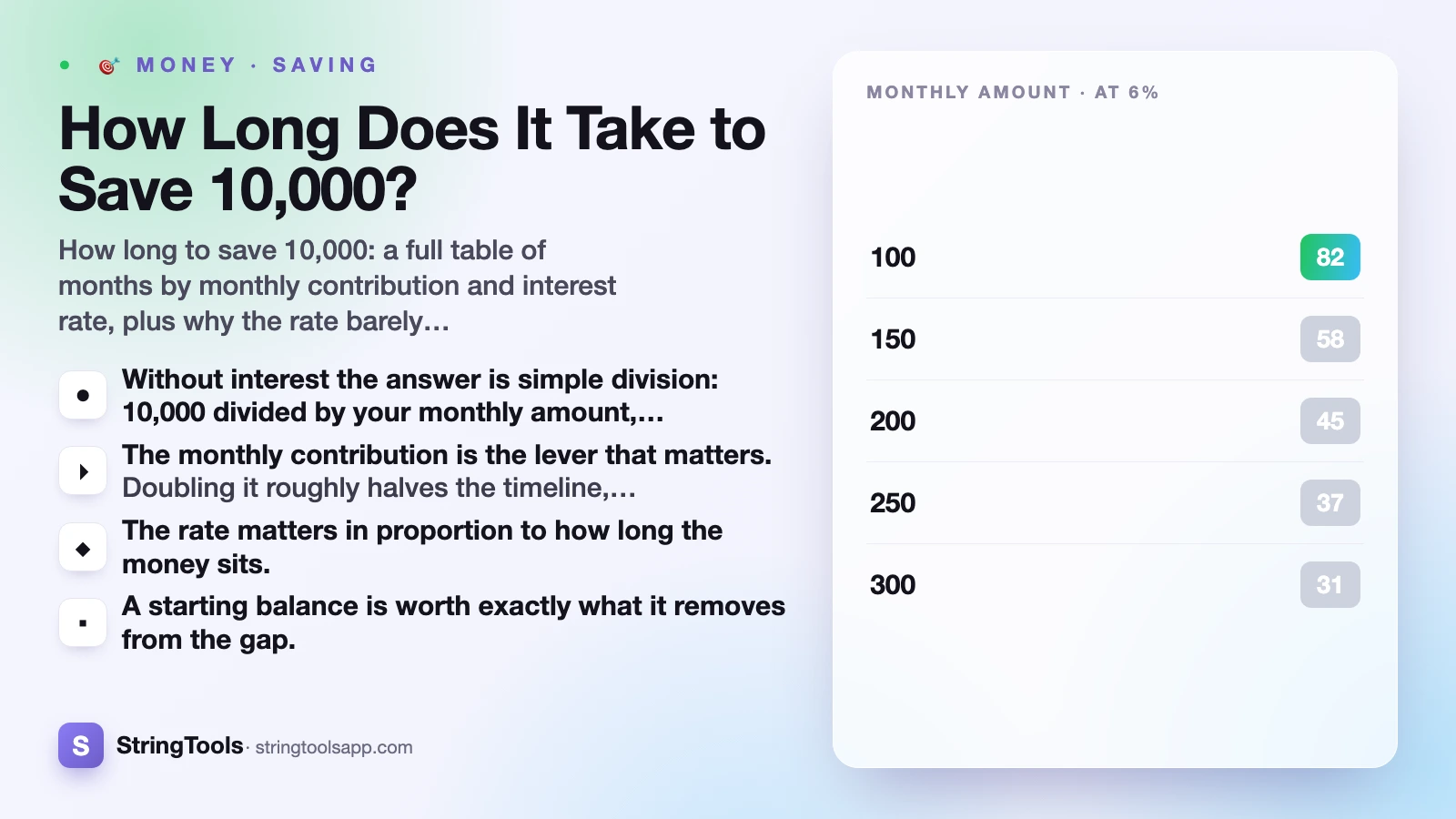
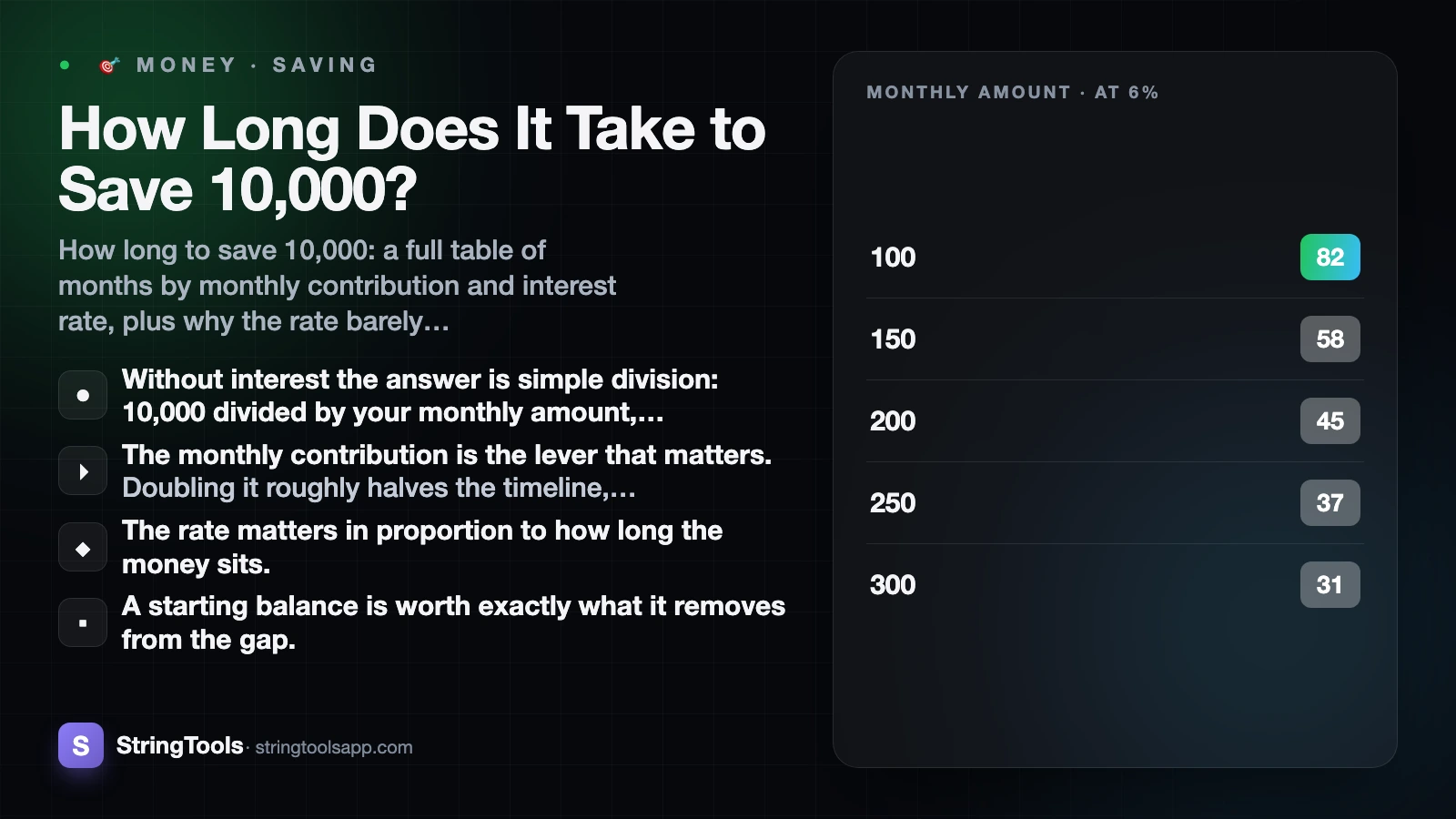
| 100 | 100 | 93 | 87 | 82 |
| 150 | 67 | 64 | 61 | 58 |
| 200 | 50 | 49 | 47 | 45 |
| 250 | 40 | 39 | 38 | 37 |
| 300 | 34 | 33 | 32 | 31 |
| 400 | 25 | 25 | 25 | 24 |
| 500 | 20 | 20 | 20 | 20 |
| 750 | 14 | 14 | 14 | 13 |
| 1,000 | 10 | 10 | 10 | 10 |
Read across the top row and then the bottom row. At 100 a month, the difference between no interest and an illustrative 6% is 18 months, which is a year and a half of your life. At 1,000 a month the entire spread collapses to nothing: the exact figures are 10.00 months at 0% and 9.78 at 6%, both of which round up to 10.
That is the single most useful thing in this table, and it is the opposite of what most savings content implies. Interest is a function of time, so it can only reward a plan that takes a long time. If your plan is short, the rate on the account is close to irrelevant and you should choose the account for access and safety instead.
What a starting balance does
A starting balance does not accelerate the plan. It shortens it, by removing its own value from the gap before the division happens.
At 300 a month with no interest:
| Already saved | Gap remaining | Months to 10,000 |
|---|---|---|
| 0 | 10,000 | 34 |
| 1,000 | 9,000 | 30 |
| 2,500 | 7,500 | 25 |
| 5,000 | 5,000 | 17 |
Each 1,000 of opening balance buys back 3.33 months at this contribution, which rounds to between three and four months a time. The relationship is exactly linear with no interest, and only very slightly better than linear with it.
One caution on what counts. The starting balance is money held for this goal that you can actually reach on the day, not your total across all accounts. Cash already committed to next month's rent is not a starting balance, and a fixed term maturing after your target date does not shorten the plan at all.
Which lever to pull when the answer is too slow
Suppose 34 months is longer than you want. There are three variables and they are not equally useful.
Raising the contribution is the reliable one, and the effect is proportional: 300 to 400 a month takes the plan from 34 months to 25, and 300 to 600 takes it to 17. The whole table above is really one relationship seen from different angles.
Lowering the target is the fastest, and it is worth asking whether 10,000 is a real requirement or a round number. If the goal is an emergency fund, the right target is not a round figure at all, it is a multiple of your own essential monthly bills, which is the method in how much emergency fund do I need.
Chasing a higher rate is the one people reach for first and it is the weakest of the three at short horizons. It also introduces a trade-off the table does not show: accounts that pay more usually pay more because the money is less accessible, tied up for a term, or exposed to a value that can fall. For a goal a couple of years out, that is a poor trade, which is the argument in saving or investing for a goal.
If there is genuinely no room in the budget for a larger contribution, the honest fix is on the income and spending side rather than the savings side, and the priority order there is covered in how much of my paycheck should I save.
There is a fourth lever that does not appear in any equation: a one-off payment into the plan. A tax refund, a bonus or the proceeds of selling something act exactly like a larger starting balance applied part way through, removing their own value from whatever gap remains. A single 1,500 payment into a 300-a-month plan lands on the same month as raising the monthly contribution by 50 would achieve over the same period.
Why the number you can sustain beats the number you can imagine
The table is arithmetic. Finishing is behaviour, and the two come apart in a predictable way.
A contribution set at the very limit of what a good month allows will be missed in an ordinary month. Two missed transfers make the plan feel broken, and broken plans get abandoned rather than adjusted. The savings goal calculator flags a contribution above roughly 20% of the income you enter for exactly this reason, and flags it harder above 50%.
So pick the largest amount you would still pay in the month the car needs tyres, and set that as the standing order for the day after payday. Add extra on top in the months that go well, as a separate manual transfer, rather than raising the automatic one. The automatic figure is a promise you have to keep thirty-four times; the manual one costs nothing when you skip it.
Milestones help more than they should. At 300 a month you reach a quarter of the target around month 9, half around month 17 and three quarters around month 25. The calculator shows those as dates rather than month numbers, which is worth doing on paper if nothing else, because a date is something you can look forward to and a month number is not.
What to do the day you get there
Two things, and both of them are easier to decide now than then.
Decide in advance what the money is actually for, in a sentence specific enough to be checked. A finished 10,000 with no defined purpose becomes a general balance, and a general balance gets spent in pieces small enough that none of them feels like a decision.
Decide where the contribution goes next. The month after a goal completes is the single most likely moment for a savings habit to end, because the transfer that was doing a job now has no job. Redirect it before the first pay day after completion, whether to the next goal or to a longer-term pot.
And re-check where the money is sitting. A balance that was fine at 2,000 may deserve a second look at 10,000, on access, on protection limits and on whether it is still in the same account as everything else. The US Securities and Exchange Commission publishes plain-English guidance on savings and investment choices at Investor.gov, including its own compound interest calculator if you want to check the forward version of these figures against a second source.
Frequently Asked Questions
How long does it take to save 10,000?
From nothing and with no interest, it takes 100 months at 100 a month, 50 months at 200, 34 months at 300, 25 months at 400, 20 months at 500 and 10 months at 1,000. Interest shortens the slow plans more than the fast ones: at an illustrative 4% a year the 100-a-month plan finishes in 87 months while the 1,000-a-month plan still takes 10.
How much do I need to save each month to reach 10,000 in a year?
About 833.34 a month with no interest, since 10,000 divided by 12 is 833.33 recurring and you round up so the last month does not land short. At an illustrative 4% a year it is 818.17. Check that figure against your take-home pay before committing: a plan taking much more than a fifth of income tends not to survive a full year.
Does interest really make a difference to a 10,000 goal?
It depends entirely on how long the plan runs. At 100 a month an illustrative 6% saves 18 months against no interest. At 1,000 a month the same rate saves 0.22 of a month, which rounds away to nothing. Interest is paid for time, so a short plan earns very little of it whatever the rate.
Does a starting balance speed things up?
It removes its own value from the gap, which is not quite the same thing. At 300 a month, starting with 1,000 takes the plan from 34 months to 30, with 2,500 to 25 months, and with 5,000 to 17 months. Each 1,000 buys back about 3.33 months at that contribution, and the relationship is linear when no interest is involved.
Should I chase a higher rate to get there faster?
For a goal a year or two away, the rate is the least powerful of the three levers and usually comes with a cost in access or in the risk that the balance is lower when you need it. Raising the contribution or reconsidering the target both work more reliably. For a goal many years out the calculation changes, and a regulated adviser is the right person to ask about your own case.
Is 10,000 the right savings target?
Only if something specific costs that. It is a satisfying round number rather than a calculated one. If the purpose is an emergency fund, the correct target is a multiple of your own essential monthly bills, so it might be 6,000 or 24,000. Working out the real number first often changes the timeline more than any change to the monthly contribution would.
Sources and references
Investor.gov (investor.gov) · compound interest calculator (investor.gov). Content was reviewed against these sources as of the last-updated date above; external figures and rules may change after publication.