
Four goals, one pay cheque, and the sum nobody does
When you are saving for several goals at once, solve each one separately, then add the monthly figures together and look at that total. Almost nobody does. Each goal looks affordable alone, and the sum of four reasonable goals is usually the number that breaks the plan.
Key Takeaways
- The figure that decides whether your plan survives is never any single goal's monthly amount. It is the total of all of them against what you can actually spare.
- In the household below, four defensible goals came to 1,458.34 a month, and the largest of them was only 541.67. Nobody would have flagged any individual row.
- When the total is impossible, sequencing usually rescues the plan where splitting does not: the same four goals all landed on time at 900 a month when funded one at a time in deadline order.
- Sequencing has a test you can run in a minute. Build the cumulative-gap column and check each line against its own deadline. If any line overruns, no amount of discipline will fix it.
- Interest helps far less than people expect over short horizons. On a 9,000 gap at an illustrative 4% a year, it saves 13.65 a month over 12 months and 13.88 a month over 120 — almost identical in cash, but 1.8% of the payment against 18.5%.
- This is general information, not personal financial advice. For a decision that turns on your own circumstances, speak to a regulated adviser.
This post is the arithmetic for the messy case, where targets compete. If you have exactly one target and want the single-goal method — the gap-divided-by-months walkthrough, how big a share of income a plan can bear, the payday standing order and the quarterly review — that is covered in how to set a savings goal you will actually hit. Start there, then come back here once there is more than one number on the page.
What interest does to the number, and what it does not
Before adding goals together, it is worth settling how much the account's own growth contributes, because people routinely over-credit it and under-fund the plan as a result.
With no interest, a plan is just what you started with plus what you paid in. Once the account pays something, each deposit has its own run of compounding, so the plan is an ordinary annuity: FV = P(1+r)^n + C x [((1+r)^n - 1) / r], with r the monthly rate, meaning the annual percentage divided by twelve and then by a hundred. Solving that for C is what the savings goal calculator does in its contribution mode, and it is the compound interest maths run backwards. The forward version is explained in compound interest explained.
Here is a 9,000 gap from a zero opening balance, solved both ways. The rate is an illustrative 4% a year, chosen only to keep the example readable. It is not a forecast, not a rate on offer anywhere, and returns are never guaranteed.
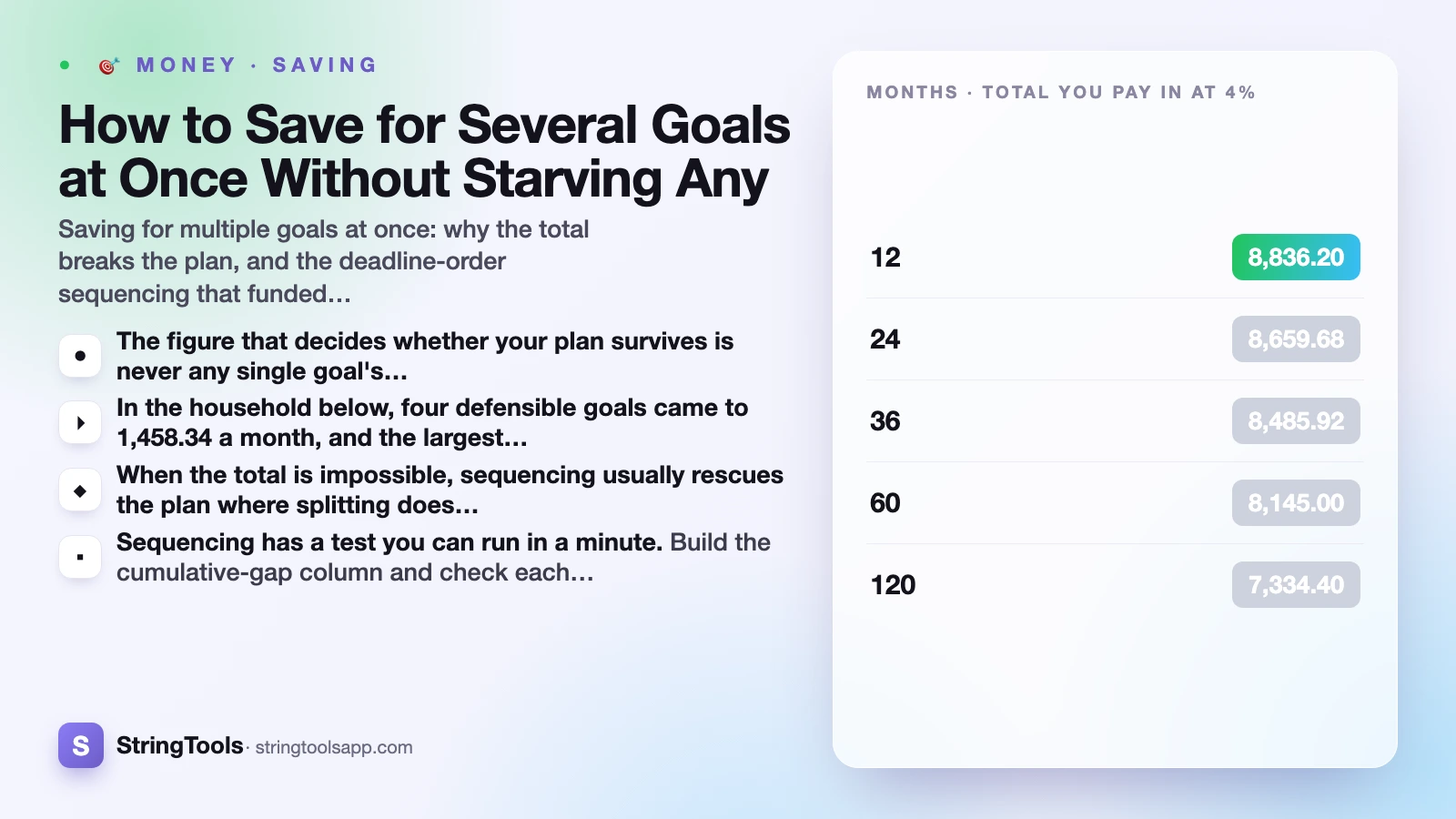
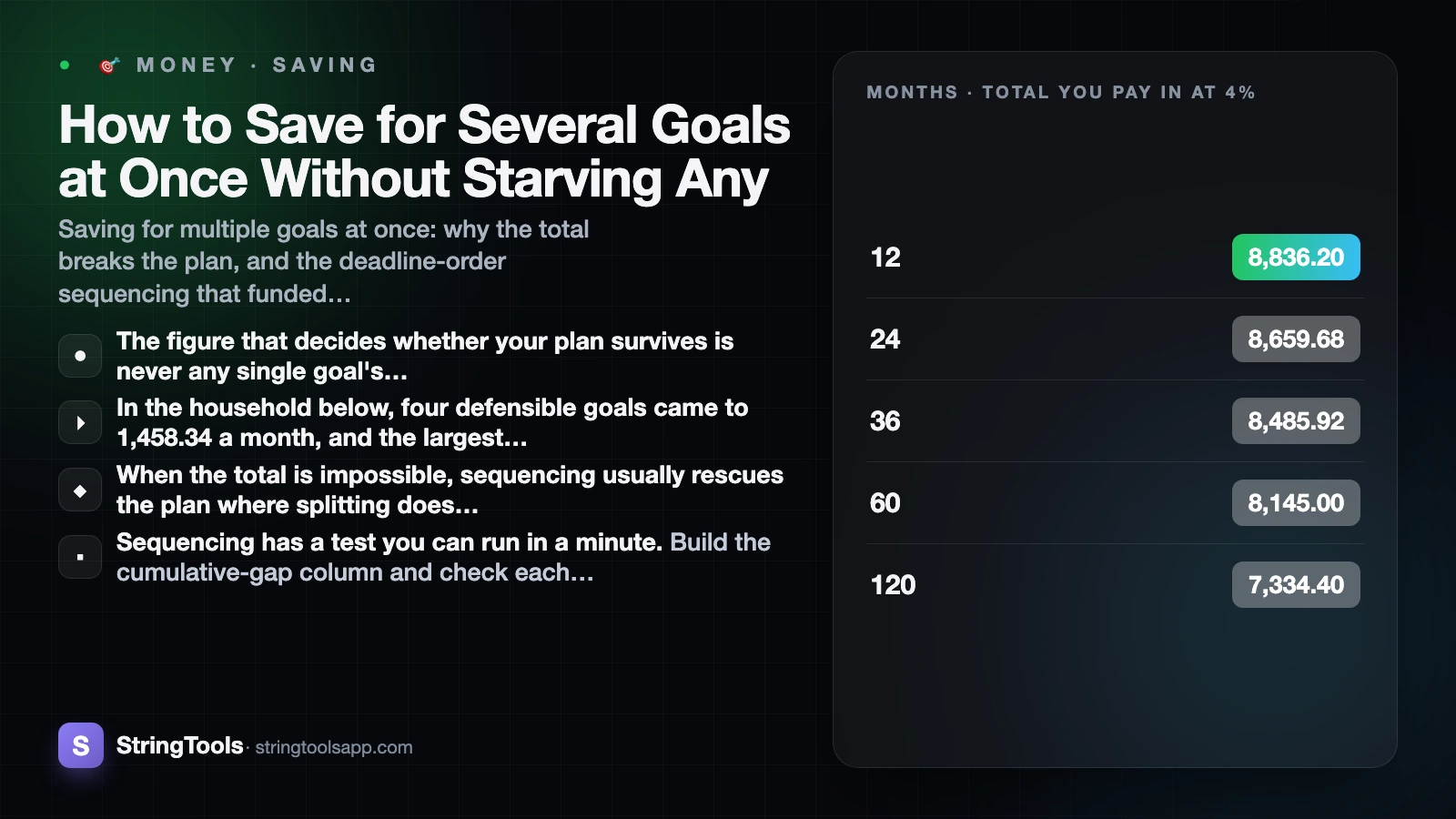
| Months | Monthly at 0% | Monthly at an illustrative 4% | Monthly saved | Total you pay in at 4% |
|---|---|---|---|---|
| 12 | 750.00 | 736.35 | 13.65 | 8,836.20 |
| 24 | 375.00 | 360.82 | 14.18 | 8,659.68 |
| 36 | 250.00 | 235.72 | 14.28 | 8,485.92 |
| 60 | 150.00 | 135.75 | 14.25 | 8,145.00 |
| 120 | 75.00 | 61.12 | 13.88 | 7,334.40 |
Look at the fourth column. In cash terms the help is almost identical at every horizon, somewhere between 13.65 and 14.28 a month. What changes is what that help is a share of: 1.8% of the payment over a year, 18.5% over a decade.
That matters for a multi-goal plan specifically. Short goals should be costed as if the rate were zero, because assuming otherwise understates each row by a rounding error and the four rows together by enough to matter. Only the long goal — the deposit, the retirement pot — earns the right to have growth built into its figure.
Step one: list every goal, not the loudest one
Most savings plans fail at this step rather than at the arithmetic. You pick the goal that is on your mind, set a transfer, and then discover in month four that the car needs tyres and the wedding you agreed to attend is in Spain.
So write them all down, each with three numbers: the target, what you already hold for it, and the month you need it by. A goal without a date cannot be solved, and a date without a target is a wish.
Here is a household with four, solved with the annuity formula above. The 4% column is illustrative throughout.
| Goal | Target | Already saved | Deadline | Monthly at 0% | Monthly at 4% |
|---|---|---|---|---|---|
| Emergency fund top-up | 6,000 | 1,500 | 12 months | 375.00 | 363.17 |
| Car replacement | 9,000 | 0 | 24 months | 375.00 | 360.83 |
| House deposit | 30,000 | 4,000 | 48 months | 541.67 | 487.06 |
| Family trip | 3,500 | 500 | 18 months | 166.67 | 160.33 |
| Total | 48,500 | 6,000 | 1,458.34 | 1,371.38 |
Every row is defensible on its own. The emergency top-up is 375 a month, which sounds manageable. The trip is 166.67, which sounds trivial. No single row would make anyone hesitate. It is only the total line that tells you the truth, and the total is 1,458.34 a month.
If the emergency fund is one of your goals and you are not sure the 6,000 target is right, size it from your own bills first: the method is in how much emergency fund do I need. The predictable-but-irregular costs, the ones that are not emergencies at all, belong in a separate pot, which is the distinction drawn in sinking fund vs emergency fund.
Step two: test the total, because the rows will always pass
Say this household takes home 4,000 a month. The parallel plan asks for 1,458.34, which is 36.5% of take-home pay, before a single bill is paid.
Notice what the individual rows did not tell you. Checked one at a time, 375 and 166.67 and 541.67 all read as modest commitments, and each would pass any sanity test you applied to it. The failure is only visible in the sum, which is why a multi-goal plan needs a different check from a single-goal one: you are testing the total against capacity, not each target against your enthusiasm for it. Where a sustainable savings share of pay sits, and how it fits alongside the rest of a budget, is argued out in how much of my paycheck should I save and in how to set a savings goal you will actually hit. Take your ceiling from there and bring it here as a single figure.
Suppose that figure is 900 a month for this household. The shortfall against the parallel plan is 558.34 a month. That is not a motivation problem. It is an arithmetic result, and it has exactly four honest responses: raise the capacity, lower a target, push a deadline out, or change the order in which the goals are funded.
The fourth one is the one people forget, and on these numbers it is free.
Step three: fund goals in deadline order, not all at once
Splitting 900 four ways gives every goal a trickle and misses the near deadlines. Funding them one at a time, earliest deadline first, sends the whole 900 at a single target until it is finished, then moves the full amount to the next.
The total gap is 42,500. At 900 a month that is 47.2 months of saving. Because each goal is completed before the next starts, the finish dates stack up like this:
| Funded in this order | Gap | Cumulative gap | Finished in month | Deadline | On time |
|---|---|---|---|---|---|
| Emergency fund top-up | 4,500 | 4,500 | 5.0 | 12 | Yes |
| Family trip | 3,000 | 7,500 | 8.3 | 18 | Yes |
| Car replacement | 9,000 | 16,500 | 18.3 | 24 | Yes |
| House deposit | 26,000 | 42,500 | 47.2 | 48 | Yes |
All four goals land on time on 900 a month, when the parallel version of the identical plan demanded 1,458.34, a difference of 558.34 a month. Nothing was cut and no deadline moved. The only change is that the money stopped being divided.
Sequencing works whenever the early goals are small relative to the late ones and the late deadline has room in it. It fails when two large goals share a date, or when the last goal is so big that the cumulative total overruns its deadline. Run the cumulative column before you commit: if any line finishes after its deadline, sequencing alone will not save the plan and you are back to cutting a target or extending a date.
One caveat worth naming. The emergency fund should normally be first in the queue regardless of its deadline, because it is the thing that stops the other three plans from being funded by a credit card the first time something breaks.
When the number is still impossible
Sometimes the cumulative column misses anyway. In that case work through the options in this order, because they cost you different things.
Extend the deadline first, where the deadline is soft. A trip can move a season. Stretching a 36-month goal to 48 cuts the monthly figure by a quarter and costs you only patience.
Cut the target next, where the target was an estimate rather than a price. A 30,000 deposit and a 26,000 deposit are both real plans; find out which the actual purchase needs before you assume the larger one.
Raise the capacity third, and be specific about where from. A pay rise diverted entirely to the plan before it reaches your current account is the least painful source, because you never adjusted to it.
Drop a goal last, and do it deliberately rather than by default. A goal that quietly receives nothing for eight months has already been dropped; you just have not admitted it, and you have lost the chance to have chosen which one.
What you should not do is keep the impossible plan and rely on discipline. The arithmetic does not care how determined you are.
Making a multi-goal plan survive contact with real life
Give each goal its own pot, not its own line in a spreadsheet. With several targets in one balance you cannot tell which one you are behind on, and the total looks healthy right up to the month the nearest deadline arrives. Separate pots make the cumulative column real.
Recalculate quarterly, not weekly. Three months is long enough for something to have genuinely changed and short enough to fix. What you are checking is whether the cumulative column still lands before each deadline, which takes about ten minutes.
And re-run the whole thing whenever a goal is finished or added. Finishing the first goal in a sequence is the moment the full contribution is meant to move to the next one, and it is also the moment it most easily leaks into ordinary spending. Decide where it goes before it arrives.
For the definitions underneath all of this, the US Securities and Exchange Commission's investor education site has a plain-English introduction at Investor.gov, and in the UK GOV.UK is the authority on the tax treatment of specific account types. None of this is personal financial advice.
Frequently Asked Questions
How do I split my money between several savings goals?
Usually you should not split it. Solve each goal separately, add the results, and if the total is more than you can spare, fund the goals one at a time in deadline order rather than giving each a trickle. In the worked example, four goals demanded 1,458.34 a month in parallel but all landed on time at 900 a month sequentially. Nothing was cut and no deadline moved.
Does interest change how much I need to put aside for a short goal?
Barely. On a 9,000 gap at an illustrative 4% a year, interest cuts the monthly figure by 13.65 over 12 months and by 13.88 over 120 months. The cash help is almost identical, but it is 1.8% of a one-year payment and 18.5% of a ten-year one. Cost short goals as if the rate were zero, and only build growth into the long ones.
Which savings goal should I fund first?
Earliest deadline first, with one exception: a basic emergency cushion normally goes to the front of the queue whatever its date, because it is the thing that stops the other goals being funded by a credit card the first time something breaks. After that, build the cumulative-gap column in deadline order and check each line finishes before its own deadline.
Is it better to save for goals one at a time or all at once?
One at a time is usually cheaper in monthly terms, because the full contribution finishes each goal early and then moves on. Splitting only wins when two goals share a deadline, or when one goal has a psychological value that keeps you saving at all. Check the cumulative total against each deadline before you choose.
When does sequencing fail, and what do I do then?
It fails when two large goals share a date, or when the last goal is so big that the cumulative total overruns its deadline. The cumulative column tells you before you commit. If a line overruns, work in this order: extend the softest deadline, cut a target that was an estimate rather than a price, raise capacity from a pay rise you have not adjusted to yet, and only then drop a goal deliberately.
How often should I redo the calculation?
Every three months, and immediately whenever a goal is finished, added, or repriced. The quarterly check is quick: confirm that each goal's cumulative total still lands before its deadline. Finishing a goal matters most, because that is when the freed-up contribution either moves to the next target or disappears into ordinary spending.
Sources and references
Investor.gov (investor.gov) · GOV.UK (gov.uk). Content was reviewed against these sources as of the last-updated date above; external figures and rules may change after publication.