
The honest answer, and the three numbers it turns on
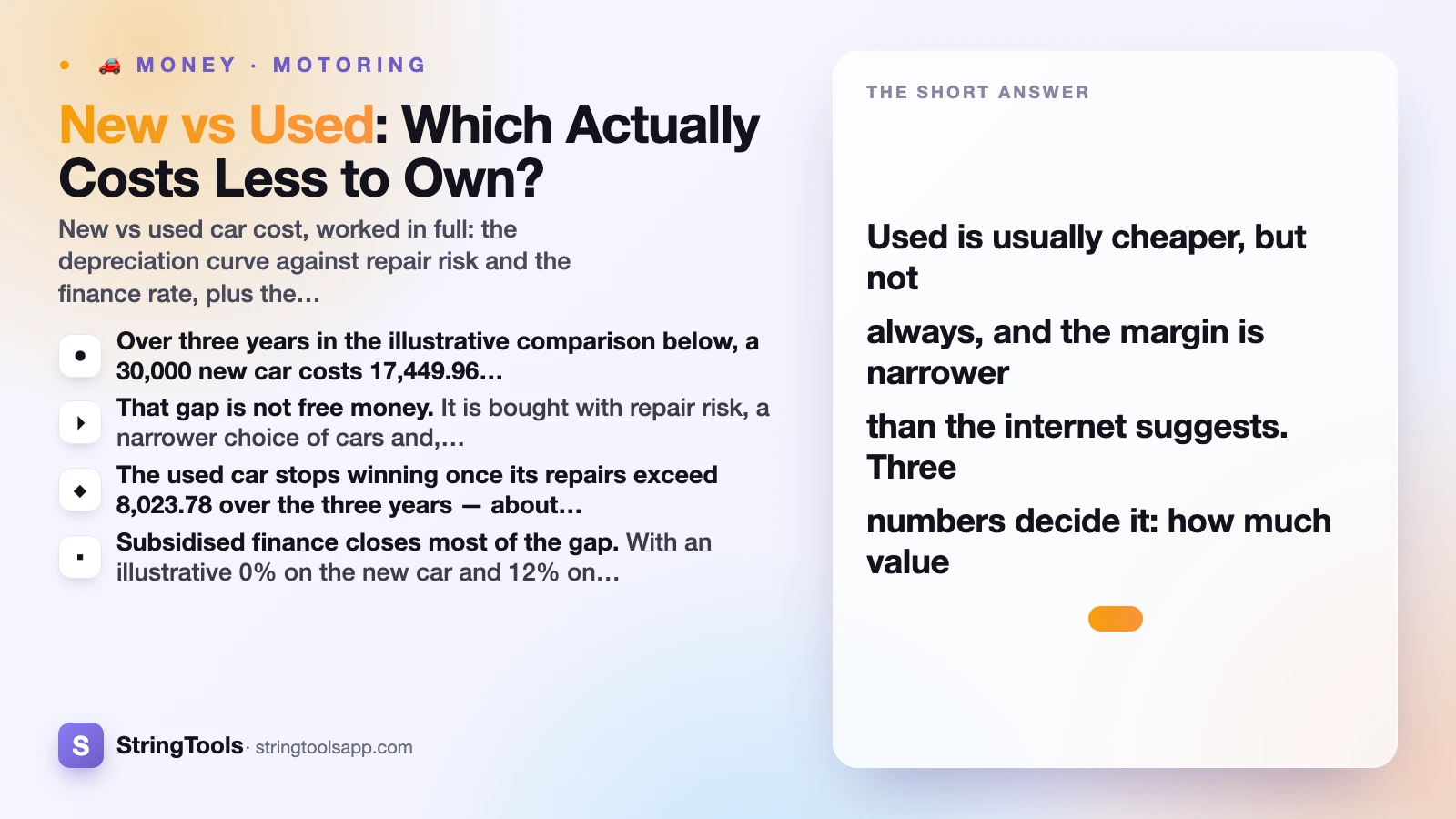
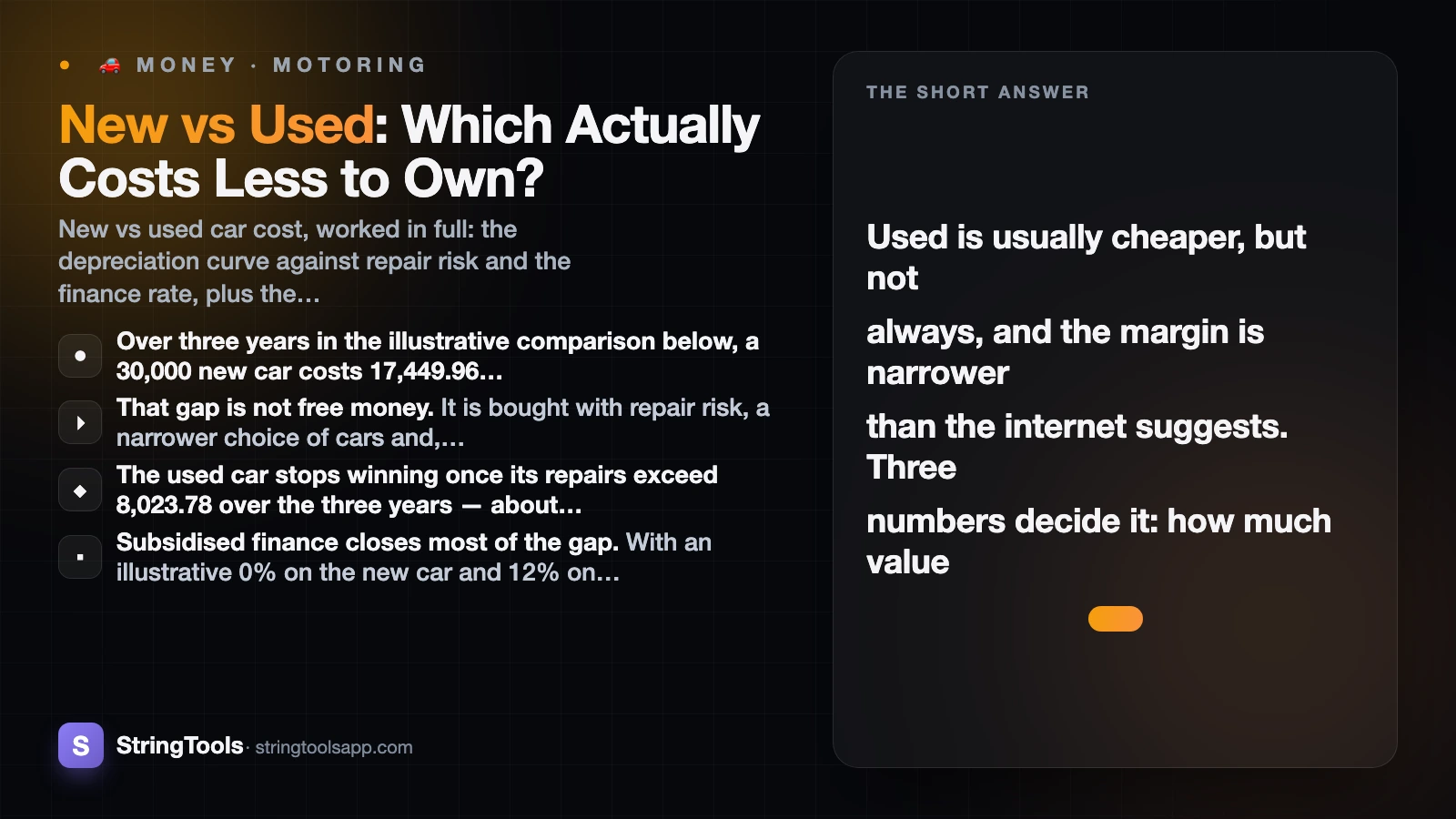
Used is usually cheaper, but not always, and the margin is narrower than the internet suggests. Three numbers decide it: how much value each car loses while you own it, how much you spend keeping the older one running, and the gap between the finance rates on offer. Change any one of them enough and the answer flips.
Key Takeaways
- Over three years in the illustrative comparison below, a 30,000 new car costs 17,449.96 to own and a 17,000 three-year-old one costs 11,826.18. Used wins by 5,623.78.
- That gap is not free money. It is bought with repair risk, a narrower choice of cars and, usually, a higher interest rate.
- The used car stops winning once its repairs exceed 8,023.78 over the three years — about 2,674.59 a year.
- Subsidised finance closes most of the gap. With an illustrative 0% on the new car and 12% on the used one, the difference falls to 1,345.07, or about 37 a month.
- If the used car depreciates almost as hard as the new one, the gap halves again.
- The decision is a comparison of two ledgers, not a rule. Build both before you choose.
Every rate and value here is illustrative, not a forecast. This is general information, not financial advice.
Why there is no general answer
The claim that used cars are always cheaper rests on one true fact: a car loses value fastest when it is new, so the first owner pays for the steepest part of the curve. Buy at three years old and someone else has absorbed it.
But the money case has two counterweights that move independently of that fact. The older car has spent three years wearing out, so its expected repair bill is higher and its warranty is probably gone. And used-car finance is generally offered at higher rates than new-car finance, because the collateral is worth less and worth less predictably. Manufacturers also periodically subsidise finance on new cars in a way that nobody subsidises on used ones, which can move the effective price by thousands without the sticker changing at all.
So the comparison is a three-way tug of war: depreciation pulling towards used, repair risk and finance rates pulling towards new. Which side wins depends on the specific cars, the specific offers and how long you keep it — not on a general principle. The way to settle it is to build both ledgers, in the same shape, over the same period, using the method in the true cost of owning a car.
The comparison, worked in full
Two versions of broadly the same car. The new one costs 30,000 and is worth 17,000 after three years. The used one is that same car at three years old, bought for 17,000, and worth 11,000 three years later. Both are financed over 48 months, the new one at an illustrative 6% and the used one at an illustrative 10%, and the table counts the interest actually paid in the first 36 months. Repairs and servicing are budgeted at 300 a year for the car under warranty and 800 a year for the older one.
| Three-year cost | New at 30,000 | Used at 17,000 |
|---|---|---|
| Value lost | 13,000.00 | 6,000.00 |
| Servicing and repairs | 900.00 | 2,400.00 |
| Interest paid over 36 months | 3,549.96 | 3,426.18 |
| Total | 17,449.96 | 11,826.18 |
| Per month | 484.72 | 328.50 |
The used car is 5,623.78 cheaper over three years, or 156.21 a month. That is a real and substantial difference, and it is almost entirely one line: the used car loses 7,000 less value. Every other line is close, and the interest figures are nearly identical because the higher rate is applied to a much smaller balance.
Both columns deliberately exclude fuel, insurance, tax and parking. On two versions of the same model those are broadly similar, though not identical — a newer car can be more efficient and is sometimes cheaper to insure thanks to safety equipment, and sometimes dearer because it is worth more to replace. Price them separately for the actual cars using the fuel cost calculator and two real insurance quotes.
What would have to be true for the new car to win
The useful question is not which column is smaller, but how fragile the answer is. Two things close the gap, and both happen regularly.
Repairs. The used car's 5,623.78 advantage is spent the moment its repairs rise far enough. Holding everything else constant, the used car would need to cost 8,023.78 in servicing and repairs over the three years — 2,674.59 a year — to draw level. That is a lot for a well-kept six-year-old car, and entirely possible for a neglected one or for a model with a known expensive failure.
The finance rate. Subsidised new-car finance is the single biggest thing that flips this comparison, because it removes an entire line from one column.
| Three-year cost | New at an illustrative 0% | Used at an illustrative 12% |
|---|---|---|
| Value lost | 13,000.00 | 6,000.00 |
| Servicing and repairs | 900.00 | 2,400.00 |
| Interest paid over 36 months | 0.00 | 4,154.93 |
| Total | 13,900.00 | 12,554.93 |
| Per month | 386.11 | 348.75 |
The gap collapses from 5,623.78 to 1,345.07 — about 37 a month for a car three years younger with a full warranty. Reasonable people choose either column at that margin.
A third case is worth knowing about: if the used car turns out to depreciate almost as hard as the new one, say from 17,000 down to 9,000 rather than 11,000, its three-year total in the base scenario rises to 13,826.18 and the advantage falls to 3,623.78. This is common on models that have fallen out of favour, and it is a good reason to check what the specific used car you are considering was worth three years ago rather than assuming the curve has already flattened.
Depreciation is a shape, not an age
The received wisdom is to buy at two or three years old. The reasoning is sound — the curve is steepest at the start — but the age is not the point. The shape is.
Two cars of the same age can sit at completely different places on their own curves. A model in high demand with limited supply may lose very little between three and six years old, which makes it expensive to buy used and cheap to own. A model that has been discounted heavily when new, or that has fallen out of fashion, keeps falling, which makes it cheap to buy and expensive to own — you take a share of a decline that is still running.
You can see this without any special data. Look up what the used car you are considering sold for new, and what the same age and mileage is advertised at today. That tells you how much it has already lost. Then look at cars of the same model that are three years older still, and you can see how much it is likely to lose next. The gap between those two figures is your depreciation line, and it is far more reliable than any percentage rule.
Two practical rules follow. Avoid assuming a car has finished depreciating just because it is no longer new. And treat unusually cheap used examples with suspicion: a price well below the rest of the market is often the market pricing in a problem you have not found yet.
Repair risk is a distribution, not an average
The 800 a year in the table is an average, and averages are the wrong way to think about repairs on an older car. Most years cost very little. Occasionally a year costs several thousand. The budgeting problem is not the mean, it is the variance.
That matters because of what the variance lands on. If a 2,500 repair arrives while you have savings, it is an annoying transfer from one account to another. If it arrives while you have none, it goes on a credit card at an interest rate that will make it considerably more expensive than 2,500, and the used car's advantage evaporates into finance charges. The used car is cheaper on average and riskier month to month, and the risk is only affordable if you have a buffer.
Three things genuinely reduce the risk rather than just deferring it: a documented service history, a pre-purchase inspection by someone who is not selling you the car, and choosing a model with a dull reputation for reliability over a more interesting one. A manufacturer-approved used programme with a warranty is another route, and you pay for it in the price.
The US Federal Trade Commission's guide to buying a used car from a dealer covers the disclosures and warranty paperwork you are entitled to, which is worth reading before you are standing in a forecourt being hurried.
What the ledger leaves out
A spreadsheet decides this comparison only if the two cars are otherwise identical, and they rarely are.
- Warranty and predictability. A new car's costs are known for its first years. For some households that predictability is worth paying for, entirely rationally.
- Safety and efficiency. Equipment improves over time. A newer car may be meaningfully safer, and on high mileage a more efficient one recovers part of its premium through the fuel line. Check the actual figures for both cars in the fuel economy database rather than assuming newer means cheaper to run.
- Choice. New means exactly the specification you want. Used means the best compromise available this month.
- Your time. Finding a good used car takes weeks of searching, viewing and being disappointed. That is a real cost, even if it never appears in a ledger.
- How long you will keep it. The longer you hold either car, the more the depreciation advantage of buying used shrinks, because you are spreading a flatter part of the curve over more years. Over ten years the two columns converge considerably.
None of this changes the arithmetic. It changes how much the arithmetic should decide.
How to settle it for your own case
Pick the two actual cars, not the categories. Then build the same four lines for each, over the number of years you realistically expect to keep it.
Write down the purchase price and a defensible resale figure at the end of your ownership period, taken from what similar cars of that future age are advertised at today. Subtract to get the value lost. Add a servicing and repair budget that reflects the car's age and warranty, not its best case. Add the interest you would actually pay on the finance you have actually been quoted — the rate on the offer letter, not the advertised headline. Add anything that differs between the two, such as insurance if the quotes diverge.
Then compare totals, and compare them again with the used car's repair line raised by half. If neither total fits your budget, the prior question is how much car you can afford rather than which one to buy. If the answer survives that, it is a robust answer. If it flips, the honest conclusion is that the two cars cost about the same and you should choose on the things that are not money.
The car affordability calculator will do the finance and running-cost side of each column for you, including depreciation, and it will also tell you whether the payment on either one fits your budget in the first place. If you are weighing finance against leasing or paying cash as well, car loan vs lease vs cash covers that separate decision. And whichever you choose, the CFPB's auto loan resources are a good check on the agreement before you sign it.
Frequently Asked Questions
Is it cheaper to buy a new or used car?
Usually used, because the first owner absorbs the steepest part of the depreciation curve. In the illustrative three-year comparison here, a 17,000 used car costs 11,826.18 to own against 17,449.96 for the 30,000 new version, a difference of 5,623.78. But subsidised new-car finance or an unlucky repair history can close that gap almost entirely.
How much do repairs have to cost before a used car stops being cheaper?
In the example above, the used car's 5,623.78 advantage disappears once its servicing and repairs reach 8,023.78 over three years, or about 2,674.59 a year. That is unlikely for a well-maintained car with a service history and quite possible for a neglected one, which is why a pre-purchase inspection is worth its cost.
Does 0% finance make a new car cheaper than a used one?
It can come very close. Removing the interest line from the new column and applying an illustrative 12% to the used one narrows the three-year difference from 5,623.78 to 1,345.07, or about 37 a month. Check whether the subsidised rate is conditional on paying the full list price, because a discount forgone is a cost that does not appear on the finance agreement.
What is the best age to buy a used car?
There is no single answer, because age is a proxy for where a car sits on its own depreciation curve and different models flatten at different points. Rather than picking an age, compare what the specific car sold for new, what it costs now, and what examples three years older are advertised at. The second gap is the cost you are signing up for.
Should I count insurance and fuel when comparing new and used?
Yes, but price them separately rather than assuming. On two versions of the same model they are broadly similar. A newer car can be cheaper to insure because of its safety equipment or dearer because it costs more to replace, and it may be more efficient, which matters most at high mileage. Get real quotes for both cars.
Does buying used still save money if I keep the car for ten years?
Less than it does over three. The advantage of buying used comes from skipping the steep early part of the depreciation curve, and the longer you hold either car the more that one-off saving is spread across the years. Over a long ownership period the two options converge, and reliability and running costs matter more than the purchase decision did.
Sources and references
buying a used car from a dealer (consumer.ftc.gov) · fuel economy database (fueleconomy.gov) · CFPB's auto loan resources (consumerfinance.gov). Content was reviewed against these sources as of the last-updated date above; external figures and rules may change after publication.