

What the rule says, in one paragraph
The 20/4/10 rule is a widely repeated guideline for buying a car: put at least 20% down, borrow for no more than four years, and keep total monthly vehicle costs under 10% of your income. It is a rule of thumb from consumer-finance writing, not a lending standard. No regulator endorses it and no lender applies it.
Key Takeaways
- Each leg guards a different failure: the deposit guards against negative equity, the four-year cap guards against paying for a car you no longer want, and the 10% guards against the car crowding out everything else.
- Under the rule, a 20,000 car needs 4,000 down and costs 390.61 a month over 48 months at an illustrative 8% APR.
- Run backwards, the 10% leg is brutal. On 3,500 of gross monthly income with 100 of insurance, the rule permits a car of about 12,800.
- On 2,500 a month it permits about 7,680, which in many markets is not a car you would want to rely on for commuting.
- The rule is usually quoted against gross income, and versions differ on whether the 10% covers payment plus insurance or every running cost. Those two ambiguities change the answer by thousands.
- Treat a failed leg as a signal about which lever to pull, not a verdict on the purchase.
Every rate and cost here is illustrative. This is general information, not financial advice.
The three legs, and what each one is actually protecting
The rule is memorable because it is three numbers, but it is useful because each number defends against a distinct problem.
20% down is about the gap between what you owe and what the car is worth. A car loses a meaningful share of its value in the first year, and a loan amortises slowly at the start because the early instalments are mostly interest. Put nothing down and the two curves cross badly: for the first stretch of the loan you owe more than the car would fetch, so a write-off or an early sale leaves you paying for a car you no longer have. A deposit of roughly a fifth is the smallest amount that usually keeps you the right side of that line from day one.
Four years maximum is about the mismatch between how long you pay and how long you want the car. Stretching a loan to six or seven years lowers the instalment and lengthens the period during which selling means writing a cheque. It also raises the total interest. Four years is a compromise between an affordable payment and being free of the debt before the car starts costing real money in repairs.
10% of income is about everything else in your life. A car is one line in a budget that also contains rent or a mortgage, food, childcare, debt and saving. Keeping the car under a tenth of income leaves room for a surprise. The tighter the rest of the budget, the more that headroom matters.
| Leg | Protects against | What failing it looks like |
|---|---|---|
| 20% deposit | Negative equity | Owing more than the car is worth if it is written off or you sell early |
| 4-year term | Paying past the car's useful life to you | Still paying in year six, trapped in a car you want to replace |
| 10% of income | Budget crowding | The car is fine until the boiler breaks, then it is not |
Where the rule came from
Honestly: nowhere official. The 20/4/10 formulation circulates in personal-finance journalism, car-buying guides and educator material, and it has been repeated widely enough that it now reads like received wisdom. No central bank, consumer regulator or lending body publishes it as guidance, and there is no single authoritative source you can point a sceptical friend to.
That matters for how much weight to give it. Guidance that genuinely comes from a consumer body looks different: the CFPB's auto loan resources and the US Federal Trade Commission's pages on financing or leasing a car explain the mechanics, the paperwork and the traps, and pointedly do not hand you a magic ratio.
A rule of thumb earns its keep by being roughly right and easy to remember, not by being endorsed. 20/4/10 is roughly right about the three things that actually go wrong with car finance, which is why it survives. It is not right about how much car a person on a modest income can have.
What the rule permits, in money
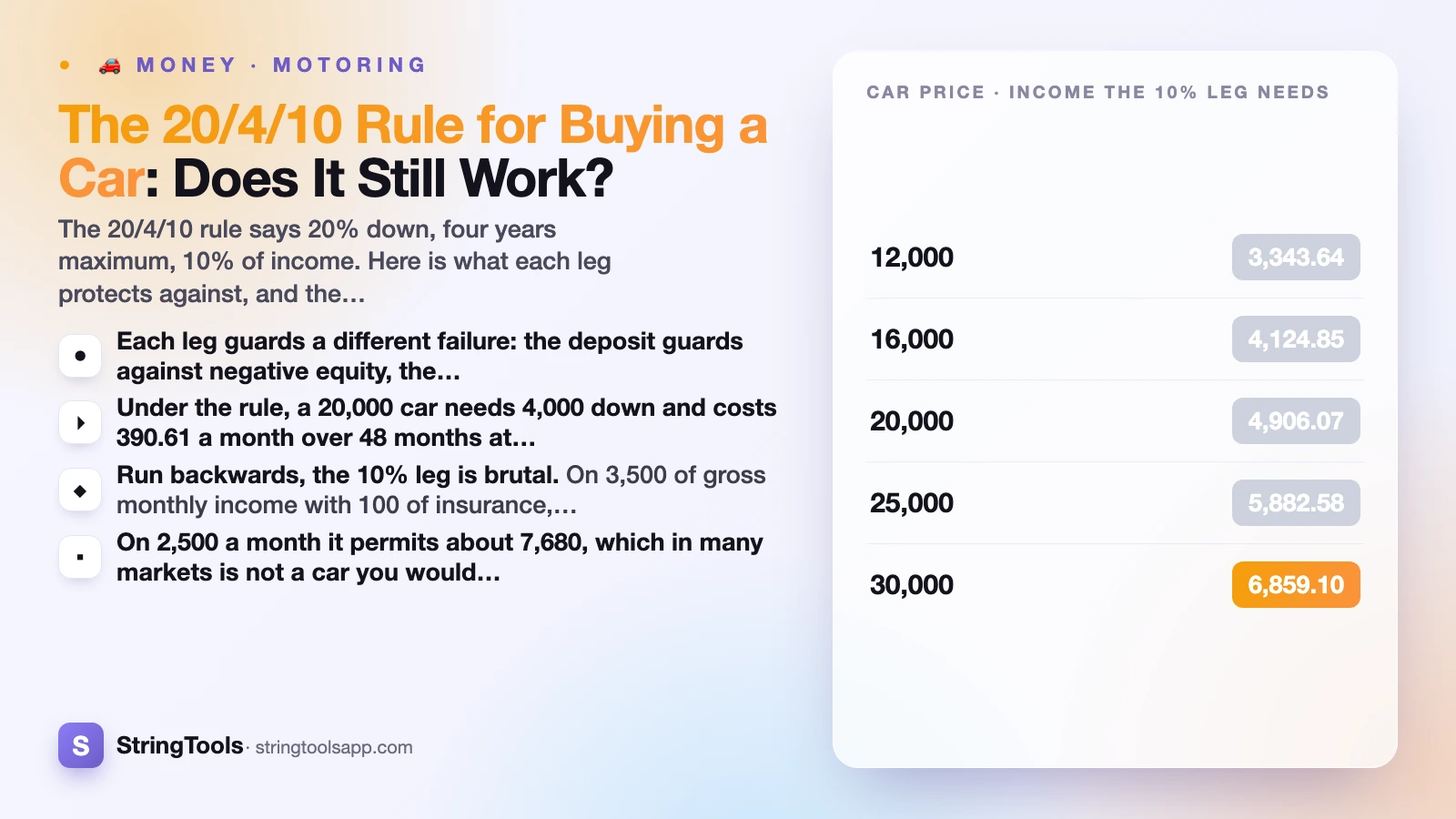
Take the rule at face value and apply it to a range of prices. Each row assumes exactly 20% down, a 48-month term and an illustrative 8% APR. The last column is the gross monthly income the 10% leg would require, assuming an illustrative 100 a month of insurance on top of the payment.
| Car price | 20% deposit | Amount borrowed | Monthly payment | Income the 10% leg needs |
|---|---|---|---|---|
| 12,000 | 2,400 | 9,600 | 234.36 | 3,343.64 |
| 16,000 | 3,200 | 12,800 | 312.49 | 4,124.85 |
| 20,000 | 4,000 | 16,000 | 390.61 | 4,906.07 |
| 25,000 | 5,000 | 20,000 | 488.26 | 5,882.58 |
| 30,000 | 6,000 | 24,000 | 585.91 | 6,859.10 |
The pattern is worth sitting with. A perfectly ordinary 20,000 car, bought exactly as the rule prescribes, wants a gross income near 4,900 a month — around 59,000 a year — before it passes all three legs. That is not a fringe case or an expensive car. It is the kind of price a used family hatchback reaches.
Change the term and the arithmetic changes, but the rule will not let you: the four-year cap is the leg that stops you buying the payment. That is the point of it, and it is also where most people quietly break it. If you are wondering what the longer term would actually cost, should you take a longer car loan works it through.
Run it backwards and it gets uncomfortable
The more useful direction is income to price. Take 10% of gross monthly income, subtract an illustrative 100 of insurance, treat the remainder as the payment, invert the amortisation formula over 48 months at an illustrative 8% APR, then gross the loan up by the 20% deposit.
| Gross monthly income | 10% ceiling | Left for the payment | Loan supported | Car price the rule allows | Deposit needed |
|---|---|---|---|---|---|
| 2,500 | 250 | 150 | 6,144.29 | 7,680.36 | 1,536.07 |
| 3,500 | 350 | 250 | 10,240.48 | 12,800.60 | 2,560.12 |
| 4,500 | 450 | 350 | 14,336.67 | 17,920.84 | 3,584.17 |
| 6,000 | 600 | 500 | 20,480.96 | 25,601.20 | 5,120.24 |
| 8,000 | 800 | 700 | 28,673.34 | 35,841.67 | 7,168.33 |
On 2,500 a month the rule permits a car of about 7,680 with 1,536 saved up first. Depending on where you live, that is either a perfectly sensible older car or nothing you would trust for a daily commute in winter. On 3,500 it permits about 12,800, which is realistic but not generous.
The rule is not wrong in those rows. It is telling you something true and unwelcome: a reliable car is expensive relative to a modest income, and the gap has to be closed by something. Usually that something is a longer term, a smaller deposit, or an older car with higher repair risk — each of which is a real trade with a real cost, rather than a loophole.
The four places it breaks
Low incomes. Below roughly 3,000 a month the rule can price you out of any car that is dependable enough to protect the job that pays for it. If you need the car to earn, a car that fails the 10% leg but starts every morning may still be the better decision than one that passes and does not. Be honest that you are choosing a worse financial position for a good reason, rather than pretending the rule is satisfied.
High-cost cities. Where rent takes half of take-home pay, 10% of gross on a car is not conservative, it is optimistic. The right ceiling in an expensive city is often well below the rule. Conversely, in places where a car is the only way to reach work, the 10% is an unavoidable cost rather than a discretionary one, and something else in the budget has to give.
Gross versus net. Most versions of the rule use gross income, which is the most permissive reading available. Against take-home pay the same 10% is a much tighter constraint, which is why the car affordability calculator works from take-home and treats anything over 20% of it as risky. If you want the rule to mean what it sounds like it means, apply it to the money that actually lands in your account.
What counts inside the 10%. Some versions say payment plus insurance. Others say all transport costs, which pulls in fuel, servicing, tax and parking, and can double the figure being tested. A rule whose answer changes by that much depending on which version you heard is a rule you should treat as a rough check. The true cost of owning a car sets out everything that would be inside the strict version.
A more useful way to use it
Stop treating 20/4/10 as a pass or fail test and start treating it as a diagnostic. Each failed leg names its own fix, and the fixes are not interchangeable.
- Failing the deposit leg means you are exposed to negative equity. The fix is to save longer or spend less, not to shorten the term.
- Failing the term leg means you are buying more car than your cash flow supports. The fix is a cheaper car, not a bigger deposit.
- Failing the 10% leg means the car is squeezing the rest of your life. The fix might be either of the above, or it might be a cheaper insurance group, or it might be that this is not the year.
Two legs failing at once is the genuine warning sign, and a small deposit combined with a long term is the specific combination that produces the worst outcomes, because it stacks slow amortisation on top of fast early depreciation.
It is also worth noticing what the rule ignores entirely. It says nothing about running costs, nothing about depreciation, and nothing about whether you have savings behind you. A car that passes all three legs while your emergency fund is empty is not a safe purchase; the first repair goes on a card.
Check your own numbers against it
Take the car you are actually looking at, the deposit you actually have, and the APR you have actually been quoted rather than an advertised rate. Work out the deposit as a percentage of the price, count the months on the finance agreement, and add the payment to your real insurance quote as a share of your income.
The car affordability calculator runs all three legs for you alongside the full monthly cost, and it does it against take-home pay rather than gross, so the answer it gives is the stricter one. It also carries running costs and depreciation through every figure, which the rule itself never does. Nothing you enter leaves your browser.
If two legs fail, the most useful next step is usually not to hunt for a better rate. It is to reopen the price. A cheaper car fixes all three legs at once, and it is the only lever that does. To find the price that does it, work forwards from your own budget with how much car can I afford.
Frequently Asked Questions
What is the 20/4/10 rule for buying a car?
It is a widely repeated rule of thumb: put at least 20% down, take a loan of no more than four years, and keep total monthly vehicle costs under 10% of your income. It comes from consumer-finance writing rather than from any regulator or lender, and its value is that each leg guards against a specific, common mistake.
Is the 20/4/10 rule realistic today?
It is realistic for middle and higher incomes and increasingly hard below them. On 4,500 gross a month the rule allows roughly a 17,920 car, which is workable. On 2,500 a month it allows roughly 7,680, which in many markets buys an older car with real repair risk. The rule is not broken so much as it is honest about a gap that is genuinely difficult to close.
Does the 10% in 20/4/10 use gross or take-home pay?
Most versions use gross income, which is the more permissive reading. Applying the same 10% to take-home pay is considerably stricter and, for most households, closer to what the budget can actually bear. Versions also differ on whether the 10% covers only the payment and insurance or every running cost, so say which version you are using before comparing answers with anyone.
What if I fail one leg of the rule?
Treat it as a pointer rather than a veto. A failed deposit leg means exposure to negative equity, a failed term leg means the car costs more than your cash flow supports, and a failed 10% leg means the car is squeezing the rest of your budget. Two failed legs at once, particularly a small deposit with a long term, is the combination that reliably goes wrong.
Why is 20% down the recommended deposit?
Because it is roughly the amount that keeps what you owe below what the car is worth from the start. Cars lose value fastest early, while a loan repays principal slowest early, so with little or nothing down the two curves cross and you spend part of the term underwater. A fifth down usually prevents that, and you pay no interest on money you never borrowed.
Does the 20/4/10 rule apply to leasing or used cars?
Not cleanly. A lease has no deposit in the ownership sense and no balance to be underwater on, so the first two legs do not translate; only the income test really survives. For used cars the legs apply as written, but interest rates on used finance are often higher, which makes the four-year cap bite harder against the same monthly payment.
Sources and references
CFPB's auto loan resources (consumerfinance.gov) · financing or leasing a car (consumer.ftc.gov). Content was reviewed against these sources as of the last-updated date above; external figures and rules may change after publication.