
What the extra years buy, and what they cost
Stretching a car loan lowers the payment and raises the total. On 25,000 borrowed at an illustrative 8% APR, going from 48 months to 84 cuts the payment from 610.32 to 389.66 — a saving of 220.66 a month — and raises the interest from 4,295.51 to 7,731.05. You also spend most of those extra years owing more than the car is worth.
Key Takeaways
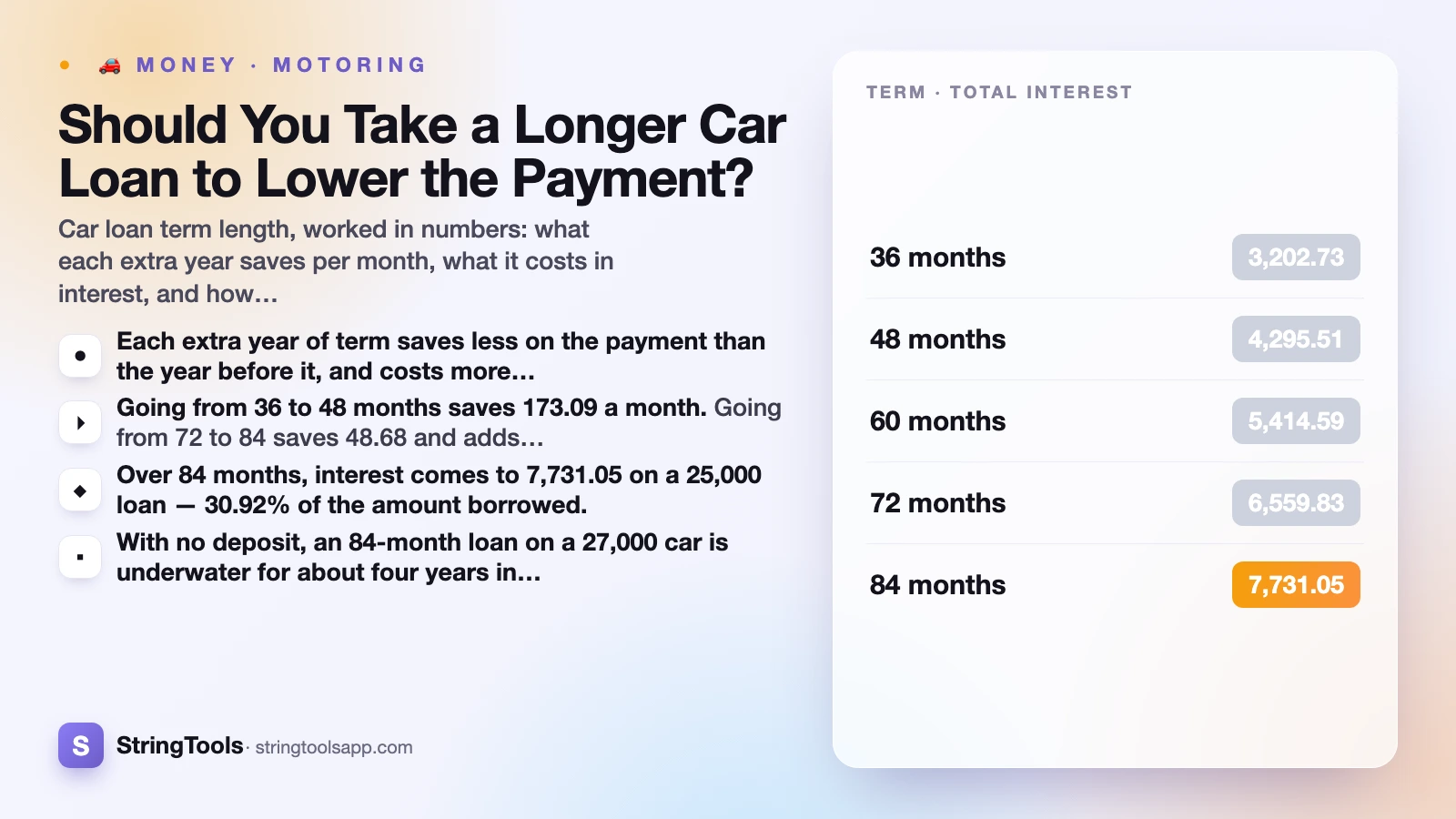
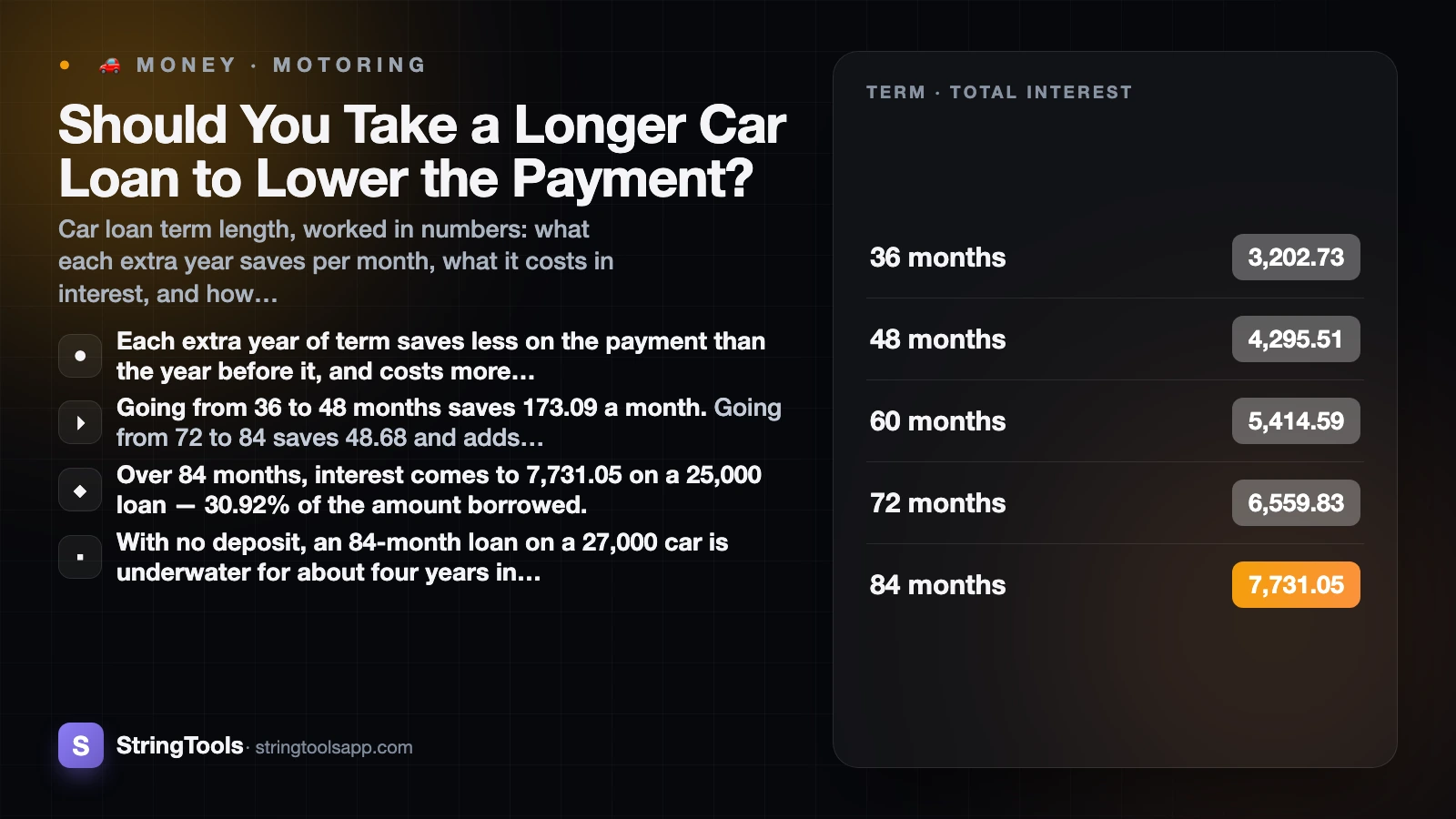
- Each extra year of term saves less on the payment than the year before it, and costs more in interest than the year before it. The trade gets steadily worse.
- Going from 36 to 48 months saves 173.09 a month. Going from 72 to 84 saves 48.68 and adds 1,171.22 of interest for the privilege.
- Over 84 months, interest comes to 7,731.05 on a 25,000 loan — 30.92% of the amount borrowed.
- With no deposit, an 84-month loan on a 27,000 car is underwater for about four years in the illustrative value curve below. A 48-month loan is above water inside the first year.
- The term is the lever that turns any price into any payment, which is why the payment is the wrong thing to negotiate.
- If cash flow genuinely needs the longer term, the safer versions are a bigger deposit or a cheaper car, not a seventh year.
All rates and values here are illustrative. This is general information, not financial advice.
The whole trade in one table
Borrow 25,000 at an illustrative 8% APR and vary only the term. Nothing else changes: same car, same rate, same borrower.
| Term | Monthly payment | Total repaid | Total interest |
|---|---|---|---|
| 36 months | 783.41 | 28,202.73 | 3,202.73 |
| 48 months | 610.32 | 29,295.51 | 4,295.51 |
| 60 months | 506.91 | 30,414.59 | 5,414.59 |
| 72 months | 438.33 | 31,559.83 | 6,559.83 |
| 84 months | 389.66 | 32,731.05 | 7,731.05 |
The headline is easy to read and easy to misread. Yes, the payment falls by nearly half between the first row and the last. But the interest more than doubles, and by the bottom row you are paying 7,731.05 to borrow 25,000 — 30.92% of the sum borrowed, added to a car that will be seven years older by the time you own it.
The mechanism is simple. Interest accrues on the outstanding balance, so a loan that takes longer to clear spends longer accruing. Nothing about a long term is a trick; it is arithmetic. The trick is only in how the choice is presented. For the mechanics of how each instalment divides between interest and principal, how loan amortization works sets it out.
Each extra year is a worse deal than the last
The table above hides the most useful pattern. Look at what each additional twelve months actually does.
| Step | Monthly payment saved | Extra interest paid |
|---|---|---|
| 36 to 48 months | 173.09 | 1,092.78 |
| 48 to 60 months | 103.41 | 1,119.08 |
| 60 to 72 months | 68.58 | 1,145.24 |
| 72 to 84 months | 48.68 | 1,171.22 |
The two columns move in opposite directions. The first extra year buys a large reduction in the payment for a little over a thousand in interest. The last one buys a reduction of less than fifty a month, and costs more.
That is the practical case for treating four or five years as the normal range and anything beyond it as something that needs justifying. By the time you are considering the seventh year, you are paying roughly 24 in interest for every 1 a month the payment falls, and committing to a car for a period over which your circumstances, your household and your taste in cars may all change.
If the payment still does not fit at 48 or 60 months, the term is not the problem. The price is. Working backwards from a monthly budget to a maximum price, as in how much car can I afford, is the version of this question that has a good answer.
The part nobody quotes: how long you are underwater
A loan repays principal slowly at the start, because the early instalments are mostly interest. A car loses value fastest at the start. Put those two curves together and there is a period at the beginning of every car loan when you owe more than the car would fetch. The term decides how long that period lasts.
Take a 27,000 car bought with no deposit, financed at an illustrative 8% APR, against an illustrative value curve that leaves the car worth 80% after a year, 68% after two, 58% after three, 49% after four and 42% after five.
| Month | Illustrative value | Balance on an 84-month loan | Equity | Balance on a 48-month loan | Equity |
|---|---|---|---|---|---|
| 12 | 21,600.00 | 24,001.71 | -2,401.71 | 21,034.63 | 565.37 |
| 24 | 18,360.00 | 20,754.57 | -2,394.57 | 14,574.14 | 3,785.86 |
| 36 | 15,660.00 | 17,237.91 | -1,577.91 | 7,577.43 | 8,082.57 |
| 48 | 13,230.00 | 13,429.37 | -199.37 | 0.00 | 13,230.00 |
| 60 | 11,340.00 | 9,304.73 | 2,035.27 | — | — |
The 84-month column is negative for about four years. The 48-month column is positive inside the first year and comfortably so thereafter.
Negative equity is harmless right up until it is not. It matters if the car is written off or stolen, because an insurer pays what the car was worth, not what you owe, and the difference is yours to settle. It matters if your circumstances change and you need to sell, because selling means writing a cheque. And it matters at trade-in, because the shortfall is usually rolled into the next loan, so you start the next car already behind. That is how people end up two cars behind on one finance agreement.
The value curve above is illustrative and depreciation varies enormously by model, so treat the crossing point as a shape rather than a date. The shape is the same for every long loan.
Why the payment is the wrong thing to negotiate
The term is the variable that lets any price become any payment. That is why the showroom conversation starts with "what payment are you looking for?" — once you answer, the price becomes negotiable in the wrong direction.
Run it from the other side. On the affordability arithmetic, a 450 monthly payment at an illustrative 8% APR supports a loan of 18,432.86 over 48 months and 28,871.67 over 84. Same payment, same budget, 10,438.81 more car. The extra car is real, and so is the 5,761.19 of additional interest and the four extra years of exposure that came with it.
Neither answer is wrong in itself. What is wrong is choosing between them without seeing both, which is exactly what happens when the negotiation is conducted in monthly payments. Three defences work:
- Agree the price of the car before any discussion of finance, and treat them as separate transactions.
- Ask for the total amount payable, not just the instalment. It is on the agreement, and it is the number that compares two offers honestly.
- Decide your term before you walk in, and treat it as fixed the way you treat the deposit as fixed.
It is also worth remembering that the finance payment is only part of the monthly cost. Insurance, fuel, servicing, tax and parking arrive whatever term you choose, and the true cost of owning a car sets out how large that share really is.
When a longer term is genuinely defensible
There are honest reasons to take more than four years, and they have a common feature: the longer term is a deliberate choice about cash flow, made with the total cost in view.
A low or subsidised rate changes the arithmetic materially. At 0%, a longer term costs nothing but exposure, and the case against it is only the negative equity and the length of the commitment. The lower the rate, the cheaper the extra years.
A large deposit does much of the work the short term was doing. Put 20% or more down and the balance starts below the car's value, so even a longer loan spends little or no time underwater.
Income that is genuinely rising — a training contract ending, a fixed-term commitment finishing — can justify a lower payment now with the intention of clearing it early later. That only works if the loan allows overpayment without penalty, which you must check rather than assume.
And sometimes a car is a tool that protects income, and the reliable one costs more than the short term allows. Choosing a longer term with clear eyes is a reasonable decision. Sliding into one because the monthly figure looked comfortable is not.
The middle path, and its catch
The obvious compromise is to take the longer term for safety and overpay to clear it early. On a loan where interest accrues on the outstanding balance, that genuinely works: every extra payment reduces the balance immediately, so it reduces tomorrow's interest and shortens the term.
There are two conditions. First, the agreement must allow overpayment without a penalty, and the overpayment must reduce the balance rather than being held as a credit against future instalments. Second, you have to actually do it, month after month, without the lower required payment quietly becoming the amount you pay. Most people who plan to overpay do not, which is the honest reason a short term works better in practice than a long one plus discipline.
Watch for one specific structure: agreements where the interest is fixed at the outset rather than accruing on the balance. Paying those off early saves little, because the interest was calculated for the full term before you started. The language to look for is precomputed interest, and it is worth reading the agreement for it before you sign rather than after.
How to pay off a car loan faster covers the overpayment strategies in detail, including refinancing and what to do if you are already underwater.
Choosing your own term
Work out the term from the car rather than from the payment. A reasonable default is the shortest term whose payment fits comfortably inside your all-in car budget once running costs are paid, and that is usually four years, sometimes five.
Then test it. Take the payment at your chosen term and the payment at the term one step longer, and look at the extra interest beside the monthly saving. If the saving is small and the interest is large, you have your answer. If the payment only fits at six or seven years, treat that as the car telling you it is too expensive, and go back to the price.
Put your real figures into the car affordability calculator with two different terms side by side. It shows the payment, the total interest, the running costs and the share of take-home pay the car would take, so you can see what the extra years buy in full rather than one number at a time. Nothing you enter leaves your browser.
Before signing, it is worth reading the US Federal Trade Commission's guidance on financing or leasing a car and the CFPB's auto loan resources, both of which explain what is on the agreement and what you are entitled to ask for. The term is one of the few things on that document you fully control, and it is the one that costs the most to get wrong.
Frequently Asked Questions
Is a 72 or 84 month car loan a bad idea?
It is rarely the cheapest option and often the riskiest. On 25,000 at an illustrative 8% APR, an 84-month loan costs 7,731.05 in interest against 4,295.51 over 48 months, and with no deposit it leaves you owing more than the car is worth for roughly four years. It can be defensible with a low rate, a large deposit, or a clear plan to overpay, but not simply because the payment fits.
How much does a longer car loan actually cost?
On 25,000 borrowed at an illustrative 8% APR, each extra year adds a little over 1,000 in interest while saving progressively less on the payment. The step from 72 to 84 months saves 48.68 a month and adds 1,171.22 of interest, which is roughly 24 of interest for every 1 a month saved.
What car loan term should I choose?
The shortest term whose payment fits comfortably inside your all-in monthly car budget after running costs are paid. For most buyers that is four or five years. If the payment only works at six or seven, the honest reading is that the car is too expensive rather than that the term is too short.
How long will I be underwater on a car loan?
It depends on the deposit, the term and how fast that particular model loses value. In the illustrative example here, a 27,000 car bought with no deposit on an 84-month loan is underwater for about four years, while the same car on a 48-month loan is above water within the first year. A deposit of around a fifth usually prevents it entirely.
Can I take a long car loan and just pay it off early?
Usually yes, and it works on any agreement where interest accrues on the outstanding balance, because every extra payment reduces the balance immediately. Two things must be true: the agreement must permit overpayments without penalty and apply them to the balance, and you must actually make them. Check for precomputed interest, where paying early saves very little.
Does a longer loan term mean I can buy a more expensive car?
Yes, and that is precisely the trap. At 450 a month and an illustrative 8% APR, 48 months supports a loan of 18,432.86 and 84 months supports 28,871.67 — over 10,000 more car for the same payment, bought with 5,761.19 of extra interest and four more years of commitment. Decide the price first, then the term.
Sources and references
financing or leasing a car (consumer.ftc.gov) · CFPB's auto loan resources (consumerfinance.gov). Content was reviewed against these sources as of the last-updated date above; external figures and rules may change after publication.