
The short answer, and the sum behind it
Work out the total you can give a car each month, subtract the cost of running it, and only what is left buys the car. Turn that remaining payment into a loan size with the annuity formula, add your deposit, and you have a maximum price. The running costs come out first, not last.
Key Takeaways
- Affordability is a monthly all-in number, not a sticker price. The price falls out of the budget, rather than the budget being stretched to fit the price.
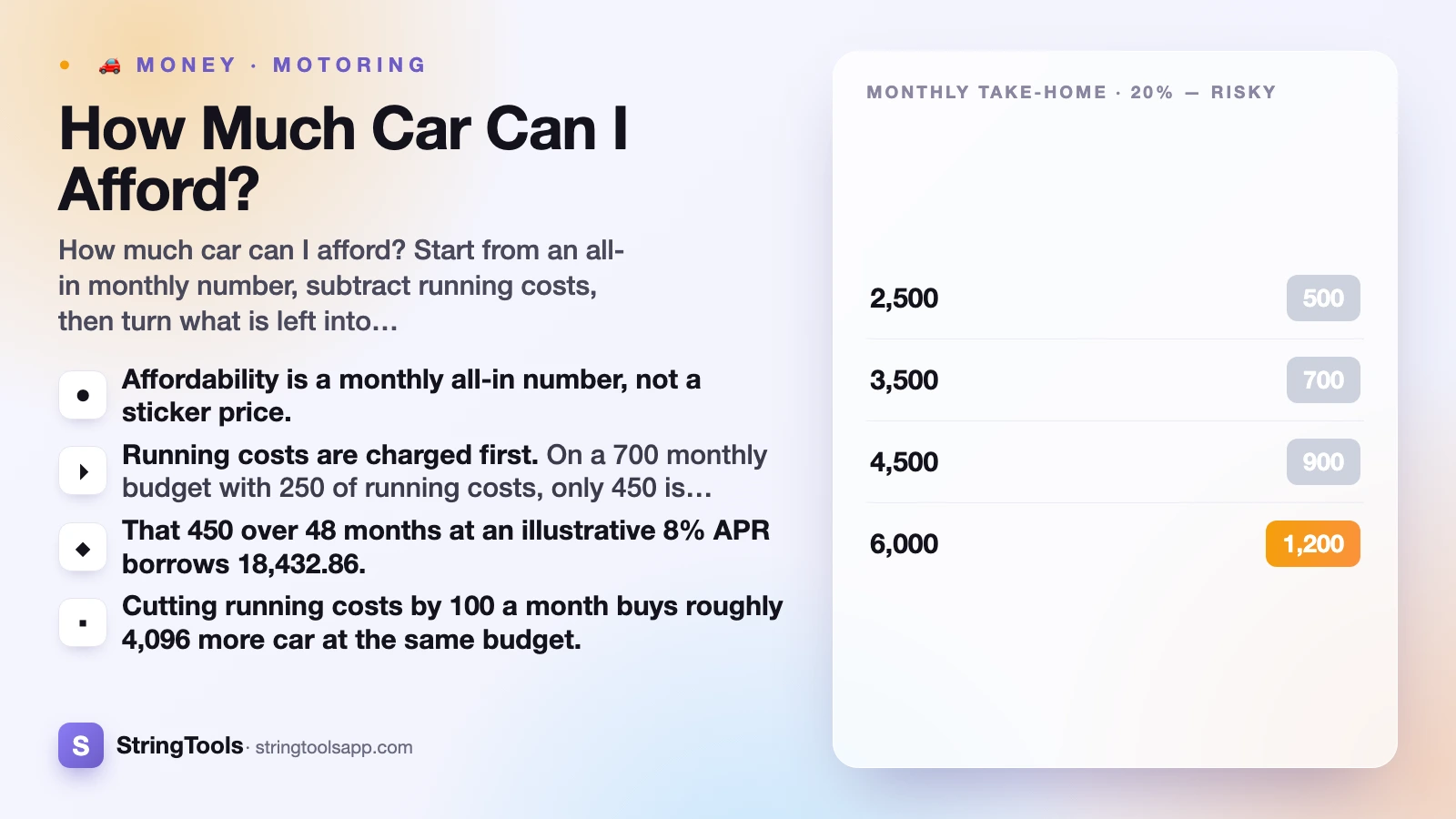
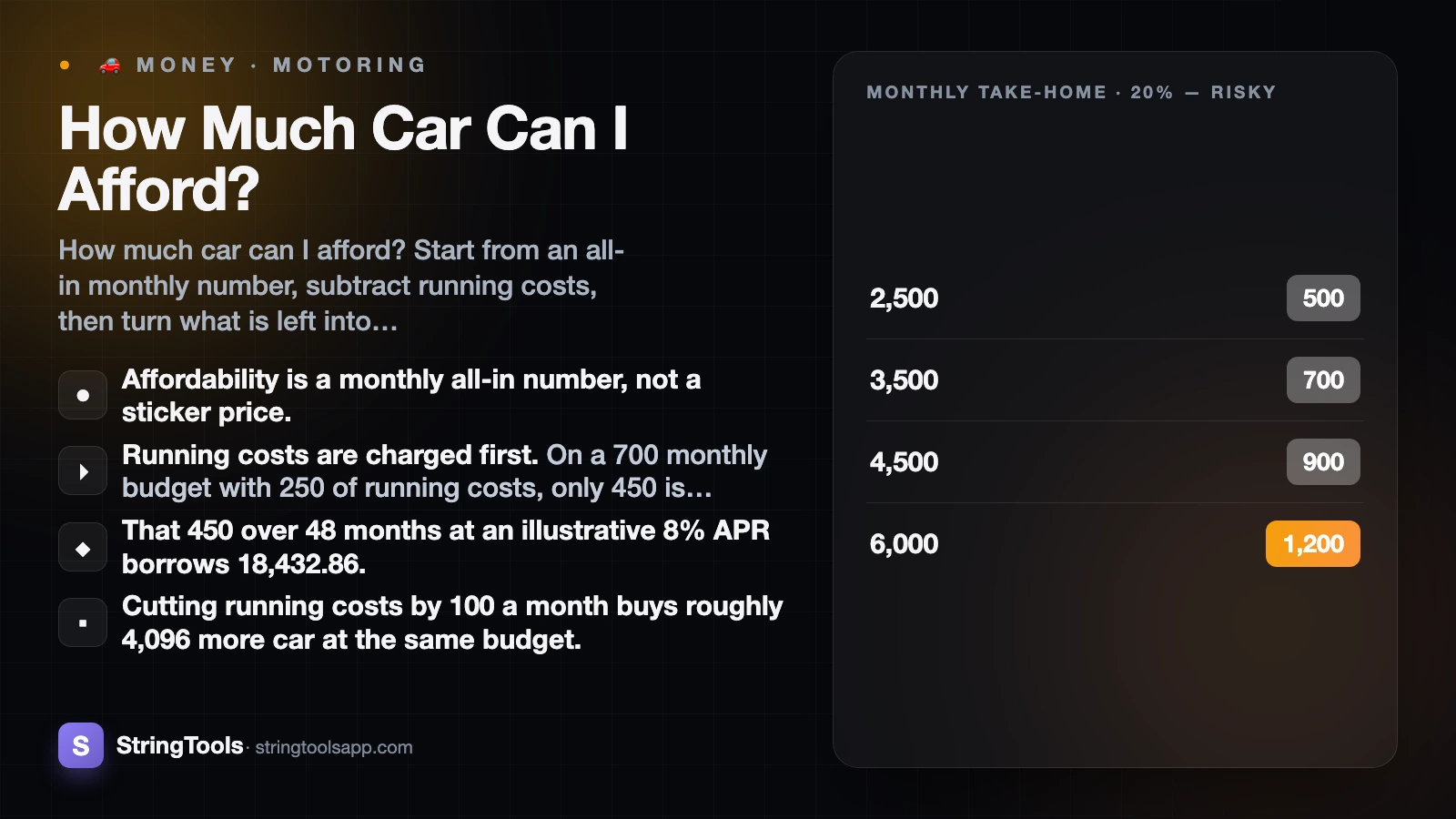
- Running costs are charged first. On a 700 monthly budget with 250 of running costs, only 450 is available for finance.
- That 450 over 48 months at an illustrative 8% APR borrows 18,432.86. With a 2,000 deposit, the car can cost 20,432.86.
- Cutting running costs by 100 a month buys roughly 4,096 more car at the same budget. Adding 2,000 to the deposit buys exactly 2,000 more car.
- A longer term raises the price you can reach and raises the interest you pay for it, which is a different trade from the one the monthly figure implies.
- Most budgeting guidance treats a car that takes under 10% of take-home pay as comfortable and 20% or more as risky.
Every rate and cost below is illustrative, chosen to keep the arithmetic readable. This is general information, not financial advice.
The dealer asks the wrong question on purpose
"What monthly payment were you looking for?" is the most expensive question in the showroom. It sounds like a budgeting question. It is a targeting question: any price can be made to fit any payment by stretching the term, and once you answer, the conversation is about the payment rather than the car.
The payment is also only part of what the car takes. Insurance, fuel or charging, servicing and tyres, road tax or registration, and parking all arrive on the same bank statement as the finance instalment, and they arrive whether or not there is a loan at all. Buy with cash and the finance line disappears while the other five stay exactly where they were.
So the honest version of the question is: what is the largest total monthly commitment I can make to a car, and what price does that commitment reach once the running costs are paid? That is the order the car affordability calculator works in, and it is the order the rest of this guide follows. If you want the monthly figures unpacked line by line, what a car really costs per month does exactly that.
Step one: set the all-in monthly number
Start with take-home pay, not gross. Tax and pension contributions never reach your account, so they cannot pay for a car.
There is no law here, but the bands most budgeting guidance converges on are easy to remember, and they are the bands the calculator uses. Under 10% of take-home pay on all car costs together is comfortable: a surprise repair fits without borrowing. Between 10% and 15% is manageable for most households. Between 15% and 20% the car is competing with your saving. At 20% or more, one depreciating object is taking a fifth of everything you earn, and there is nowhere for a bad month to go.
| Monthly take-home | 10% — comfortable | 15% — stretched begins | 20% — risky |
|---|---|---|---|
| 2,500 | 250 | 375 | 500 |
| 3,500 | 350 | 525 | 700 |
| 4,500 | 450 | 675 | 900 |
| 6,000 | 600 | 900 | 1,200 |
Read the middle column as a ceiling rather than a target. If you are also clearing debt, rebuilding savings, or living somewhere with high housing costs, your own ceiling sits below the table's. A car budget set before an emergency fund exists is a car budget that will be paid for with a credit card the first time the clutch goes.
Step two: charge the running costs before you shop
Running costs are not a footnote to the payment. On a mid-size car they routinely come to somewhere between a third and half of the monthly cash cost, and they are the part that varies most between two cars of the same price.
Six lines are worth pricing before you choose a car, not after:
- Insurance. Get real quotes for the specific model, your postcode and your age. A premium can change which car is affordable more than the price does.
- Fuel or charging. Your mileage times your economy times your local price. Work it out with the fuel cost calculator rather than guessing, because this is the line that moves most with the car you choose.
- Servicing, tyres and repairs. Part predictable, part lottery. A fixed monthly set-aside turns the lottery into a budget line.
- Road tax and registration. Small, but rarely zero, and in several countries it scales with emissions or value.
- Parking, permits and tolls. Often the difference between a cheap car in a village and an expensive one in a city.
- Anything else — breakdown cover, cleaning, a second driver on the policy.
The effect on what you can buy is direct. Holding the budget at 700 a month over 48 months at an illustrative 8% APR with a 2,000 deposit:
| Monthly running costs | Left for finance | Loan it supports | Maximum car price |
|---|---|---|---|
| 150 | 550 | 22,529.05 | 24,529.05 |
| 250 | 450 | 18,432.86 | 20,432.86 |
| 350 | 350 | 14,336.67 | 16,336.67 |
| 450 | 250 | 10,240.48 | 12,240.48 |
Each 100 a month of running costs removes about 4,096 from the price you can reach. That is the whole argument for checking an insurance quote before you fall in love with a car.
Step three: turn the leftover payment into a price
A loan payment and a loan size are the same fact stated two ways. The standard amortised payment is:
M = P x r(1+r)^n / ((1+r)^n - 1)
where P is the amount borrowed, n is the number of months, and r is the monthly rate — the APR divided by 12 and then by 100. Affordability runs it backwards, solving for the principal a known payment supports:
P = M x ((1+r)^n - 1) / (r(1+r)^n)
That is the ordinary present value of an annuity, and it is the exact inverse of the first formula, so the two round-trip: feed 450 into one and 18,432.86 comes out, feed 18,432.86 into the other and you get 450 back. If the rate is zero, both collapse to P = M x n.
Here is the whole method in one table. Running costs 250 a month, 48-month term, illustrative 8% APR, 2,000 deposit:
| All-in monthly budget | Left for finance | Loan supported | Maximum car price |
|---|---|---|---|
| 400 | 150 | 6,144.29 | 8,144.29 |
| 500 | 250 | 10,240.48 | 12,240.48 |
| 600 | 350 | 14,336.67 | 16,336.67 |
| 700 | 450 | 18,432.86 | 20,432.86 |
| 800 | 550 | 22,529.05 | 24,529.05 |
| 900 | 650 | 26,625.24 | 28,625.24 |
| 1,000 | 750 | 30,721.43 | 32,721.43 |
The figures are currency-neutral: read the units as your own. Change the APR or the term and every row moves, which is why the tool asks you for both rather than assuming them. For the mechanics of how each instalment splits between interest and principal, see how loan amortization works.
What the deposit and the term actually do
The deposit and the term both raise the price you can reach, and they are not remotely equivalent.
A deposit is a pound-for-pound transfer. It does not interact with the rate or the term at all: on the 700 budget above, the 450 payment borrows 18,432.86 whatever you put down, so a 2,000 deposit means a 20,432.86 car and a 6,000 deposit means a 24,432.86 car. No interest is paid on money you did not borrow. Rolling an outstanding balance from your current car into the new loan works the same way in reverse, and it comes straight off the price of the new car rather than being absorbed somewhere.
The term is a different animal. Stretching it raises the loan a given payment supports, but every extra month is charged for. At 450 a month and an illustrative 8% APR:
| Term | Loan supported | Total repaid | Interest |
|---|---|---|---|
| 36 months | 14,360.31 | 16,200.00 | 1,839.69 |
| 48 months | 18,432.86 | 21,600.00 | 3,167.14 |
| 60 months | 22,193.30 | 27,000.00 | 4,806.70 |
| 72 months | 25,665.53 | 32,400.00 | 6,734.47 |
| 84 months | 28,871.67 | 37,800.00 | 8,928.33 |
Going from 48 to 84 months buys 10,438.81 more car and costs 5,761.19 more interest. Whether that is a good trade is a real question rather than a rhetorical one, and it is the subject of should you take a longer car loan.
Cross-check the answer against 20/4/10
Once you have a candidate car, it is worth testing it against the rule of thumb most often quoted in consumer-finance writing: put 20% down, borrow for no more than four years, and keep total vehicle costs under 10% of income — gross income, which is how the rule is normally quoted, and part of why it is more permissive than the take-home bands used above. It is not a lending standard and no lender applies it, but as a second opinion it is unusually good at catching the two failure modes that matter — too little down and too long a term.
Run the 20,432.86 car from the main example through it. A 2,000 deposit is 9.8% of the price, so the first leg fails. The 48-month term passes. Whether the third leg passes depends on the income you entered. The calculator runs a narrower version of that leg: it measures the loan payment plus insurance — the two costs you are contractually committed to — against your take-home pay, rather than all vehicle costs against gross. The two checks are not interchangeable, so read its result as a second opinion on the payment rather than as the rule itself. One failed leg is not a veto, but it tells you exactly which lever to pull. Because the deposit also raises the price you can reach, getting to a true 20% here means putting down 4,608.21 against a 23,041.07 car — about 2,608 more than planned — or simply shopping cheaper.
The 20/4/10 rule covers where it came from, and the places where it quietly stops working — particularly on lower incomes and in expensive cities, where the rule can price you out of any car at all. The US Federal Trade Commission's guidance on financing or leasing a car is a better guide to the paperwork you will actually be asked to sign.
The ten-minute version, tonight
Open your banking app and find last month's take-home figure. Multiply it by 0.10 and 0.15. Those two numbers bracket your all-in monthly budget, and the second is a ceiling rather than a plan.
Then price the running costs for the actual car you are considering, not a generic one. Two insurance quotes, one fuel-cost run at your real weekly mileage, a servicing set-aside, and whatever tax and parking cost where you live. Subtract that total from your budget.
Whatever survives is your finance payment. Put it into the car affordability calculator with a realistic term, the APR you have actually been quoted rather than an advertised headline rate, and your deposit. It runs the sum backwards and gives you a maximum price, a full cost breakdown including depreciation, the share of take-home pay the car would take, and the 20/4/10 check. Everything stays in your browser on that device.
Then do the thing that makes the whole exercise worth it: take the price it gives you and shop under it. The gap between the maximum you can afford and the amount you choose to spend is the only part of this that you get to keep. For current borrowing conditions rather than the illustrative 8% used here, the Federal Reserve publishes average consumer credit terms in its G.19 release, and the CFPB's auto loan resources explain what to check before signing.
Frequently Asked Questions
How much car can I afford on a 3,500 monthly take-home pay?
Most budgeting guidance would put the all-in ceiling between 350 (10%, comfortable) and 525 (15%) a month for everything the car costs. Take 500 of that, subtract 250 of running costs, and 250 is left for finance. Over 48 months at an illustrative 8% APR that borrows 10,240.48, so with a 2,000 deposit the car can cost 12,240.48. Lower the running costs and the price rises.
Should car affordability be based on gross or take-home pay?
Take-home pay. Tax and pension contributions never arrive in your account, so a percentage of gross overstates what is available by whatever your deductions come to. The 20/4/10 rule of thumb is usually quoted against gross income, which is one reason it is more permissive than the take-home bands used here.
Does a bigger deposit let me buy a more expensive car?
Yes, and pound for pound. The deposit does not change the loan your payment supports, so it simply adds to the price. On a 450 monthly payment over 48 months at an illustrative 8% APR the loan is 18,432.86 whatever you put down: a 2,000 deposit means a 20,432.86 car, a 6,000 deposit means a 24,432.86 car. You also pay no interest on the part you did not borrow.
What percentage of income should a car payment be?
There is no fixed rule. The bands most guidance converges on treat all car costs together — finance, insurance, fuel, servicing, tax and parking — as comfortable under 10% of take-home pay, manageable to about 15%, stretched to 20%, and risky above that. A payment-only percentage flatters the car, because the payment is often little more than half the monthly cost.
Can I afford a car with no deposit?
Often yes, but you buy less car and you spend longer owing more than it is worth. With no deposit the entire price is borrowed, so the price you can reach is exactly the loan your payment supports, and the balance starts above the car's value the moment it is registered. A deposit is the cheapest way to shorten that period, because it costs no interest.
How do I work out the maximum car price by hand?
Take your monthly payment M, the monthly rate r (APR divided by 12 then by 100) and the number of months n, then compute P = M x ((1+r)^n - 1) / (r(1+r)^n) and add your deposit. At 450 a month, 8% APR and 48 months, r is 0.0066667, (1+r)^48 is about 1.375666, and P works out to 18,432.86. If the rate is zero, the loan is simply M x n.
Sources and references
financing or leasing a car (consumer.ftc.gov) · G.19 release (federalreserve.gov) · CFPB's auto loan resources (consumerfinance.gov). Content was reviewed against these sources as of the last-updated date above; external figures and rules may change after publication.