
The 5-Second Math That Changes How You See Money
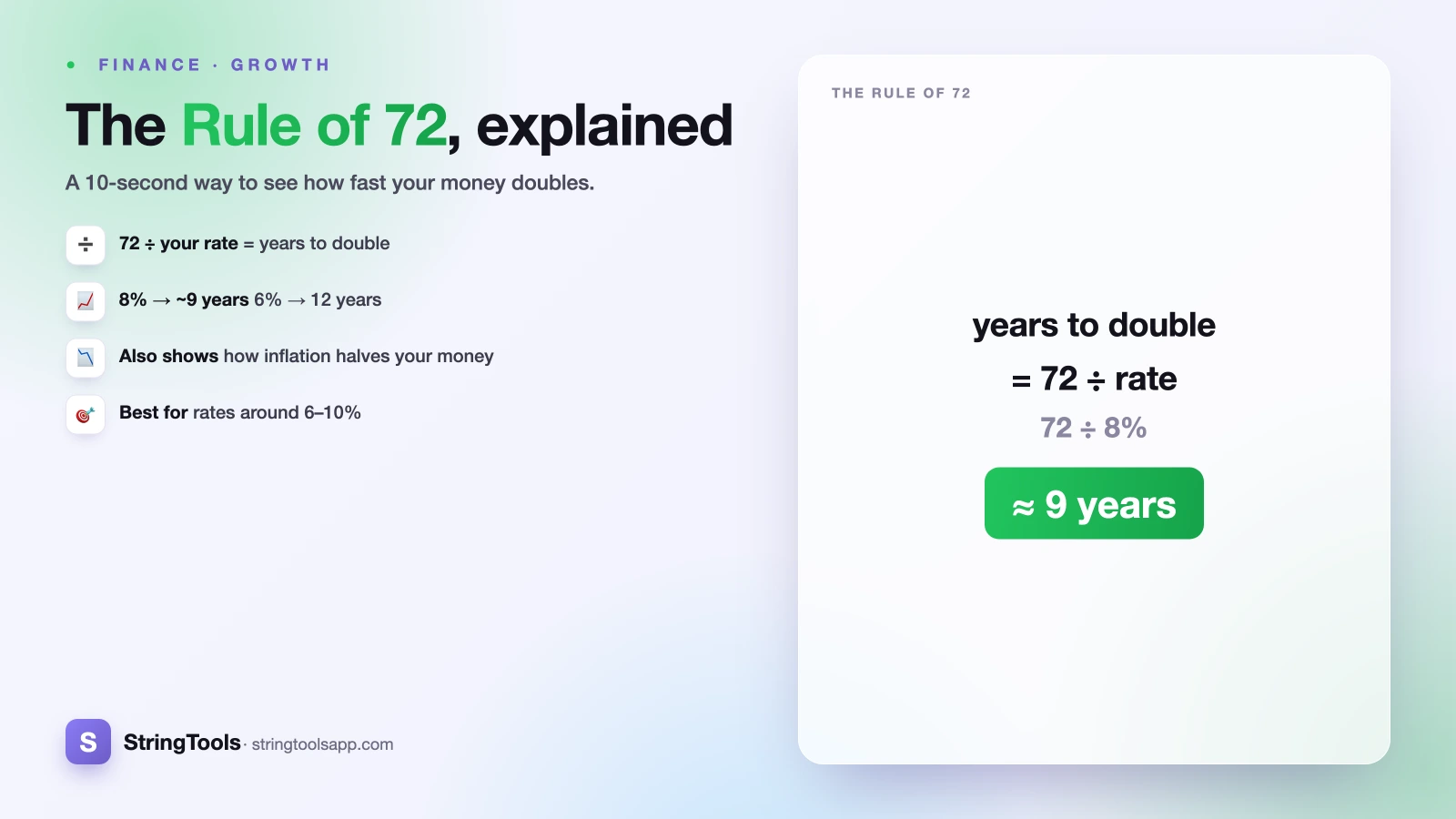
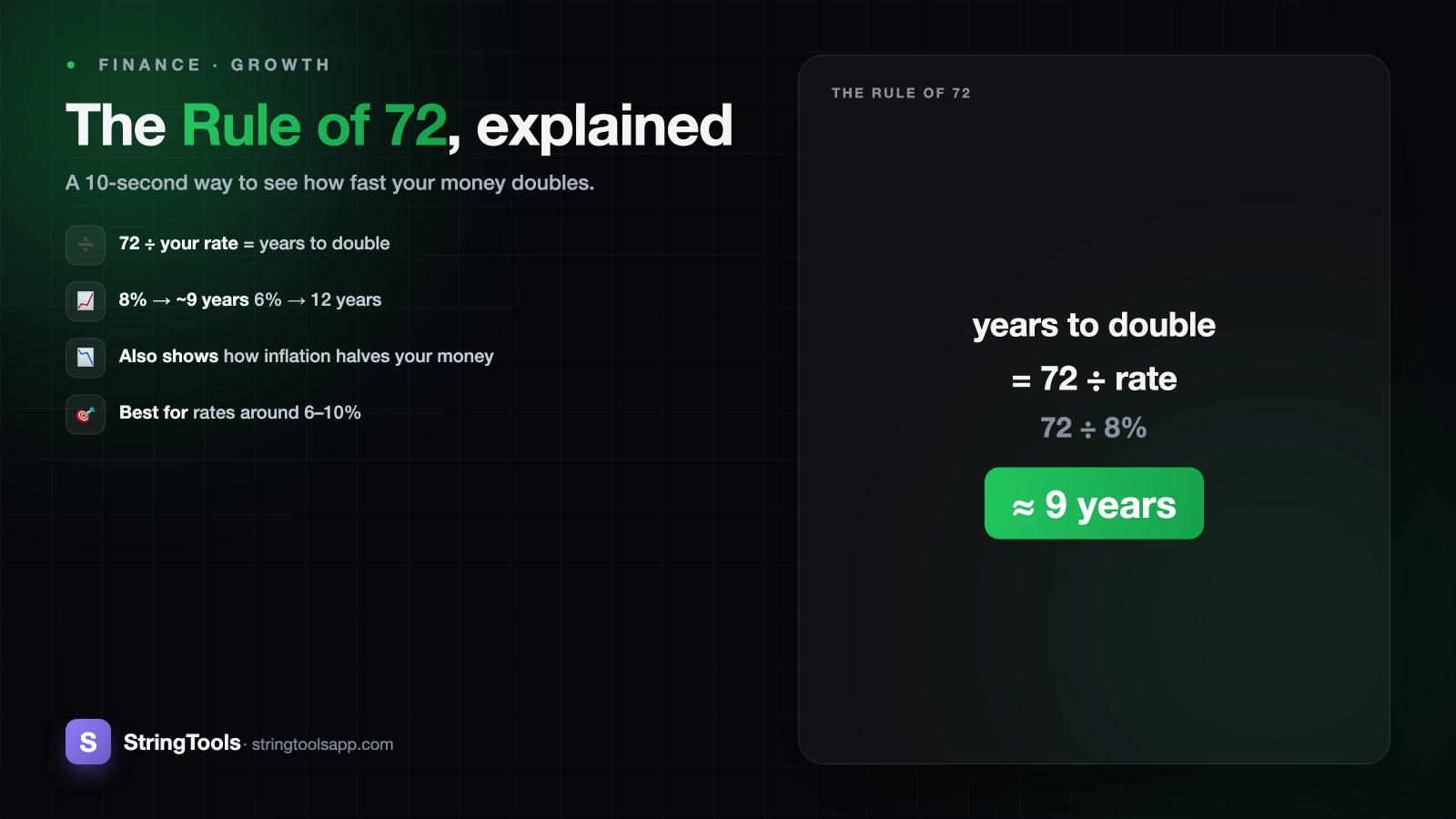
Here is a number you can do in your head at a dinner party: divide 72 by your annual return, and you get the years it takes your money to double. Earning 8% a year? Your money doubles in about 9 years. Earning 6%? Twelve years. That's it. No spreadsheet, no calculator, no logarithms.
This shortcut is called the Rule of 72, and it has been used by bankers, investors, and quietly savvy savers for centuries. It won't give you an exact answer to the penny, but it's remarkably close for the returns most people actually earn, and it turns the abstract idea of "compounding" into something you can feel.
The real power isn't the doubling trick itself. It's that once you internalize it, you start seeing the hidden cost of low returns, the slow theft of inflation, and the compounding trap of debt, all in the same simple frame. This is general education, not financial advice, but by the end you'll have a tool you can use for the rest of your life.
How the Rule of 72 Actually Works
The formula is almost embarrassingly simple:
Years to double ≈ 72 ÷ annual interest rate
Use the rate as a whole number, not a decimal. So for 8%, you divide 72 by 8, not by 0.08. That gives you 9 years.
You can also run it backwards. If you know how many years you have and want to find the return you'd need to double your money, just divide 72 by the number of years:
Required rate ≈ 72 ÷ years to double
Want to double your money in 10 years? You need roughly 72 ÷ 10 = 7.2% a year. Want it in 6 years? You'd need about 12%. This reverse version is great for sanity-checking any "double your money" pitch. If someone promises to double your cash in 3 years, that implies about 24% a year, sustained, which should make you deeply skeptical.
The reason 72 works is rooted in the math of exponential growth. The precise doubling time comes from natural logarithms (specifically, the natural log of 2 is about 0.693, so the "true" constant is closer to 69.3). But 72 is easier to divide evenly by 2, 3, 4, 6, 8, 9, and 12, which is exactly the range of returns people care about, so it became the popular standard.
Worked Examples at Real-World Rates
Let's put actual numbers to it. Say you invest $10,000 and leave it alone.
At 6% a year: 72 ÷ 6 = 12 years to double. So after 12 years you'd have roughly $20,000, after 24 years about $40,000, and after 36 years around $80,000.
At 8% a year: 72 ÷ 8 = 9 years. Your $10,000 becomes about $20,000 in 9 years, $40,000 in 18, and $80,000 in 27.
At 9% a year: 72 ÷ 9 = 8 years. Roughly $20,000 in 8 years, $40,000 in 16, $80,000 in 24.
At 12% a year: 72 ÷ 12 = 6 years. That's $20,000 in 6 years and $40,000 in 12.
Notice how a seemingly small difference in rate reshapes the outcome. Over 36 years, 6% gives you three doublings ($80k) while 8% gives you four ($160k). Same starting cash, double the result, all from three extra percentage points. That is the entire argument for caring about fees and returns, compressed into one comparison. To see the exact dollar figures for your own numbers, run them through the compound interest calculator rather than trusting the rounded estimate.
The Rule Works Against You, Too
Here's the uncomfortable flip side: doubling math doesn't care whether the thing growing is your wealth or your problems. The Rule of 72 also tells you how fast money loses value and how fast debt grows.
Inflation: If prices rise 6% a year, the purchasing power of your cash is cut in half in about 72 ÷ 6 = 12 years. A $100 grocery run today would cost about $200 in the same basket after 12 years of 6% inflation. Even a "mild" 3% inflation halves your money's value in roughly 24 years, which is a big deal over a retirement. This is why cash sitting in a near-zero savings account can quietly lose ground.
Debt: Credit card interest compounds against you the same way. At 24% APR, unpaid debt effectively doubles in about 72 ÷ 24 = 3 years. That's how a balance you "meant to pay off" balloons if you only make minimum payments.
Fees: A 1% annual fund fee doesn't sound like much, but over decades it eats a meaningful slice of your doublings. Seeing returns and drags in the same doubling frame is what makes the rule so clarifying. For the difference between advertised and real rates, see APR vs APY vs interest rate.
Where the Rule Gets Fuzzy (and How to Fix It)
The Rule of 72 is an approximation, and it's honest to say where it drifts. It's most accurate for annual rates roughly between 6% and 10%, the sweet spot where it lands within a few months of the true answer.
At the extremes it wanders. At very low rates, the more accurate constant is closer to 69.3 or 70. At very high rates, the estimate overshoots the true doubling time. For example, the Rule of 72 says 24% doubles money in 3 years, but the mathematically exact figure is closer to 3.2 years, and at 2% the rule says 36 years while the true value is about 35.
A common refinement: some people use 69.3 or 70 for continuous compounding (the theoretical limit where interest is calculated constantly), and a few add a small adjustment, bumping the number up toward 72 or 73 for higher rates. In practice, most people just keep 72 because the error is tiny in the range that matters and the mental math stays clean.
The bottom line: treat the Rule of 72 as a fast estimate for intuition and back-of-envelope planning, not as the number you'd put in a financial plan. When precision matters, verify with a calculator.
How to Actually Use This in Your Life
The Rule of 72 shines as a decision filter, not a forecasting engine. A few practical ways to put it to work:
Stress-test any investment pitch. If a return sounds too good, convert it to a doubling time and ask whether that's plausible. "Double your money in 2 years" implies about 36% a year, sustained, which almost nobody delivers safely.
Compare your options quickly. A savings account at 4% doubles your money in 18 years; a diversified portfolio historically averaging around 7-8% doubles in roughly 9-10. That gap, seen as doublings, is often the nudge people need to stop leaving long-term money in cash.
Plan around your time horizon. If you're 30 and money you won't touch until 60 grows at 8%, that's over three doublings. A dollar today could become roughly eight. That framing makes "start early" concrete instead of preachy.
Watch your debt with the same lens. Any balance at 20%+ interest is doubling in under four years if ignored. Prioritize accordingly. For the mechanics behind all of this, read compound interest explained.
Verify Before You Rely: Run Your Own Numbers
The Rule of 72 is a wonderful thinking tool, but it was never meant to replace real math. Two people with the same rate can end up with very different totals depending on how often interest compounds, whether they add contributions each month, and how taxes and fees bite. The rule ignores all of that by design, which is what keeps it simple.
So use 72 to build intuition and to sniff out claims that don't add up, then confirm the actual dollars before you make a decision. Plug in your starting amount, your rate, your time horizon, and your monthly contributions, and let the math be exact.
The fastest way to do that is our free, privacy-first compound interest calculator. It runs entirely in your browser, so your numbers never leave your device, and it shows you the precise doubling point plus the full growth curve. Try entering the examples above and watch how close the Rule of 72 gets, then adjust for your real situation.
This article is general education, not personalized financial advice. For decisions about your specific circumstances, consider speaking with a qualified professional.
Frequently Asked Questions
Is the Rule of 72 accurate?
It's a close approximation, not an exact figure. The Rule of 72 is most accurate for annual rates between roughly 6% and 10%, where it lands within a few months of the true doubling time. At very high or very low rates it drifts, so use it for quick intuition and verify precise figures with a compound interest calculator.
Why is the number 72 and not 70 or 69?
The mathematically exact constant is about 69.3 (the natural log of 2). But 72 divides cleanly by 2, 3, 4, 6, 8, 9, and 12, which covers the return rates people care about most, making mental math easy. Some use 69.3 or 70 for continuous compounding or very low rates.
Can the Rule of 72 show how inflation erodes savings?
Yes. Divide 72 by the inflation rate to estimate how long until your money's purchasing power is cut in half. At 6% inflation, that's about 12 years; at 3%, roughly 24 years. It's a stark way to see why cash held too long can quietly lose real value over time.
How do I find the return needed to double my money?
Flip the formula: divide 72 by the number of years you have. To double your money in 10 years, you'd need about 7.2% a year; in 6 years, roughly 12%. This reverse check is handy for spotting unrealistic promises, since short doubling times imply very high, hard-to-sustain returns.
Does the Rule of 72 work for debt and credit cards?
Yes, compounding works the same against you. Divide 72 by your interest rate to see how fast a balance doubles if left unpaid. At 24% APR, debt effectively doubles in about 3 years. It's a quick way to grasp why high-interest balances are so urgent to pay down.