
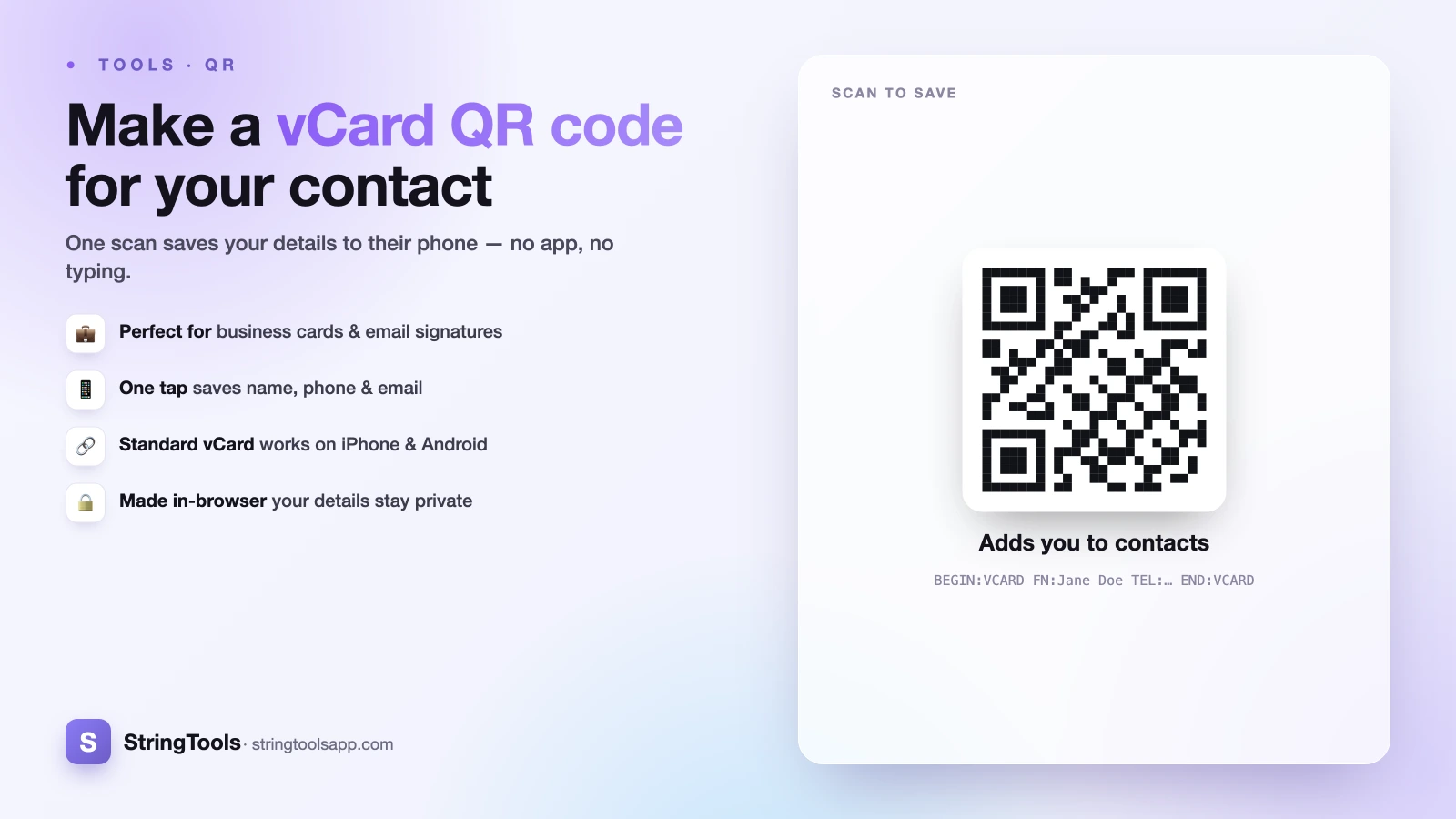
One scan, and you're in their phone
You hand someone a paper business card. Best case, it sits in a drawer. Worst case, it's in the bin before you reach the car park. Either way, your details rarely make it into the one place that matters: their phone's Contacts app.
A vCard QR code fixes that. It's a small square barcode that holds your name, phone, email, company, and website. Someone points their camera at it, taps the banner that pops up, and you're saved as a contact instantly. No typing, no misspelled surnames, no lost cards.
That single tap is why vCard QR codes have quietly become the standard on modern business cards, email signatures, conference badges, shop windows, and market stalls. This guide walks through exactly how to make one, what to put in it, and how to keep it scannable in the real world. You can build yours for free in a couple of minutes with our QR code generator — and because it runs entirely in your browser, your contact details never leave your device.
What a vCard QR code actually is
A QR code is just a container for text. What makes a "vCard" QR code special is the format of that text: it follows the vCard standard, a plain-text structure that phones recognize as contact information.
A basic vCard looks like this in the raw:
BEGIN:VCARD VERSION:3.0 FN:Priya Sharma ORG:Northwind Design TEL:+44 20 7946 0958 EMAIL:priya@northwind.example URL:https://northwind.example END:VCARD
When a camera decodes those lines, it doesn't just show text — it understands FN as a full name, TEL as a phone number, and EMAIL as an email. That's what triggers the "Add to Contacts" option instead of a plain wall of characters.
There's also a shorter cousin called MeCard, originally from Japanese phones, which packs the same idea into a compact single line: MECARD:N:Sharma,Priya;TEL:+442079460958;EMAIL:priya@northwind.example;;. MeCard produces a slightly simpler QR code because it holds fewer characters, though vCard is more widely supported for richer fields. Most generators, including ours, let you fill in a friendly form and handle the format behind the scenes.
No app needed: how phones read it
The reason vCard QR codes work so well is that support is built into the phone, not bolted on with a separate app.
On an iPhone, open the native Camera app and point it at the code. A yellow banner slides up offering to create a new contact — tap it, review the fields, and hit Done. This has worked on every iPhone since iOS 11.
On Android, the stock Camera app (or Google Lens) does the same on most phones running Android 9 and up. Point, wait for the prompt, tap to save. Some budget or older Android cameras don't scan automatically; in that case Google Lens or any free QR app reads it fine.
That near-universal, no-download experience is the whole pitch. The person you just met doesn't have to install anything or trust an app store — they use the camera they already had open. For a US, UK, Canadian, or Australian audience where iPhones and recent Androids dominate, you can reasonably assume the scan will just work.
How to make yours in four steps
Here's the full process using our free generator.
1. Open the QR code generator and choose the contact or vCard option. You'll get a form instead of a plain text box.
2. Fill in your details: full name, phone number, email, company, job title, and website. Enter the phone number in full international format (for example +1 415 555 0132) so it dials correctly no matter where the scanner lives.
3. Generate and preview. The QR code appears instantly. Test it right away by scanning it with your own phone — confirm your name and number land in the contact card exactly as expected.
4. Download the image (PNG is fine for screens; ask for SVG if you're sending it to a printer, since it scales without going blurry).
That's it. The whole thing happens in your browser, so nothing is uploaded to a server. Worked example: a freelance photographer puts her name, mobile, Gmail, and portfolio URL into the form, downloads the PNG, and drops it into the footer of her email signature. Every reply now carries a one-tap way to save her — no attachment, no landing page.
Keep it short so it stays scannable
Here's the trade-off nobody mentions: the more data you cram into a QR code, the denser and harder to scan it becomes. Each extra field adds more tiny squares (called modules), and past a point the pattern gets so fine that cameras struggle, especially on a small printed card or in poor light.
So be ruthless about what earns a place. A strong vCard usually needs just four things:
- Full name
- One phone number (your best contact number, not three)
- One email address
- One website or company URL
Skip the second fax line, the full postal address, and the long job description unless they genuinely matter. If you find yourself wanting to include a whole profile — social links, address, bio, a photo — that's a sign you want a link to a page rather than a fat vCard. A single short URL in the QR keeps the code sparse and lets the page hold everything else. Our companion guide on static vs dynamic QR codes covers when that link-based approach is worth it.
Printing and design that survive the real world
A QR code that scans perfectly on your monitor can fail on a printed card if you ignore a few physical basics.
Size: aim for at least 2 x 2 cm (about 0.8 inches) on a business card, and larger for anything read from a distance. A rough rule for posters and shop windows is that scan distance is roughly ten times the code's width — a 3 cm code reads comfortably from about 30 cm, a 30 cm poster code from around 3 metres.
Contrast: dark code on a light background, always. Black on white is safest. Avoid low-contrast pairings like grey-on-beige, and never invert to a light code on a dark background unless you've tested it — many scanners expect dark-on-light.
Quiet zone: leave clear empty space (a margin of at least four modules) around the code. Text or graphics crowding the edge is a common reason a code won't lock on.
After printing, test the actual printed piece with two or three different phones before you order 500 of them. Ink bleed, glossy glare, and lamination can all affect a real scan in ways a screen preview won't reveal.
The one catch: it's permanent, so plan for change
A vCard QR code is a static QR code. That means your contact details are baked directly into the pattern of the code itself — there's no server in the middle, which is exactly why it's free forever, works offline, and can't secretly track who scans it.
The flip side: if your phone number or email changes, the old printed code still points to the old details. You can't edit a printed square. You regenerate a fresh QR code and reprint whatever it lives on.
For most people that's a fair deal — you don't change your mobile number often, and reprinting a business card is cheap. But if you expect details to change (a new starter whose extension isn't assigned yet, a rebrand in progress), consider encoding a stable short link to a contact page instead, so you update the page rather than the code. And the same static-code idea powers plenty of other everyday uses — see how to make a WiFi QR code for letting guests join your network without sharing the password out loud.
Ready to make yours? Open the free, private, browser-based QR code generator, fill in your details, and you'll have a scannable contact code in under two minutes — no signup, no watermark, and nothing sent to a server.
Frequently Asked Questions
Is a vCard QR code free, and does it expire?
Yes. A vCard QR code is a static code, meaning your details are stored inside the pattern itself with no subscription and no server involved. It never expires and works offline forever. The only limitation is that you can't edit it after printing — if your details change, you generate and reprint a new one.
What's the difference between vCard and MeCard formats?
Both encode contact details so a phone offers to save them. vCard is the fuller international standard with clearly labelled fields and the widest support. MeCard packs the same core details into one compact line, producing a slightly simpler code. For most people the practical difference is minor; a good generator picks a sensible format for you.
Do people need an app to scan my contact QR code?
No. iPhones read vCard QR codes with the built-in Camera app (since iOS 11), and most Android phones do the same through the stock camera or Google Lens (Android 9 and up). The scanner just points their camera and taps the prompt to save you. Only some older or budget Android cameras may need a free QR app.
How much information should I put in a vCard QR code?
Keep it lean: full name, one phone number, one email, and one website usually cover it. Every extra field makes the code denser and harder to scan, especially when printed small. If you need to share a lot — address, social links, a bio — encode a short link to a contact page instead of stuffing it all into the code.
Are my contact details private when I generate the code?
With our generator, yes. The QR code is created entirely in your browser, so your name, number, and email are never uploaded to a server. Because the finished code is static, it also contains no tracking — scanning it saves your contact without reporting anything back to you or anyone else.