
Retirement is a date you calculate, not an age you are given
You can afford to retire on the date your savings, plus any pension income, can cover your target spending for the rest of your life. Work it out by pricing the retirement you actually want, subtracting income that starts later, and finding the year your pot reaches that figure.
Key Takeaways
- Your date rests on four numbers: target spending in retirement, what you have saved, what you add each year, and the return you assume after inflation. You control the first three.
- Plan from your spending, not your salary. A salary includes tax, pension contributions and commuting costs that all stop when you do.
- Most people stop working before any state pension starts, so a plan has two phases: the bridge years funded entirely by you, then the years with pension income alongside.
- Where health cover is tied to a job or an eligibility age, the bridge years are the expensive ones — and that cost often sets the earliest workable date.
- The levers are asymmetric. Spending less pulls the date in twice over, because it lowers the target and raises what you save each year.
- Part-time or phased work is what most people actually do, and it helps the plan more than the modest income suggests.
The usual question is "what age can I retire?", which quietly assumes somebody else decides. They don't. A government sets the age its pension starts paying, and a scheme sets the age you can touch its money — but the date you stop working for a living is an output of your own arithmetic. Two people the same age, on the same salary, can have retirement dates a decade apart purely because one of them spends less.
This is general information, not financial advice. A regulated adviser is the right person for a decision this irreversible.
Step one: price the retirement you want, not the salary you earn
The most common planning mistake is anchoring to income. You hear that you need 70–80% of your final salary, multiply, and move on. That rule of thumb exists because it is easy, not because it fits you: it overshoots badly for someone who has cleared their mortgage, and undershoots for someone planning to travel for a decade.
Build the number from the bottom instead. Take what you actually spend in a year, then adjust each line for the version of you who no longer goes to work.
| Cost | What usually happens when you stop working | Worth checking |
|---|---|---|
| Mortgage or rent | Drops to zero if the mortgage is cleared; unchanged if you rent | Whether the loan genuinely ends before your target date |
| Retirement contributions | Stop entirely | Often one of the largest single lines to disappear |
| Commuting, parking, work clothes, lunches | Fall sharply | Add up a real month, not a guess |
| Payroll and income taxes | Usually fall, because the income is lower and often taxed differently | Rules differ by country and by account type |
| Food, heating, electricity | Flat to slightly up — you are home all day | A quiet, real increase people miss |
| Travel, hobbies, eating out | Often rise in the first decade, then taper | Budget the early "go-go" years honestly |
| Health cover, dental, optical, care | Rise with age in almost every system | The line most likely to be underestimated |
| Supporting children or parents | Falls, or doesn't, depending on timing | Be realistic about adult children |
Do the whole exercise in today's money. If every figure is in today's prices you can use a real return — the return after inflation — and skip inflating each line by hand. Just remember the actual cash number you will need decades out is larger.
Converting an annual spending target into a pot size is the well-trodden part: a common starting point is roughly 25 times annual spending, the inverse of a 4% withdrawal rate. Where that rule came from, and why researchers argue about it, is covered in how much do I need to retire.
The bridge years: the gap between your last payday and your first pension
Almost every retirement plan has a gap in the middle of it, and almost every online calculator glosses over it. You stop earning on one date. Your state or social-security pension starts on a different, later one. Between those dates, every penny you spend comes out of savings you can actually reach.
Three separate ages are usually in play, and they are not the same number:
- The state or social-security pension age. Set by government, different in every country, and frequently legislated upwards. Some systems also let you claim earlier or later, which permanently reduces or increases the payment.
- The minimum age you can access a private or workplace pension. Set by tax rules, usually earlier than the state pension age, and also subject to change.
- Your own retirement date. The one you choose, and the only one you control.
That structure has two consequences. First, your withdrawals are not level: they run high during the bridge, then step down when pension income arrives. A plan assuming flat drawdown from day one understates the strain on the early years — which are also the years a bad market run does the most damage.
Second, where your money sits matters as much as how much there is. A pot you cannot legally touch until a certain age cannot fund a bridge that starts before it. Plenty of people who can afford to retire early on paper cannot actually do it, because the accessible slice is too thin. If early retirement is the goal, the ordinary taxable savings account stops being the boring option and becomes the enabling one.
Never guess your pension figure. Get the official forecast: in the United States from the Social Security Administration, in the UK from GOV.UK, and elsewhere from your national pension authority. MoneyHelper is a useful neutral explainer for UK readers.
Why healthcare decides the date in some countries and not others
This is where retirement planning stops being universal. Two people with identical savings, in two different countries, can have retirement dates years apart because of one line item.
Where health cover is attached to employment and full public cover begins at a fixed eligibility age, the bridge years carry a cost that disappears afterwards. In the United States, employer coverage typically ends when the job does, while Medicare eligibility begins at its own set age. The gap has to be covered by an individual policy, continuation coverage, or a spouse's plan — and that premium is a quotable number, not an unknown. Get a real quote for the household you would have before you fix a date.
In systems with residency-based public healthcare, such as the UK's NHS, the picture is calmer: stopping work does not remove your cover, so the bridge is about income rather than insurance. That does not make it free. Dental, optical and residential care usually sit outside the core system, and long-term care is the largest late-life cost most plans ignore entirely.
The rule is the same either way: find out what happens to your cover on the day you stop working, and price it. If the answer adds a large annual cost for a fixed number of years, that cost belongs in the bridge, not spread across the whole retirement.
Turning it into an actual date
With a spending target and a pot target, the date is just the year your savings reach that figure. The mechanics:
- Target pot = target annual spending × your chosen multiple (25× is a common starting point), less any allowance for pension income that starts later.
- Growth = what you have now, compounded, plus what you add each year, compounded.
- The date = the year those two lines cross.
In formula terms, a pot of P growing at a real return r with C added each year reaches P(1+r)^n + C × ((1+r)^n − 1) ÷ r after n years. Solving for n by hand is unpleasant, which is what the retirement calculator is for — change one input, watch the date move.
One baseline, clearly labelled illustrative, is used for the rest of this article:
- Age 40 today, £150,000 already saved (the currency doesn't change the arithmetic).
- £12,000 a year added, and that continues.
- Target spending of £40,000 a year, so a target pot of £1,000,000 at 25×.
- 4% a year after inflation, chosen to keep the example simple.
On those assumptions the pot reaches £1,000,000 in about 27 years — a retirement date around age 67. Those are assumptions chosen for clarity, not a forecast: returns are not guaranteed and past performance does not predict future results.
The levers that move the date, and how unequal they are
Here is what happens to that baseline when you pull one lever at a time. Everything else is held constant, and every row uses the same baseline above.
| Change from the baseline | Years until the target pot | Date moves |
|---|---|---|
| Baseline — save £12,000/yr, spend £40,000/yr, 4% real return | 27.1 | — |
| Save 25% more (£12,000 → £15,000 a year) | 24.6 | 2.5 years earlier |
| Retire on 10% less (£40,000 → £36,000 a year), savings unchanged | 25.0 | 2.1 years earlier |
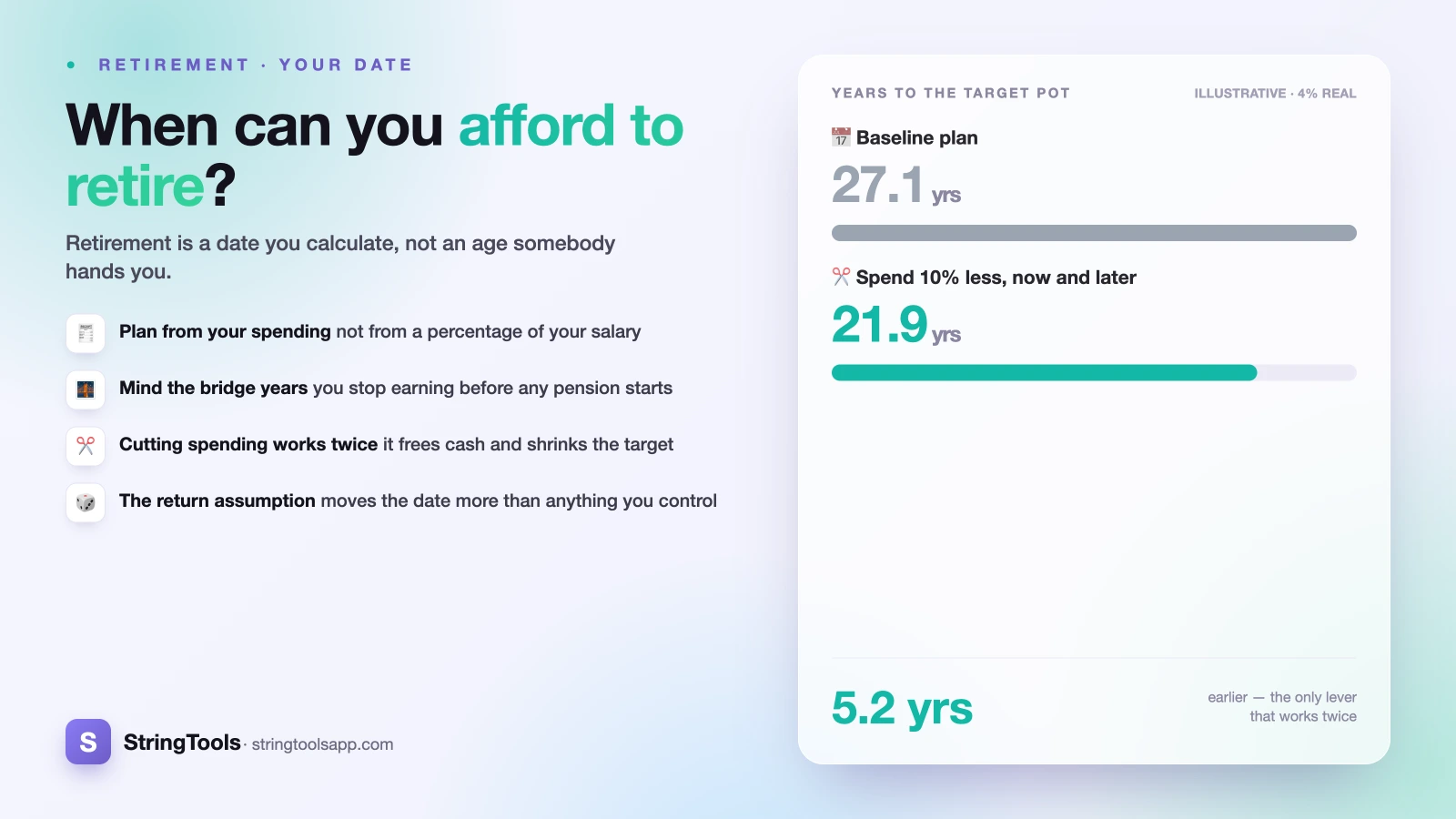
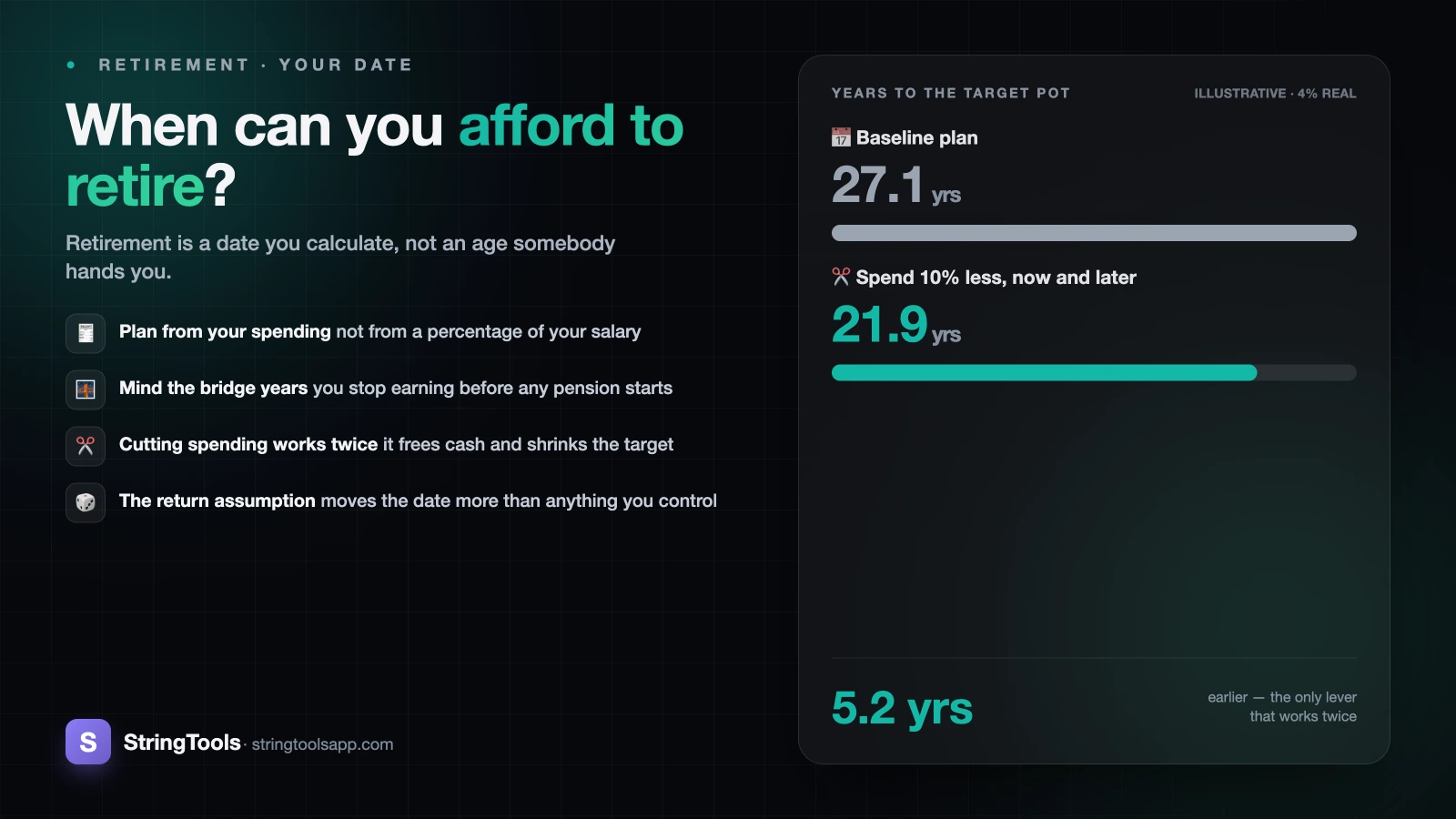
| Cut spending 10% now and in retirement (save £16,000, target £900,000) | 21.9 | 5.2 years earlier |
| Part-time work covering half your spending for the first 8 years | 24.3 | 2.8 years earlier |
| Returns come in at 5% real instead of 4% | 23.7 | 3.4 years earlier |
| Returns come in at 3% real instead of 4% | 31.6 | 4.5 years later |
Three things fall out of that table.
Cutting spending is the only lever that works twice. Saving more moves one number. Spending less moves two: it frees cash to invest and shrinks the target you are aiming at. That is why a 10% lifestyle trim beats a 25% rise in contributions by a wide margin — 5.2 years against 2.5.
Working longer is the most powerful lever and the one nobody wants. It is not in the table because it is not an input — it is the output. But note its shape: each extra year adds a year of contributions, removes a year of withdrawals, and gives the pot another year to compound. Near the finish line, one extra year can move sustainable spending more than a decade of small savings increases did at the start.
The return assumption is the biggest lever and the one you don't control. One percentage point either way swings the date by three to five years. That is the honest limit of any retirement calculation: the input with the largest effect is the one you are guessing at. Plan on a conservative real return and treat anything better as a bonus. Investor.gov, run by the SEC, is a neutral starting point on how returns and costs behave over long periods.
Part-time and phased retirement: the middle option most people actually take
The framing of a single retirement date — full-time on Friday, retired on Monday — is increasingly rare. What actually happens is a taper: four days, then three, then consulting a few months a year, then nothing. It is worth planning deliberately, because the numbers are better than they look.
Look again at the table: part-time work covering half your spending for eight years pulled the date in by 2.8 years, more than a 25% jump in contributions did. The reason has little to do with the income. It protects the early years. Withdrawals taken during a bad run of returns do the lasting damage, because you sell more units to raise the same cash and less is left to recover. Halving your drawdown during the bridge is one of the most effective risk reducers available, and it costs only time you were probably going to fill anyway.
The other advantages are less measurable and often more decisive:
- Where cover is job-linked, part-time work sometimes keeps a health plan alive through the expensive gap years.
- A gradual stop is a rehearsal. Plenty of people find their real retirement spending is nothing like their forecast, and it is better to learn that while some income still arrives.
- Structure, colleagues and a reason to leave the house turn out to matter. The financial plan is only half the problem.
Two cautions. Do not assume part-time work will be available on the terms you want — negotiating reduced hours with a current employer is usually easier than finding a new part-time role later. And do not build a plan that requires the income, because health and circumstance may not cooperate. Treat it as a buffer that pulls the date in, not a load-bearing wall. That distinction, and other quiet plan-wreckers, are covered in retirement savings mistakes.
Rerun the numbers every year, and change these five inputs
A retirement date calculated once is a wish. Calculated every year it becomes a plan you can steer, because you notice drift early rather than five years too late. Put an hour in the calendar annually and revisit exactly these:
- Your real spending, not last year's estimate. Pull twelve months of actual outgoings. Targets built on remembered spending are almost always too low.
- The official pension forecast. From the national authority, not a number you wrote down four years ago. Qualifying rules, ages and amounts all change.
- Whether the contribution increase you promised yourself happened. Pay rises are the cheapest source of extra saving, because the money was never in your budget. If contributions have not moved in three years while your salary has, that is the easiest fix on the list.
- The accessible-versus-locked split. If your target date sits before the age you can touch your pension, check the accessible pot covers the whole bridge, health cover included.
- Your return assumption against reality. Not to chase performance, but to notice if you have been planning on 6% while receiving something quite different. Adjust the plan, not the hope.
The last check is the one people skip and the most important: what happens if the date is chosen for you? Redundancy, illness or caring for a parent ends a lot of careers earlier than planned. Ask where you would stand if you had to stop three years early — how short the pot would be, whether the bridge still works, what you would cut. If that scenario is survivable, the plan is robust. If it isn't, you have found this year's job, and it is usually the accessible cash rather than the total.
Run your own figures through the retirement calculator, change one input at a time, and watch which ones actually move the date. The answers are often not the ones you expect — and none of this replaces a conversation with a regulated adviser before you hand in your notice.
Frequently Asked Questions
How do I know if I can afford to retire early?
Work out your target annual spending in retirement, multiply it by a withdrawal-rate multiple (25× is a common starting point), and check whether your savings reach that figure by your target date. Then check the part most people miss: whether enough of that money is accessible before pension ages, and what health cover costs during the gap. Affording early retirement on paper and being able to fund the first years of it are different tests.
Should I plan retirement from my salary or from my spending?
From your spending. A salary includes income tax, payroll deductions, retirement contributions and commuting costs that all stop when you do, so replacement-rate rules like "70–80% of final salary" can be badly wrong in either direction. Take twelve months of real outgoings, adjust each line for the version of you who no longer goes to work, and use that total.
What are the bridge years in a retirement plan?
The period between the day you stop earning and the day your state or social-security pension begins. During it, everything is funded from savings you can actually reach, so withdrawals are at their highest exactly when a poor run of investment returns does the most damage. Get your pension start date and forecast from your national authority, then plan the bridge as a separate phase with its own budget.
Is it better to save more or to spend less in retirement?
Spending less, because it works on both sides of the equation at once — it frees money to invest and it lowers the pot you need. In the illustrative baseline in this article, increasing contributions by 25% pulled the retirement date in by about 2.5 years, while a 10% cut to spending now and in retirement pulled it in by about 5.2 years. Those are illustrative figures, not a forecast.
Does working part-time really bring my retirement date forward?
Yes, and by more than the income alone suggests. In the illustrative example here, part-time work covering half of your spending for the first eight years moved the date about 2.8 years earlier. The bigger benefit is that it cuts withdrawals during the early years, when selling investments in a falling market causes the most lasting damage to a portfolio. Treat it as a buffer, though, not a requirement — the work may not be available when you want it.
How often should I recalculate my retirement date?
Once a year, and after any large change — a house move, a new job, a health event, an inheritance. Recheck your actual spending, your official pension forecast, whether your contributions rose with your pay, the split between accessible and locked savings, and your assumed real return. An annual rerun turns a one-off estimate into something you can correct while there is still time to correct it.
Sources and references
Social Security Administration (ssa.gov) · GOV.UK (gov.uk) · MoneyHelper (moneyhelper.org.uk) · Medicare (medicare.gov) · Investor.gov (investor.gov). Content was reviewed against these sources as of the last-updated date above; external figures and rules may change after publication.